Snow Room and Salt Room Manufacturers for Hotel Spas: How to Specify and How to Choose
Snow rooms and salt rooms are the two rooms in a hotel spa most likely to be bought from the wrong kind of company. Both look, in a moodboard, like finishes. Neither one is. A snow room is a refrigeration plant wrapped in a cold-store envelope. A salt room is a hygroscopic, mildly corrosive material assembly with its own air handling. When they are procured as decoration, they fail as engineering — and they fail slowly, eighteen months after handover, which is exactly when nobody wants to open a wall.
This article is about how the two rooms are actually built and how to tell, in a tender interview, whether the company in front of you manufactures them or resells them. It makes no claims about health effects of any kind. Everything below is construction, plant and interface.

Why these two rooms get specified badly
In most hotel spa packages the wet rooms carry a real specification. The sauna has a heater kW figure, a bench layout and a ventilation rate. The steam room has a generator size, a fall to drain and a substrate build-up. Then the drawing reaches the snow room and the salt room and the specification becomes a photograph plus the words "snow room, by specialist".
That gap is where the money goes. Three things get lost in it:
- The plant. A snow room needs a condensing unit somewhere, with airflow, drainage, service access and a route to get it there. If the plant room was sized before the snow room was drawn, it is not in the budget.
- The envelope. A room held near or below −5 °C, surrounded on all sides by hot, humid spa areas, is fighting the strongest vapour drive on the project. If the vapour barrier is detailed as though this were a normal partition, the insulation will wet out.
- The maintenance contract. Both rooms have consumables and both have a service interval. A supplier who cannot tell you the interval has never operated one.
A snow room is a machine, not a finish
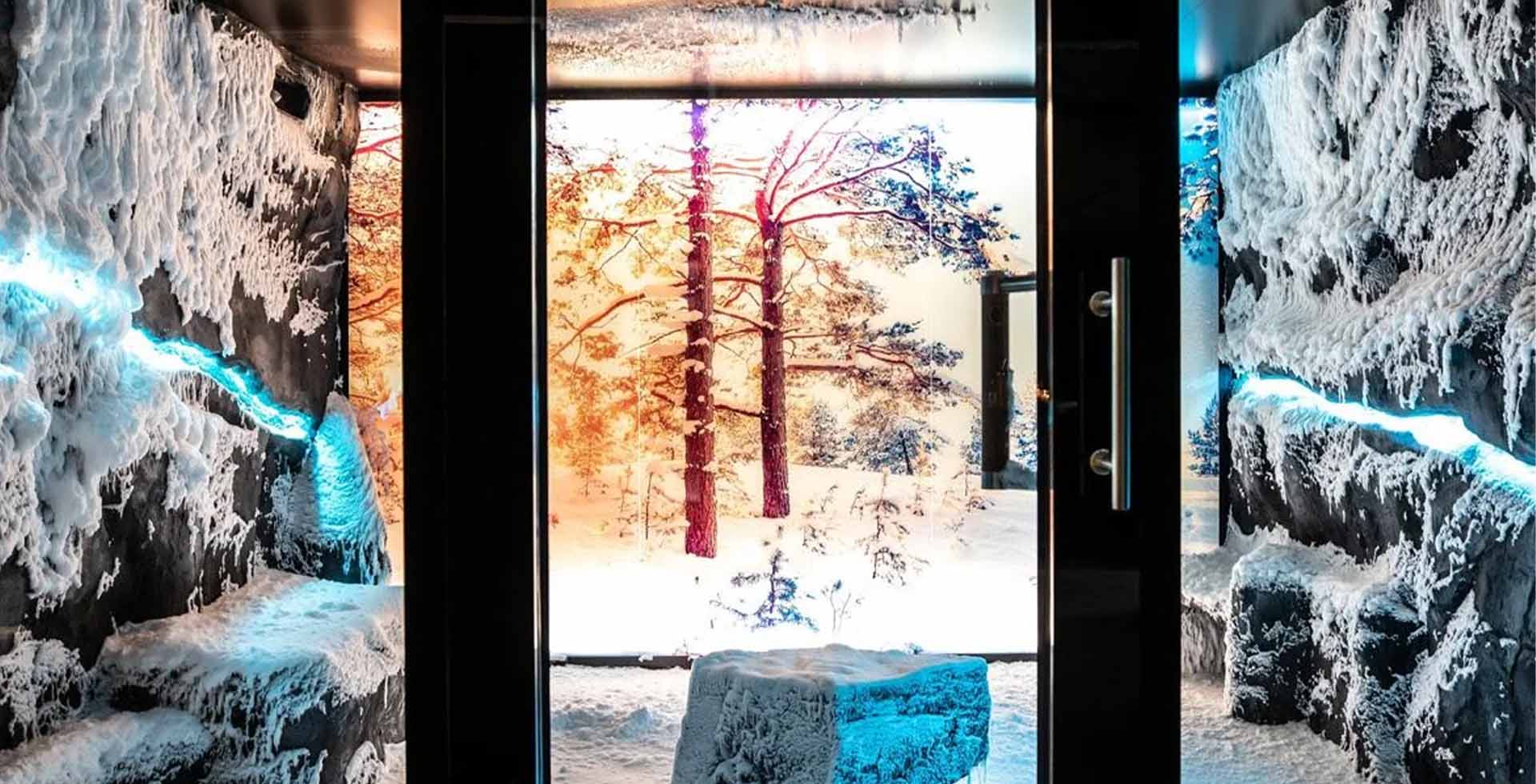
Strip away the frosted rockwork and a snow room is a small cold store with a snow generator in the ceiling. The specification questions are the ones you would ask of any refrigeration package.
Operating condition
Design air temperature is about −10 °C, the figure TechnoAlpin gives for its indoor snow rooms, and the exact setting depends on whether the room is intended to hold lying snow on benches and ledges or simply to run cold with intermittent snowfall. That single decision changes the plant size, the panel thickness and the running cost. Ask for it in writing before anyone prices anything.
Envelope
The build-up is cold-store practice: insulated sandwich panel with a rigid PUR or PIR core, thickness chosen for the design temperature and the surrounding ambient, with a continuous, sealed vapour barrier on the warm side. In a spa the warm side is a corridor or a relaxation area at 24–28 °C and often high humidity, so the vapour drive into the panel is far more aggressive than in a supermarket cold room. Every penetration — lighting, the snow generator, sensors, the door frame, the drain — is a place where that barrier can be broken. The detailing of those penetrations, not the panel itself, is what separates a room that lasts from one that grows ice inside its own construction.
Door and threshold
A cold-room door in a spa needs a heated frame and a heated gasket, or it freezes shut. It also needs to be operable by a guest in bare feet with wet hands, which is a different requirement from a warehouse door. The threshold detail matters too: meltwater will run out of the room every time the door opens.
Drainage and defrost
There is a drain in the floor and it will freeze unless the trap is heated or the trap is located outside the cold envelope. There is a defrost cycle on the evaporator and the condensate from that cycle has to go somewhere on a heated, falling route. Two of the three most common snow room complaints we are called to look at come down to one of these two details.
Plant and heat rejection
A cold room of this class is a refrigerating system in the sense of the EN 378 safety and environmental series, and the condensing unit rejects heat continuously. In a basement spa in a Gulf climate that heat has to be taken somewhere real — it is not a rounding error on the spa's cooling load. Heat recovery from the condenser into domestic hot water or into the thermal suite pre-heat is possible and worth studying early, because it is nearly impossible to retrofit. Refrigerant choice belongs in the same early conversation, because the EU phase-down of fluorinated gases changes what a plant can be recharged with over its life.
Where it sits in the circuit
A snow room is a contrast station. It only works as a guest experience if it is reachable, barefoot and wet, from the heat rooms — and if the alternative contrast stations are nearby. On most schemes it sits with the cold plunge and the ice fountain in one cold cluster, with the heat rooms opposite; how those smaller cold positions are specified is a separate note. Get that adjacency wrong in the hotel spa design stage and no amount of plant fixes it.
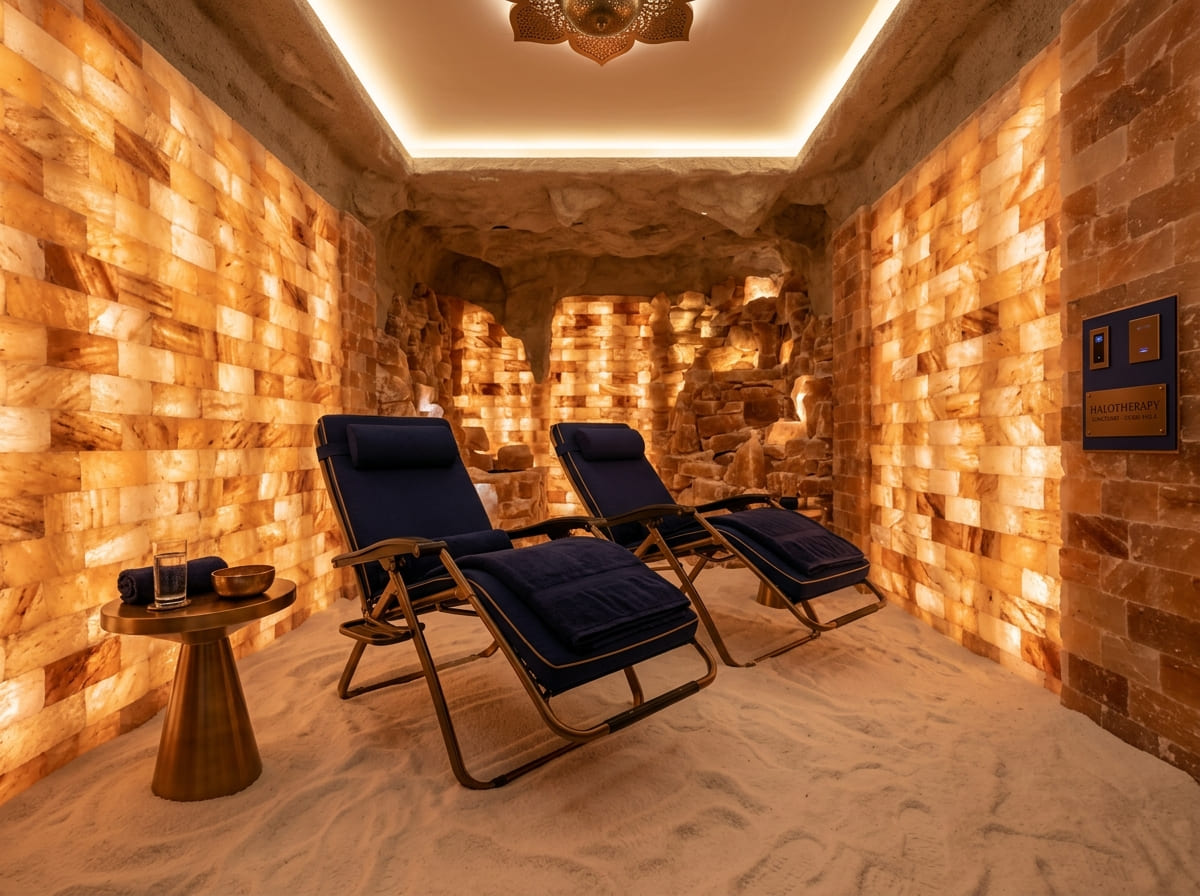
A salt room is two different products under one name
When a client says "salt room", they mean one of two things, and the two have almost nothing in common technically. Establishing which one is being bought is the single most useful thing a spa consultant can do on this package.
The first is a salt-clad room. Backlit rock salt brick or block walls, sometimes a loose salt floor, benches or loungers, ambient light. It is a material and lighting assembly.
The second is a dry salt room. The same architecture, plus a halogenerator: a machine that grinds pharmaceutical-grade sodium chloride and disperses it into the room air as a fine dry aerosol on a timed cycle. It is a material assembly plus a dosing appliance plus a dedicated ventilation strategy.
A salt room priced as the first and expected to perform as the second is one of the most common disputes on this package. The halogenerator has a service niche, a power supply, a consumable, a maintenance interval and an extract requirement. None of those appear if the room was drawn as cladding.
Salt is hygroscopic — humidity is the whole game
Rock salt pulls moisture out of the air. In an uncontrolled room the blocks weep, the faces stain and craze, mortar joints wash out and the lower courses soften. That is not a defect in the salt; it is the salt behaving normally in the wrong air. A salt room needs its own conditioned, dehumidified air supply held at a low and stable relative humidity, and it needs that supply to keep running when the spa is closed. The hygiene requirements for that plant are the ones set out in the German ventilation hygiene rules. If the salt room is on the same air path as the wet circuit — the same duct that serves the shower lobby — the blocks are already lost.
Salt is corrosive — so is everything touching it
Every fixing, bracket, sub-frame, grille and fastener in contact with or downstream of salt has to be specified for it. Stainless steel of an appropriate grade, not mild steel, not untreated aluminium, not zinc-plated. This extends into the ductwork: the extract that clears the aerosol from a dry salt room carries salt into the duct, and the duct, the grille, the damper and the filter housing all need to survive it. This is the detail most often value-engineered out and most often replaced within three years.
The floor is a structural question
A loose salt floor is a real dead load spread over the whole room, not a finish. Get the bulk density from the salt supplier, give the depth and the density to the structural engineer, and get the answer in writing before the depth is agreed. Nobody enjoys discovering this on a suspended slab over a function room. The same check, with a filled brine load instead of a salt floor, is the one we describe in the note on flotation rooms.
Lighting
Backlighting is what makes the room. It is also a heat source inside a hygroscopic material, and the drivers are a service item. Low-wattage LED behind the blocks, drivers located outside the salt cavity and accessible without dismantling the wall, and a colour temperature agreed against a physical sample — because rock salt varies from batch to batch and a render will not tell you what the wall will look like.
The MEP interface schedule — the document that settles the argument
On every project where this package goes well, one document exists early: a line-by-line schedule of who supplies what and who installs it. On every project where it goes badly, it does not. Here is the shape of it.
| Item | Typically supplied by | Typically installed by | Interface note |
|---|---|---|---|
| Snow room insulated envelope and door | Specialist | Specialist | Needs a level, tolerance-checked slab and a clear structural opening |
| Refrigeration plant and pipework | Specialist | Specialist / MEP | Plant location, airflow, drainage and service access to be agreed at concept |
| Power supply to plant and to room | MEP | MEP | Dedicated circuit, isolator position, load confirmed before board schedule freezes |
| Snow room floor drain and heated trap | MEP | MEP | Trap heating or trap outside the cold envelope — decide, don't assume |
| Condensate and meltwater route | MEP | MEP | Must be heated or fall clear of the cold zone |
| Salt room substrate and waterproofing | Main contractor | Main contractor | Handed over dry, flat and vapour-checked before salt starts |
| Salt blocks, sub-frame and backlighting | Specialist | Specialist | Stainless sub-frame; drivers outside the cavity and accessible |
| Halogenerator (if a dry salt room) | Specialist | Specialist | Service niche, power, consumable route and maintenance access |
| Dedicated conditioned air to salt room | MEP | MEP | Low, stable RH; corrosion-rated grilles and duct; runs out of hours |
| Controls, BMS points and interlocks | Specialist / MEP | MEP | Agree the points list at design stage, not at commissioning |
When we work as a specialist subcontractor under a main contractor, this table is the first thing we issue and the last thing anyone argues about. It is worth insisting on from any supplier you are considering.
Eight questions that separate a manufacturer from a reseller
Ask these in the interview. The answers take about twenty minutes and they are decisive.
- What design air temperature are you pricing, and does the room hold lying snow? A reseller will answer with a product name. A manufacturer will answer with a number and then ask you what the room is for.
- Show me your vapour barrier detail at the door frame and at the snow generator penetration. This is the question. Either the detail exists or the conversation is over.
- Where is the condensing unit, and who is taking its heat? If the answer is "the MEP contractor will sort it", the plant is not in anyone's budget.
- Is the salt room clad, or dosed? If the supplier does not immediately distinguish the two, they have not built one.
- What RH will you hold in the salt room, and what happens overnight? "Normal spa conditions" is a wrong answer.
- What grade of fixings, and what happens to the extract duct? Corrosion is the failure mode; a manufacturer has an opinion about it.
- What is the maintenance interval and what is the consumable cost per year? Not the price — the interval and the item. An operator-facing answer means they have handed rooms over and been called back.
- Whose certification is whose? See below. This one catches more suppliers than any other.
Certification: be precise about whose is whose
This is worth a paragraph of its own, because the sector is loose about it and the looseness is a warning sign.
A spa manufacturer holds certification for its own quality system and its own production. Ours is ISO 9001 — TS EN ISO 9001:2015, with a registered scope covering sauna and spa products manufacturing and after-sales services. That is our certificate and it is about how we manufacture.
The CE marks, EN 60335 conformity, TÜV and GS marks that appear in this sector belong to the component manufacturers — the heater maker, the control maker, the steam generator maker. They are real, they matter, and they should be requested by component in the submittal. But a supplier who presents component certification as though it were their own company certification is either careless or hoping you will not check. Ask for the certificate, look at the scope line, and see whose name is on it.
Where we sit
Sauna Dekor Spa Solutions has manufactured and installed wellness rooms since 1987, from our own production facility in Istanbul, with projects delivered in more than 35 countries and offices including Dubai and Doha. Snow rooms and salt rooms are part of the same scope as our commercial spa packages: concept, shop drawings, MEP interface coordination, manufacture, installation, commissioning and after-sales. We work directly for operators and developers, and as a specialist subcontractor under main contractors.
If you are specifying either room now, the useful starting points are the snow room and salt room pages, and the thermal suite page if the two rooms are part of a full circuit.
Frequently asked questions
Who manufactures snow rooms for hotel spas?
Snow rooms are built by wellness specialists who combine cold-store envelope construction with a commercial refrigeration package and a snow generator. It is a small field, because it requires both a joinery and panel capability and a refrigeration capability under one contract. Sauna Dekor Spa Solutions manufactures and installs them as part of complete thermal circuits.
What is the difference between a salt room and a dry salt room?
A salt room in the general sense is a room clad in rock salt block, usually backlit, sometimes with a loose salt floor. A dry salt room adds a halogenerator that disperses micronised sodium chloride into the room air on a timed cycle, which brings its own power, service, consumable and ventilation requirements. The two are priced very differently and should never be conflated in a tender document.
What temperature does a snow room run at?
Design air temperature is about −10 °C, the figure TechnoAlpin gives for its indoor snow rooms. The exact figure depends on whether the room is required to hold lying snow on benches and ledges, and it should be fixed in the specification before pricing, because it drives panel thickness, plant size and running cost.
Can a snow room and a salt room share air handling with the rest of the spa?
No. The snow room is a sealed refrigerated envelope with its own plant. The salt room needs a dedicated, dehumidified supply held at a low and stable relative humidity, running out of hours, with corrosion-rated ductwork and grilles. Putting either on the general wet-area air path is the most common cause of early failure.
Why do salt walls stain and crumble?
Almost always humidity. Rock salt is hygroscopic; in air that is too humid or that swings, the blocks absorb moisture, weep, stain and lose face integrity, and the joints wash out. The fix is not a better block — it is dedicated air handling and a substrate that cannot wick moisture into the assembly.
Do you work as a subcontractor to a main contractor?
Yes. A large share of our hotel work is delivered as a specialist subcontractor under a main contractor, with an agreed MEP interface schedule, shop drawings issued for coordination, and a defined commissioning and handover sequence. Details are on our subcontractor page.
What certification should I ask a snow room or salt room supplier for?
Ask for the supplier's own company quality certification and read its scope — ours is ISO 9001 with a manufacturing scope. Then ask separately for component certification, by component, from the component manufacturer: heater, control panel, generator, refrigeration plant. Treat any supplier who blurs the two as a supplier who has not been audited recently.


Yorumlar
Yorum Gönder