Who Manufactures Ice Fountains and Shock Buckets for Hotel Spas — and the Four Things That Decide Whether the Cold Step Gets Used

Ice fountain delivered for a hotel wet area, Doha.
An ice fountain is the cheapest position in a thermal suite to draw and the easiest one to get wrong, because it looks like a piece of furniture and behaves like a piece of refrigeration plant. We survey wet areas where the fountain is dry by ten in the morning, where the bowl is warm and the ice has slumped into a puddle, and where the drain under it was never run because the drawing showed a sculpture. None of that is a manufacturing fault. It is a specification that treated a machine as a finish.
Sauna Dekor Spa Solutions manufactures and installs the cold positions in a thermal circuit — ice fountains, shock buckets, cold plunge pools and snow rooms — alongside the hot ones. The cabins, benches and hammam elements are made in our own workshop at İkitelli OSB, Başakşehir, Istanbul. The business has been doing this since 1987, which makes this its fortieth year, with delivered work in more than 35 countries and current site work across the UAE, Saudi Arabia, Qatar and Türkiye. What follows is the order in which we ask the questions when a cold step arrives on a drawing.
What an ice fountain actually is
Strip the joinery away and there are four components. A flake or nugget ice machine, almost always sited remotely. An insulated delivery chute or drop. A bowl, basin or trough that holds the ice and lets the meltwater go. And a drain, sized and trapped, with a fall to it.
The visible part is the bowl. The part that decides whether the position works is the machine, and the machine is a refrigeration appliance with a condenser that needs somewhere to reject heat into. Almost every failed ice fountain we have been called to look at failed on the machine side or the drainage side, and almost every one of them was specified from a photograph.
Decision one: production rate against throughput, not against the bowl
Ice machines are rated in kilograms per twenty-four hours at a stated ambient and a stated feed-water temperature. Two numbers get lost between that rating and the wet area.
The first is that the rating is a daily figure and your demand is not spread across a day. A club wet area at seven in the evening, or a hotel spa when two treatment rooms turn over at once, draws its ice in bursts. If the machine's hourly production is below the burst rate and the bin is small, the position empties at exactly the hour it is being judged on. Specify the bin as well as the machine, and specify the bin against the busiest hour rather than the average one.
The second is that the rating is quoted at a test ambient that Gulf plant rooms do not resemble. A machine rated at 21 °C air and 15 °C water will produce materially less at 38 °C air and 30 °C mains water, and the loss is not a rounding error. Ask the supplier for the production figure at the ambient and feed-water temperature the project actually has, not the headline one. A manufacturer who engineers the product publishes that as a table or a curve. A supplier who cannot produce it has not characterised the machine in your conditions.
Decision two: the machine is refrigeration, so it needs a plant strategy
Air-cooled ice machines reject their heat into the room they stand in. Put one in an unventilated cupboard behind the wet area and it will warm that cupboard until its own condensing pressure rises, its production falls and its duty cycle lengthens. That is the same failure mode as a boxed-in chiller, and it produces the same call: it worked in the first month. Siting, ventilation and access for a machine of this class sit inside the EN 378 requirements, not outside them.
Our design rules on this are simple and they are the ones we would want a consultant to write into the tender:
- Site the machine within roughly 10 metres of the bowl it feeds, in a space held around 25 °C, with a real ventilation route rather than a louvred door onto a corridor.
- Give the condenser clear air on the intake side and somewhere for the discharge to go that is not back into the intake.
- Leave access. Ice machines need descaling and the bin needs cleaning, and both of those are recurring rather than exceptional.
- If the plant space genuinely cannot be ventilated, price a water-cooled or remote-condenser machine at tender stage rather than discovering the constraint at commissioning — and ask which refrigerant it runs on, because the European phase-down schedule decides what will still be available to recharge it with.
Decision three: drainage, which is where the drawings usually stop
Ice melts. A busy fountain sheds meltwater continuously, and a quiet one still sheds it because the bowl sits in an ambient warmer than the ice. That water has to leave through a trapped, accessible drain with a fall to it, and the floor around the position has to be tanked and graded like the rest of the wet area rather than treated as walk-through space.
Two details we specify every time. A minimum 2 % fall to the gully, because anything flatter relies on the screed being perfect. And a trap that will not dry out, because the position is seasonal in some venues and a dry trap in a wet area is an odour complaint waiting for the quiet month. The shock bucket has the same requirement in a harsher form, since it discharges its whole volume in one go and the floor has to take that without moving it towards the changing room. The same falls-and-gully argument, one drain per station, runs through the ceiling-recessed wash positions too.
Decision four: feed water, because Gulf water scales
Ice machines are heat exchangers with a water circuit, and the mineral content of the feed decides how often they are out of service. In much of the Gulf the feed is hard, blended, or comes off a desalination plant with a chemistry that varies through the year. Specify the treatment at tender: at minimum a serviceable cartridge with a defined change interval, and a descaling regime written into the O&M with a named responsible party. Published water treatment guidance is the reference we point operators to when they want a second opinion on the regime.
The wetted materials matter for the same reason they matter on a chilled water circuit. Where the venue runs an aggressive disinfection regime, the exchanger's wetted material is a real specification line rather than a detail — and it is worth settling before the order rather than after the first failure.
Ice fountain, shock bucket or plunge — the honest comparison
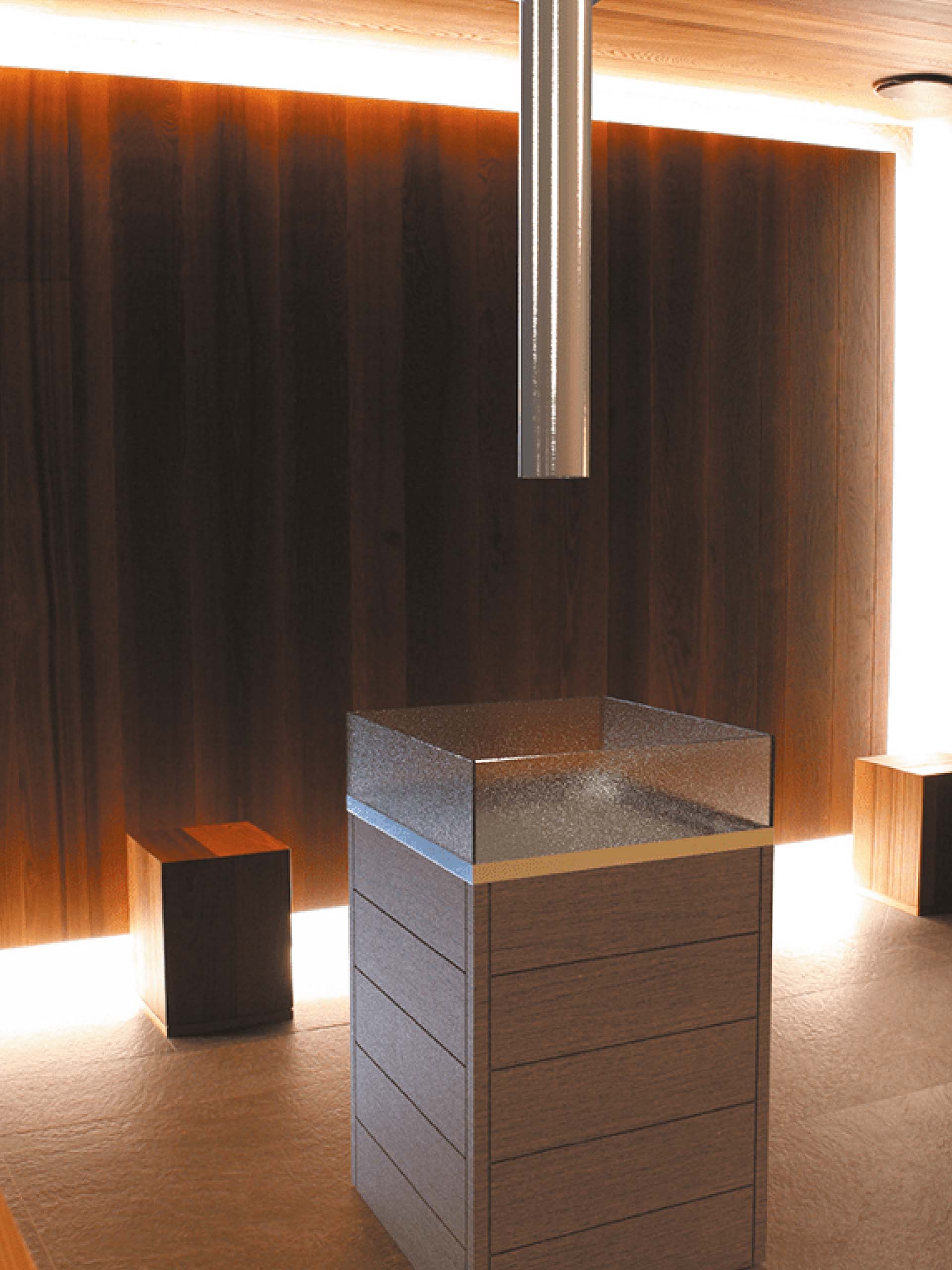
Ice fountain with a glass-sided basin in a delivered thermal suite, Germany.
These three are not three grades of the same thing. They solve different problems and they cost different amounts of floor and plant.
A cold plunge is the position with the highest capital and running cost, the largest floor take, and the longest dwell. It is also the bottleneck in every hot-and-cold circuit we have surveyed, because briefs specify one plunge per sauna and one plunge cannot serve a sauna's output. Where a circuit has a plunge, the useful question is whether it should have two positions rather than a larger one — chiller, filtration and tank are covered separately.
An ice fountain takes roughly the footprint of a basin, carries a small plant load, and gives the circuit a cold step with no bather-in-water hygiene problem at all. On floors under about 400 m² it is frequently the right answer rather than the compromise answer, and it takes bather load off the plunge where both exist.
A shock bucket is the cheapest cold position that exists, needs no refrigeration, and is the one guests use repeatedly rather than once. Its constraints are structural and drainage-related, not thermal: the fixing has to carry the filled weight and the floor has to take the discharge.
A snow room is a different order of project entirely — an insulated enclosure with its own refrigeration and its own building-fabric requirements — and belongs in the conversation only when the circuit and the floor plate can carry it. It is covered separately on snow room construction.
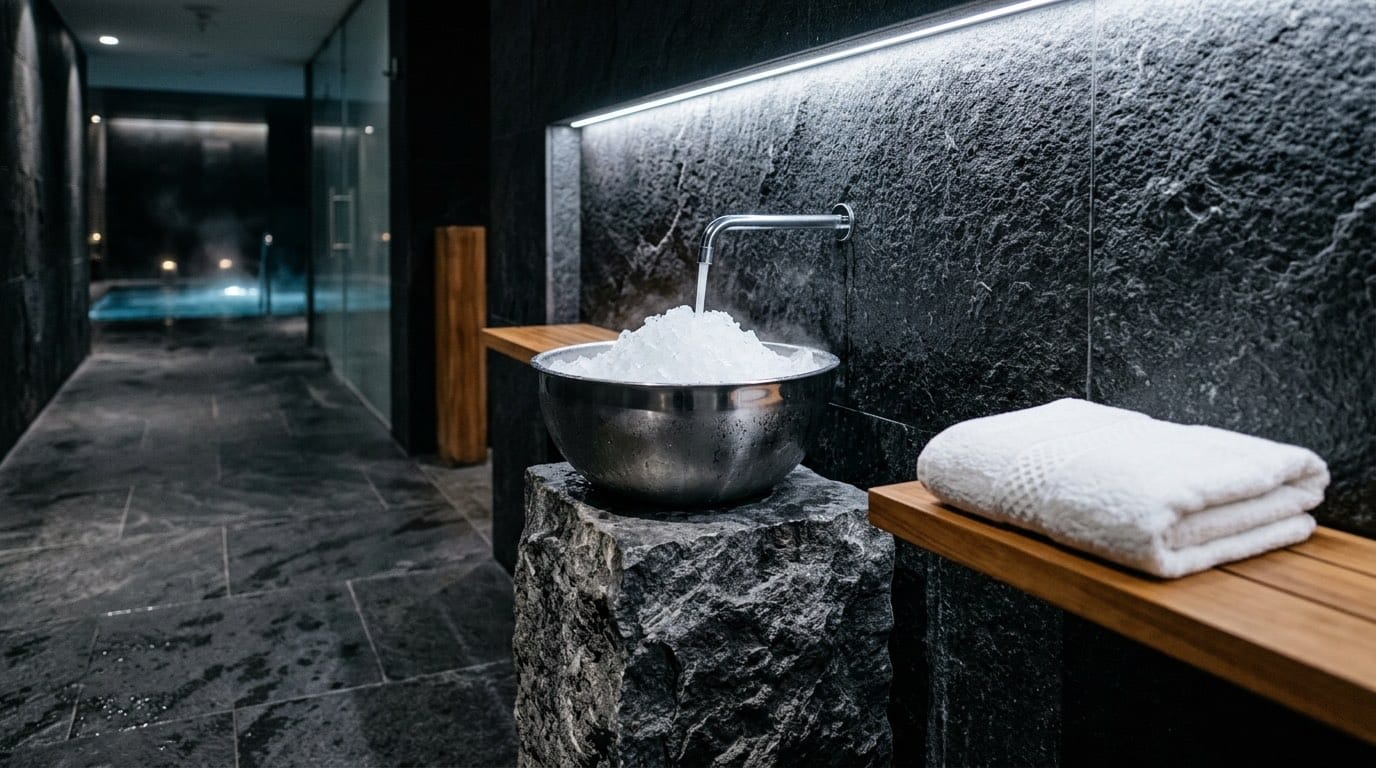
The cold step placed inside the circuit rather than down a corridor. AI-generated concept illustration, not a photograph of a built project.
Where the cold step sits in the circuit
A cold position is only worth its plant load if the route to it is short. If the guest has to cross a corridor, pass a reception desk or walk on a floor that is not graded, the position gets used once and then designed around. We plan the cold step within sight of the hot rooms it serves, on a tanked floor, with the drying and resting position immediately after it. That sequencing argument is set out on thermal suite, and the circuit itself on contrast therapy. We do not make physiological claims about any of it; the argument here is about layout, throughput and plant.
What to ask a bidder before the order
- What is the ice production rate at our ambient and our feed-water temperature — and can you show the curve?
- What is the hourly production and the bin capacity, and against which peak hour were they chosen?
- Where does the machine live, what is the design temperature of that space, and how is it ventilated?
- What is the drain size, the trap detail and the fall, and is the floor tanked to the same standard as the rest of the wet area?
- What water treatment is included, on what change interval, and who carries it in year two?
- Who attends site under warranty, and is it the same company that supplied the bowl?
The last one sorts the market quickly. A joinery contractor can build a beautiful pedestal. Whether anybody returns to descale the machine behind it is a different question, and it is the one that decides how the position looks in year three.
What we are and what we certify
Sauna Dekor Sanayi ve Ticaret A.Ş. manufactures sauna and spa products and installs them as a turnkey contractor and as a specialist wet-area subcontractor to main and fit-out contractors. Head office and workshop: İkitelli OSB Mah., Metal İş 20. Blok Sk., No: 17, Başakşehir, 34490 Istanbul. Our own certification is TS EN ISO 9001:2015, issued by EKOL Belgelendirme, with a scope covering sauna and spa product manufacturing and after-sales service. The refrigeration, controls and steam plant we install carry CE / EN 60335, TÜV, GS and VDI 6022 certification from their own manufacturers — we describe those as the manufacturers' certificates rather than as ours.
Regional context, if the project is in the Gulf: Doha and Dubai.


Yorumlar
Yorum Gönder