Hammam Shower: The Kurna, Two Taps and No Drain
Short answer: a hammam shower is not a shower. It is a kurna — a marble basin fixed to the wall, fed by 2 separate taps, with no waste outlet at all. The bather blends hot and cold in the bowl, pours it with a hand bowl, and the water leaves over the rim and across the floor. That single decision, no drain in the basin, is what sets the floor fall, the gully size and the wall fixing for the whole room.
Every hammam brief we receive shows a shower rose somewhere on the elevation, and about half of them should not. A rose and a kurna solve different problems and load the room differently: one delivers 9 to 12 litres a minute through a fixed head, the other stores 30 litres against a wall and hands the timing to the bather. Below are the 13 decisions that follow from choosing between them.
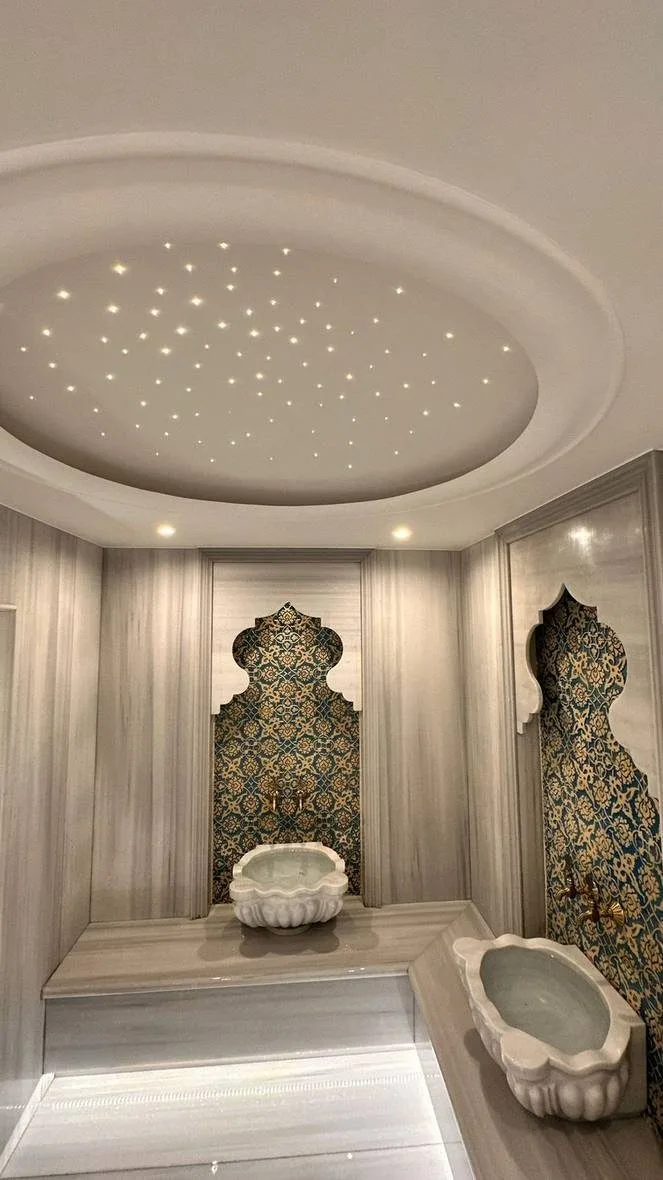
What is a hammam shower, exactly?
A wall-mounted basin with 2 taps and no outlet. A typical kurna holds 25 to 40 litres, sits with its rim 400 to 450 mm above the bather's seat, and is filled from a hot tap and a cold tap that are never mixed by a valve. The bather does the blending, by hand, in the bowl.
That sounds archaic until you use one. A mixer sets a temperature for the whole session; a kurna lets the bather re-blend for every pour, which on a 45 minute sequence at 40 to 45 °C is the difference between tolerable and pleasant. It is a user-interface decision dressed as a plumbing one.
The consequence is that a kurna has no trap, no waste and no connection below the rim. Everything that goes in either leaves in a hand bowl or goes over the edge. That is why the basin and the floor have to be designed together, and why a kurna dropped into a bathroom drawing late almost never works.
Why does the basin have no drain?
Because the floor is the drain. Removing the waste removes the trap, and removing the trap removes the only part of the assembly that can hold standing water between sessions. A basin that empties completely over its rim has nothing left in it 10 minutes after the last pour.
There is a second reason, which is maintenance. A 40 mm waste under a marble basin in a 45 °C room fed by hard water furs up, and the only access is through the stone. In a public room with 6 stations that is 6 concealed failure points; with a spill-over basin there are 0.
The cost of the decision lands on the floor. A room with 6 kurnas can have 3 of them draining at once, which is a floor flow of 60 to 90 litres a minute at peak. That is a drainage design, not a shower tray, and it is the number the room stands or falls on.
How much does a marble kurna weigh?
More than the bracket people specify for it. A basin 600 mm wide, 400 mm deep and 250 mm high, cut with 40 mm walls, contains about 0.025 m³ of marble. At roughly 2,700 kg/m³ that is 67 kg of stone, and with 35 litres of water in it the assembly reaches about 102 kg.
That load is cantilevered. With the centre of gravity about 200 mm out from the wall face, a filled basin applies roughly 200 Nm of overturning moment to its fixing, continuously, in a room that is warm and wet for 8 hours a day.
So the fixing is not a fixing; it is a support. We build a stone or reinforced corbel under every kurna, or a stainless bracket bedded into the blockwork before the tanking goes on. A resin anchor drilled through finished tile into a 100 mm block wall is not an acceptable answer at 102 kg.
How fast do the 2 taps fill it?
Faster than you would expect, and that matters. A 15 mm supply at 2 to 3 bar delivers roughly 12 to 15 litres a minute through a standard tap, and 2 taps open together fill a 35 litre basin in about 70 to 90 seconds. That figure sets the peak demand for the room.
Six stations in a public hammam, each with 2 taps, is a theoretical 150 to 180 litres a minute. Nobody designs for all 12 taps open, but the diversity assumption has to be written down, because the difference between assuming 30 % and 60 % is the difference between a 28 mm and a 42 mm branch.
The same figure drives the hot water plant. If 3 stations are filling simultaneously at 45 litres a minute with water at 45 °C from a 12 °C incoming main, the instantaneous load is around 100 kW. A domestic cylinder does not do that, which is why hammam hot water is a stored-volume problem rather than a heater-rating problem.
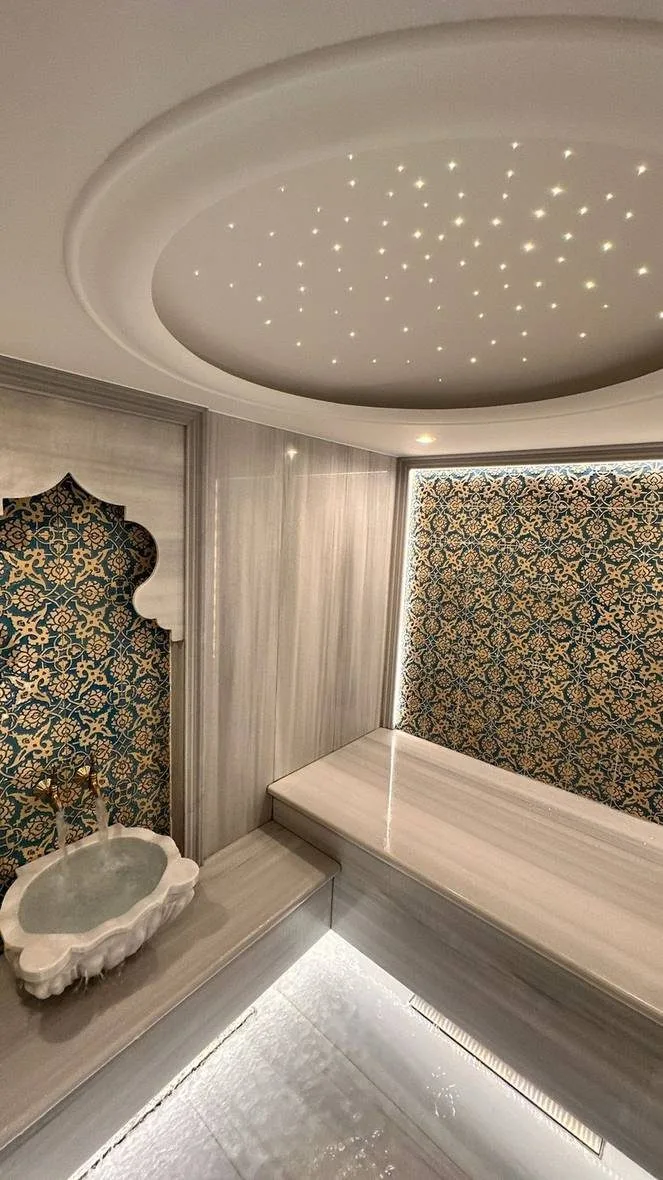
What temperature should the hot tap deliver?
Low enough to be safe on skin at the tap, because there is no thermostatic mixer downstream to catch it. We limit the hot supply serving kurnas to 48 °C at the outlet, which is the figure used for domestic hot water safety in the UK building regulations for bath filling.
That limit is not a comfort setting; it is a scald limit. Water at 60 °C, a normal cylinder storage temperature, causes a full-thickness skin injury in about 5 seconds, while at 48 °C the same injury takes several minutes. A bather leaning over a basin has their forearm under the stream.
The limiting is done upstream, at a blending valve serving the group of stations, not at each tap. Storage still sits at 60 °C or above for the sake of the water quality in the cylinder, and the blend happens after it. That is 1 valve to commission and 1 annual check rather than 6.
Which marble can a kurna be cut from?
One with low water absorption and no appetite for soap. We work in the 0.2 to 0.5 % absorption band for anything that sits in standing water, which rules out most travertines and many of the softer creams that look right in a sample box.
The second criterion is acid tolerance. Traditional black soap is alkaline rather than acidic and does no harm, but the products that arrive in a hotel spa are not always traditional, and a calcitic marble etches visibly at pH 4. Where the operator will not control the products, we specify a denser stone and say why in the O&M file.
The third is the section. A 40 mm wall on a bowl of this size is not decorative; it is what stops a chip becoming a crack at the fixing. Thinner sections exist and they arrive back at us within 3 or 4 years with a split corner, usually on the side the bather leans on.
Where do the taps go?
Above the rim, with the stream landing near the centre of the bowl, which usually means a spout projection of 120 to 150 mm. Too short and the stream runs down the inside face and splashes out; too long and the bather cannot reach the handle without leaning across the water.
Hot and cold are set apart far enough that a wet hand can find them without looking, typically 180 to 200 mm between centres. In a traditional layout the hot tap goes on the left, and where a room is used by regulars that convention is worth keeping, because people operate these by feel.
The handles matter more than the spouts. A cross handle or a lever can be turned with the back of a wrist, which is what a soaped hand actually does. A knurled knob cannot, and it is the single most common reason a beautifully specified kurna gets scratched within a season.
What happens to the water after it leaves the bowl?
It crosses the floor, which therefore needs a fall of about 2 %, or 20 mm per metre, towards a channel or gully. At 30 litres a minute from 1 station that is 0.5 litres a second, and a 100 mm channel handles it comfortably while a 50 mm point waste does not.
The channel position is set by where the bather sits, not by where the drawing has spare room. Water leaves a kurna at the rim, falls to the floor 400 mm below and spreads; if the channel is behind the bench, the water crosses the whole seated area to get to it.
Trap seals need to be deep, and they need to stay wet. A 75 mm seal is the usual minimum for a waste of this size, and in a room used twice a week we add a trap with a membrane insert, because an evaporated seal in a warm room announces itself before anyone can find it.
Does a hammam room need a shower rose as well?
Usually yes, and for a different job. The kurna is for the treatment; the rose is for the rinse afterwards, and a 9 to 12 litre per minute rinse for 2 minutes is not something anybody wants to do with a hand bowl at the end of a 45 minute sequence.
The 2 fixtures want different positions. The kurna belongs at the station, against the wall, in the warm part of the room. The rinse shower belongs on the way out, closer to the door and the cooler zone, so the sequence has a direction and the wet route does not double back on itself.
They also want different water. A rinse shower runs at 38 to 40 °C through a thermostatic valve and needs no bather blending at all, so it can take the mixer that the kurna deliberately refuses. Specifying 1 valve type for both is the compromise that makes neither work.
What does hard water do to it?
It writes on the stone. Water at 20 °dH deposits roughly 0.36 g of carbonate for every litre evaporated, and a basin lip that dries between sessions collects it as a white line. On a dark marble that line is visible within about 3 weeks.
The same hardness attacks the plant more quietly. Hard water is the single largest driver of service intervals on any heated wet-area equipment, and a hammam with hot water at 60 °C is heating the same carbonate that later appears on the basin. Softening the feed is a decision made with the room, not after it.
Where softening is refused, the practical answer is a maintenance regime rather than a material change: a mildly acidic descaler on the lips weekly, and never on the polished faces. It goes in the O&M file with the pH stated, because the wrong bottle removes the polish permanently.
How many stations does a room need?
About 1 kurna per 2 m² of usable wall, and in practice 4 to 8 in a commercial room. The controlling dimension is not the basin but the bather: a seated station needs roughly 700 mm of bench length and 900 mm of clear depth in front of it to work an arm.
That arithmetic is why a room that looks generous in plan seats fewer people than the client expects. A 5 by 4 m hammam has about 14 m of usable perimeter once the door, the entrance and the heated slab are taken out, which is 6 stations at most and 5 comfortably.
In a private house the number is almost always 1 or 2, and then the question changes from capacity to symmetry. A single kurna on a 3 m wall looks accidental; a pair set into 2 niches does not, and the second basin costs far less than the first because the supply and the support are already there.
What has to be on the drawing before the stone is ordered?
Nine numbers: the basin dimensions and wall thickness, the filled weight, the support type, the rim height above the bather's seat, the tap centres and spout projection, the hot supply limit temperature, the floor fall and its direction, the channel position and size, and the trap seal depth.
Stone is the least forgiving item in the room because it is cut once. A kurna carved 30 mm too tall cannot be trimmed on site, and the bench it sits over is usually already set. Every one of those 9 numbers is free to change on paper and expensive to change in marble.
We settle all of them before anything is cut, on the same drawing that carries the falls and the tanking, because the same 3 trades have to agree to all of it at once. It is the same discipline we apply to the extract side of a wet suite, which we set out in our note on steam room ventilation.
What this does not settle
The room. The dome, the heated slab, the marble on the walls and the waterproofing under all of it are a separate exercise with its own sequence, and we set that out in full in our guide to how to build a hammam rather than repeating it here.
It also does not settle the domestic case, where the constraint is usually build-up height rather than capacity. Fitting any of this into an existing bathroom is a conversion problem, and the numbers that decide it are the floor fall and the tanking class rather than the basin, which we cover in turkish bathroom.
And it does not settle the ritual, which is the part most guests actually book. The sequence of soap, scrub and rinse, and what the room has to do at each step, is described in what is a turkish bath.
Who is writing this
Sauna Dekor has designed and built wellness and thermal facilities since 1987 and is now in its 40th year, manufacturing in its own Istanbul facility with 19 employees, working under TS EN ISO 9001:2015, with projects delivered in more than 35 countries. On hammam work we are turnkey: the stone, the carving, the supports, the tanking, the falls, the plant interfaces and the commissioning.
What we do not make is equally clear. Taps, thermostatic blending valves, steam generators and drainage channels are not our products; they come from the equipment manufacturers we buy from, and any CE marking or EN 1111 conformity on that equipment belongs to its manufacturer rather than to us. The TS EN ISO 9001:2015 certificate is ours; the rest are theirs.
Frequently asked questions about a hammam shower
What is a kurna?
A kurna is the marble basin of a hammam: 25 to 40 litres, fixed to the wall with its rim 400 to 450 mm above the bather's seat, fed by 2 separate taps and fitted with no waste outlet at all.
Why does a hammam basin have no drain?
So that nothing stands in it. Without a waste there is no trap, and without a trap there is no standing water between sessions. The basin empties over its rim and the room floor, falling at about 2 %, carries the water to a channel.
How heavy is a marble kurna?
About 67 kg of stone for a 600 by 400 by 250 mm basin with 40 mm walls, and roughly 102 kg once it holds 35 litres. Cantilevered 200 mm from the wall that is close to 200 Nm on the support.
What temperature should hammam taps run at?
Limit the hot supply to 48 °C at the outlet, blended upstream of the stations. Water at 60 °C injures skin in about 5 seconds; at 48 °C the same injury takes minutes, and there is no mixer at the basin to catch it.
Does a hammam need a separate rinse shower?
Usually yes. A rinse rose at 9 to 12 litres a minute does in 2 minutes what a hand bowl does in 10, and it runs through a thermostatic valve at 38 to 40 °C. It belongs near the exit rather than at the station.
How many kurnas does a commercial hammam need?
Between 4 and 8, set by bench length rather than by wall area. Each seated station needs about 700 mm of bench and 900 mm of clear depth, so a 5 by 4 m room seats 5 comfortably.
What marble is used for a kurna?
A dense stone in the 0.2 to 0.5 % water absorption band, cut with walls around 40 mm. Thinner sections split at the fixing within 3 or 4 years, and absorbent stones take up soap and discolour where the bather leans.
Sources
- Hammam — the room sequence and the fixed-basin tradition behind the kurna, including the convention that bathers pour rather than immerse.
- Approved Document G, Sanitation, hot water safety and water efficiency — HM Government, England. Source for the 48 °C outlet limit used for hot water safety and for the requirement to blend downstream of storage rather than reduce storage temperature.
- Approved Document H, Drainage and waste disposal — HM Government, England. Source for the 75 mm trap water seal and for the gradient and access requirements behind the channel detail.
- HSE, HSG282: The control of legionella and other infectious agents in spa-pool systems — Health and Safety Executive, January 2017, ISBN 978 0 7176 6681 2. Source for the treatment of standing water in warm wet-area fittings and for storage temperature practice.
- Marble, properties and density — the density of about 2,700 kg/m³ used in the basin weight calculation, and the calcite composition behind the acid-etching limit.
- Condair steam and humidification documentation — Condair Group AG, March 2020. Source for the published relationship between carbonate hardness and service interval on heated wet-area plant; the equipment and its conformity marks belong to Condair as manufacturer.
- Hard water — the carbonate chemistry and the German degree (°dH) scale behind the figure of roughly 0.36 g of carbonate deposited per litre evaporated at 20 °dH.


Yorumlar
Yorum Gönder