Gobek Tasi: How a Hammam's Heated Marble Platform Is Built
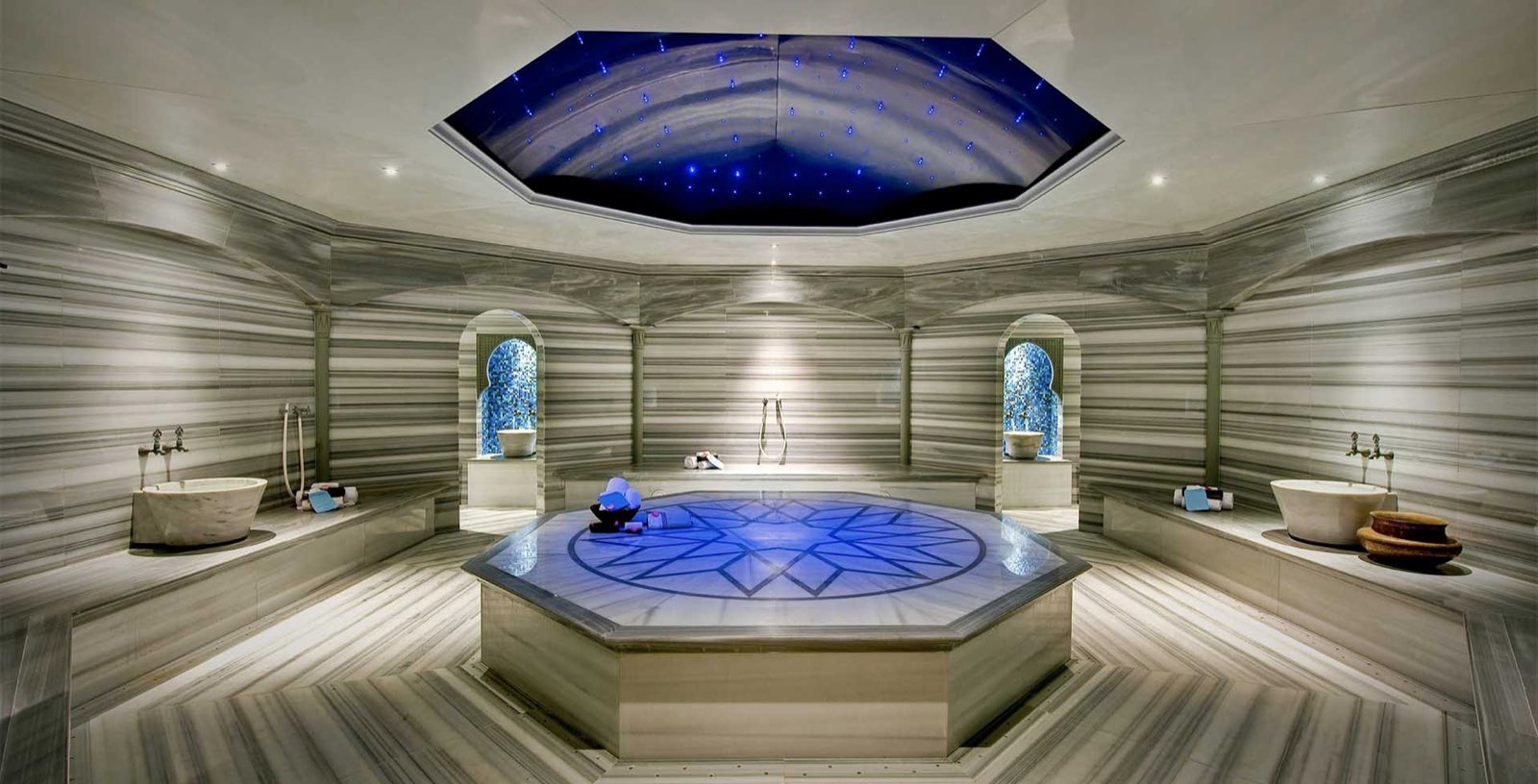
The gobek tasi — göbek taşı in Turkish, the heated marble platform at the centre of a hammam hot room — is the single heaviest and slowest element in the whole wet area. A 30 mm top slab weighs about 81 kg per square metre and needs roughly 0.36 kWh per square metre just to come up to working temperature. Almost every problem people have with one traces back to that mass.
What is a gobek tasi, and what is it actually for?
It is a large heated marble table at the centre of the hararet, the hot room, and it is a working surface rather than a decorative one. Guests lie on it for the soap and scrub; the heat comes up through the body from below, over 20 to 40 minutes, instead of arriving as hot air.
That distinction sets every specification that follows. A sauna heats you through air at 85 °C. A hammam heats you through stone at around 40 °C, with the air rarely above 45 °C and the humidity near saturation. The stone is the heat source, so the stone has to hold and deliver a steady temperature across its whole top for hours.
It also explains why the platform is not simply a marble lid on a box. Underneath sits a heated core, a bedding system that can tolerate differential movement, a waterproofing layer that has to survive that movement, and a drainage strategy for the water that will run off the edges continuously while the room is in use.
How was the gobek tasi heated before, and how is it heated now?
Historically by hypocaust: hot air and smoke from a furnace behind the wall were channelled through conduits under the floor, heating the floor and the platform above. In current work we use hydronic coils, typically running flow temperatures in the 40 to 50 °C band rather than the 70 °C used for radiators.
The old system heated the whole floor slab and the platform together from one furnace, with the rooms nearest the fire being the hottest. The Roman construction it descends from was a raised floor on pilae stacks carrying a layer of tiles, then a layer of concrete, then the finished floor — mass on mass, which is exactly why it worked and exactly why it took a day to start.
The modern equivalent keeps the mass and replaces the fire. Coils are laid in the core of the plinth and in the surrounding floor as separate circuits, because the platform wants a higher surface temperature than the floor a barefoot guest walks on. Electric mats are possible but we do not specify them here: a mat that fails is buried under 81 kg per square metre of stone, and a hydronic circuit can be isolated, tested and re-balanced from outside the room.
What surface temperature should a gobek tasi run at?
Our working band is 40 to 45 °C at the stone surface, with the surrounding floor held lower, around 30 to 33 °C. Skin tolerates a 40 °C contact surface indefinitely; at the top of the band a guest will move after a few minutes, and above it the platform becomes a place to sit rather than to lie.
The band is narrower than it looks because the surface temperature is not uniform. The slab is fed from below by a coil at a fixed pitch, so there is always a ripple between the line above a pipe and the line between two pipes. A coarse pitch gives a striped platform that a guest feels through the shoulder blades.
Marble is what flattens the ripple. At 2.08 to 2.94 W/(m·K) it conducts roughly twice as well as limestone at 1.26 to 1.33, so lateral spreading inside the slab smooths the coil pattern before it reaches the surface. This is the technical reason the traditional material is marble and not the cheaper carbonate stones that look similar in a sample box.
How long does a gobek tasi take to reach temperature?
From cold, hours rather than minutes. One square metre of 30 mm marble is about 81 kg at a density of 2.6 to 2.8 t/m³, and at a specific heat of 0.88 kJ/(kg·K) raising it from 22 to 40 °C takes 1,283 kJ, or 0.356 kWh. A 2.4 × 1.6 m platform is 3.84 m² and 311 kg of top slab alone.
Put a realistic output under it and the arithmetic finishes itself. At 150 W/m² the top slab alone absorbs 1,283 kJ ÷ 150 W, which is 8,553 seconds — about 2.4 hours, before the bedding, the plinth core and the surrounding floor have taken their share. In practice a cold hammam is a half-day start, not a half-hour one.
The operational consequence is the one clients most often have not been told. A gobek tasi is a continuously running element in a hotel or club, trimmed back overnight rather than switched off, because the energy to hold it is far less than the energy and the time to restart it. A villa hammam used at weekends needs a timer that begins the morning before, not an hour before.
Which marble should a gobek tasi be cut from, and how thick?
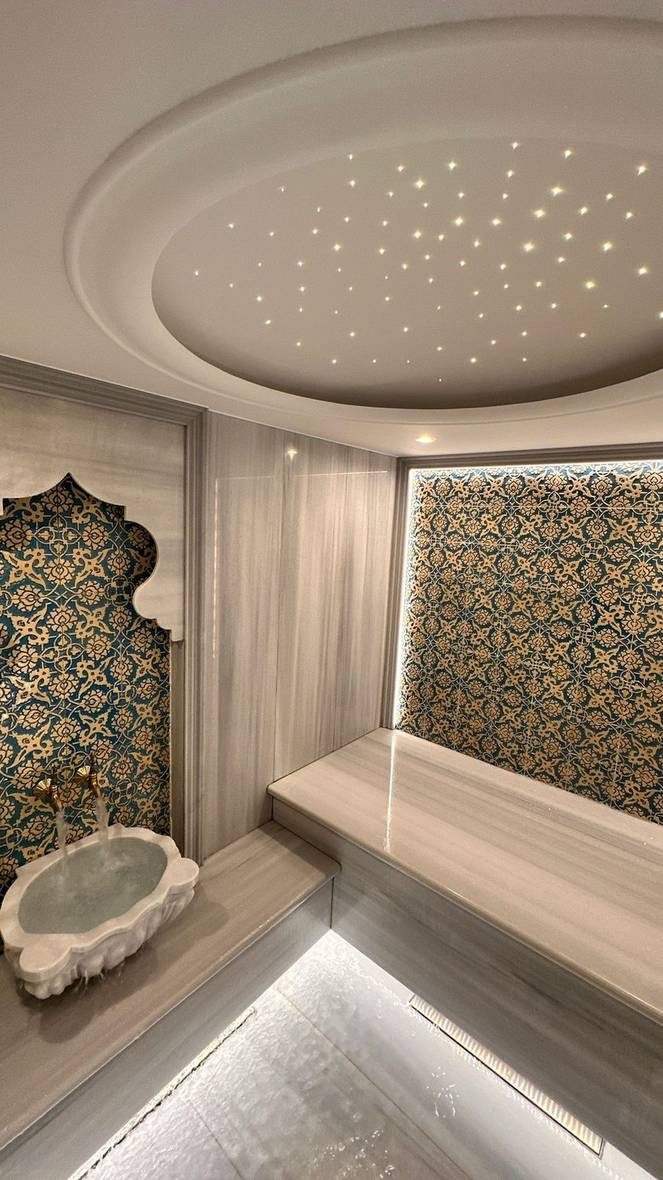
We use a white or light grey Turkish marble for the top, in a honed rather than a polished finish, at 30 mm for the platform surface and 20 mm for the vertical facing of the plinth. The top slab is the only element that has to carry both point loads and a thermal duty, so it is the only one that gets the extra 10 mm.
Thickness is a compromise with two ends. Thin stone responds faster and costs less, but it telegraphs the coil pitch and it has no reserve against a point load where a guest's elbow meets an unsupported spot over a void in the bedding. Thick stone is even and forgiving and takes proportionally longer to start: 60 mm doubles both the mass and the 2.4 hour figure above.
Finish matters as much as thickness. A polished calcite surface under soap and water is exactly the wrong place to ask someone to stand up, so the top is honed. Honing also survives the life of the room better, because the abrasion that would dull a polish is invisible on a honed face.
Why does heated marble bow, and what stops it?
Because marble has no single coefficient of thermal expansion. Published figures run from 5.5 to 14.1 × 10⁻⁶ per K — a spread of 2.6 times for one named material — and the reason is that the calcite crystals it is made of expand by different amounts in different directions, so a slab's behaviour depends on how its grains happen to be oriented.
This is not a theoretical concern. The Carrara marble cladding of Finlandia Hall in Helsinki had to have slabs replaced as early as the 1990s, and the whole façade was renewed between 2022 and 2023 with a different marble chosen on the strength of European research projects into the long-term performance of marble façades. Repeated thermal cycling of carbonate stone is a known and studied failure mode.
Three things reduce the risk in a hammam. Full, voidless bedding, so no part of the slab is free to deflect. A slab kept modest in span, so any differential is small in absolute terms. And a bounded temperature swing: a platform cycled between 30 °C overnight and 42 °C in service is asked to do far less than one cycled from 20 °C every day, which is a second argument for running it continuously.
How much does a gobek tasi move when it heats up, and what does the substrate do?
Less than a millimetre, but not in the same direction as what it sits on. A 2,400 mm slab taken up 18 K moves between 0.24 mm and 0.61 mm depending where in the 5.5 to 14.1 range that piece of marble falls. The dense concrete under it expands at 13 to 14 × 10⁻⁶ per K and moves about 0.60 mm over the same span.
The number that matters is the difference, not either figure on its own. Marble at the low end of its range against concrete at 13.5 leaves roughly 0.36 mm of relative shear along a 2.4 m bond line, every heating cycle, for the life of the room. Bedding mortar at 7.3 to 13.5 × 10⁻⁶ per K sits between them and has to absorb it.
So the platform is built to slip rather than to resist. A decoupling layer or a flexible, deformable adhesive bed lets the stone and the structure move at their own rates; a rigid sand-and-cement bed bonded hard to a heated concrete core converts that 0.36 mm into a crack, usually along the longest joint and usually in the second heating season.
Where do the movement joints go, and how wide?
At every restraint and at every change of plane, before they go anywhere in the field. The perimeter joint where the platform meets the floor is a soft joint of 8 to 10 mm filled with a flexible sealant, not grout, and the same applies where the floor meets a wall, a kurna plinth or a step.
Field joints between slabs are a different item. We hold 3 mm as a minimum working joint on a heated marble surface rather than the hairline joint a dry-laid floor can get away with, because a hairline joint has no room to close and the stone arris is what fails when it does. The joints are filled with an epoxy grout: cementitious grout in a hammam is a constantly wet, constantly warm, slightly alkaline environment and it does not last.
The layout follows from the movement figures above. Any run long enough that its calculated expansion approaches the joint width it has available needs the run broken; with 0.24 to 0.61 mm of movement on a 2.4 m slab, a continuous 6 m field is already asking a 3 mm joint to do work it was not designed for.
What falls does a hammam floor need, and where does the water go?
Water runs off the platform continuously in service, so the floor is a drainage surface first. We lay the field to a fall of about 1:50 towards a linear channel or a gully, and the top of the gobek tasi itself is given a very slight crown, in the order of 1:100, so it sheds to its edges instead of ponding under a guest.
A flat marble floor is the most common defect we are called back to look at. Stone is laid to a level line by instinct, and a hammam floor laid level holds a film of soapy water across its whole area, which is both a slip issue and the start of the grey staining that appears along joints within a season.
The fall has to be built into the screed, not into the adhesive. Trying to create 1:50 by varying the bed thickness under 30 mm stone gives voids under the thin side, and voids under a heated slab are the same defect as poor bedding: a free span that can deflect and, eventually, crack.
What does the waterproofing under a heated platform have to do?
It has to be continuous under the platform, not stopped at its edge, and it has to sit below the heating coils rather than above them. A hammam runs near saturation for hours; the tanking is a working layer, not an insurance policy, and it is loaded by the same 0.36 mm of cyclic differential movement the stone is.
Sequence is what goes wrong. The waterproofing is applied to the structural deck and turned up the walls and around the plinth as one unbroken layer, with reinforcing tape at every internal and external corner. The heated screed and the coils go on top of it. Then the bedding and the stone. A membrane laid over the coils, or stopped at the plinth face, leaves the concrete core of the platform permanently wet.
Drainage under the stone matters too. The bedding layer will carry water that finds its way through a joint, and it needs a path to the same gully the surface uses, rather than a sealed pocket under the platform where it sits warm for the next ten years.
How is a gobek tasi cleaned without etching it?
With a cleaner at pH 7 and nothing else. Marble is calcium carbonate, and acids react with it to give carbonic acid and soluble salts; vinegar and other acidic solutions are the wrong thing for marble, and 1 wrong bottle used once leaves a dull patch that only re-honing removes.
Hammam soap is an ally here rather than a problem, because traditional olive-oil soap is alkaline. The risks come from the housekeeping trolley: limescale removers, grout cleaners, many washroom disinfectants and most bathroom sprays are acidic by design, and a cleaner who treats the hammam like a shower room will etch the platform within weeks.
This belongs in the handover document, not in a conversation. We write the cleaning regime for a Turkish hammam into the operation and maintenance file with the products named, because the platform is the most expensive single surface in the room and the easiest one to damage with a product that costs very little.
What is the six-line specification for a gobek tasi?
These 6 lines make a platform quotable and buildable. Their absence is why 2 hammams that look identical on a drawing come back at different prices, and why the cheaper one is the one with a cracked joint in year 2.
- Stone: species and origin, honed finish, 30 mm top and 20 mm facing, slab sizes shown on a setting-out drawing.
- Heating: hydronic circuit, coil pitch, design flow temperature, target surface band of 40 to 45 °C stated as a number.
- Bedding: flexible or decoupled system with full, voidless contact — never a rigid bonded sand-and-cement bed.
- Joints: 3 mm minimum field joints in epoxy grout, 8 to 10 mm soft perimeter joints in sealant at every restraint.
- Falls and drainage: 1:50 to the channel in the screed, about 1:100 crown on the platform top, drainage path from the bedding layer.
- Waterproofing: continuous under the plinth and below the coils, taped at every corner, turned up the walls.
Those six lines are the package we issue for a hammam as standard, and they are set out alongside the rest of our wet-area design and installation services.
Frequently asked questions about the gobek tasi
How thick should a gobek tasi slab be? Thirty millimetres is our working default for the top and 20 mm for the vertical facing. Thinner stone telegraphs the coil pitch and has no reserve over a void in the bedding; 60 mm doubles both the mass and the warm-up time.
How hot is a gobek tasi? The stone surface runs at 40 to 45 °C, not the 85 °C of a sauna bench. Air in the hot room sits below 45 °C at close to saturation, so the heat reaches the guest by contact through the stone rather than through the air.
Can a gobek tasi be heated electrically? It can, but we do not specify it. An electric mat that fails is buried under 81 kg of marble per square metre, while a hydronic circuit can be isolated, pressure-tested and re-balanced from outside the room without lifting any stone.
Why is the marble cracking along one joint? Usually because the bed is rigid. Marble moves at 5.5 to 14.1 × 10⁻⁶ per K and the concrete under it at 13 to 14, leaving about 0.36 mm of shear along a 2.4 m line each cycle. A decoupled bed absorbs it; a bonded one does not.
How long before the platform is usable from cold? Allow half a day. The top slab alone takes about 2.4 hours at 150 W/m², and the plinth core, the bedding and the surrounding floor all have to follow it. In commercial use the platform is trimmed back overnight rather than switched off.
Should the floor around the platform be heated too? Yes, but as a separate circuit at a lower temperature, around 30 to 33 °C. A barefoot guest walks on the floor and lies on the platform, so the two surfaces have different comfort targets and should never share one loop.
Who we are
Sauna Dekor has designed and manufactured hammams, saunas, steam rooms and complete wet areas since 1987 and is now in its 40th year. The rooms are built in our own facility in Istanbul and delivered to more than 35 countries. We are a team of 19 and our quality system is certified to TS EN ISO 9001:2015.
What we do not do is worth stating plainly. We do not manufacture steam generators, heaters or control gear; those come from their own manufacturers such as Condair and EOS, and any CE marking or EN 60335 declaration on that equipment belongs to those manufacturers, not to us. We do not keep a resident installation crew outside Türkiye; site work is carried out with a locally appointed contractor.
The same mass-and-movement logic runs through the neighbouring rooms. A commercial steam room replaces the heated slab with a saturated air volume and moves the whole problem onto the ceiling fall, while a custom sauna cabin has almost no thermal mass at all and therefore the opposite start-up behaviour.
Sources
- Hammam — the gobek tasi described as a large heated marble table at the centre of the hararet, heated historically by hypocaust.
- Hypocaust — pilae stacks carrying tiles, then concrete, then the finished floor; heat channelled from a furnace behind the wall.
- Thermal conductivity of common materials, The Engineering ToolBox — marble 2.08–2.94 W/(m·K), limestone 1.26–1.33, dense concrete 1.0–1.8.
- Coefficients of linear thermal expansion, The Engineering ToolBox — marble 5.5–14.1, mortar 7.3–13.5, concrete 13–14 × 10⁻⁶ per K.
- Specific heat of solids, The Engineering ToolBox — marble at 0.88 kJ/(kg·K), the figure behind the 0.356 kWh/m² calculation.
- Density of solids, The Engineering ToolBox — marble at 2.6–2.8 t/m³, the figure behind 81 kg per square metre of 30 mm slab.
- Marble — acids react with the calcium carbonate in marble; vinegar and other acidic solutions are to be avoided in cleaning.
- Finlandia Hall — Carrara marble slabs replaced from the 1990s and the façade renewed in 2022–2023 on the basis of European research into marble façade performance.

Yorumlar
Yorum Gönder