Wet area design: what PTV 36 means for spa floors
Short answer: in wet area design, a floor's slip resistance is measured, not guessed. On the UK Health and Safety Executive's pendulum scale, a pendulum test value (PTV) of 36 or more means low slip potential, 25 to 35 moderate and 0 to 24 high. For spa floors walked on barefoot, the test should use the softer Slider 55 rubber and wet conditions. Sauna Dekor Spa Solutions builds spa wet areas; this note explains how we read and specify those numbers.
Updated: 15 October 2026
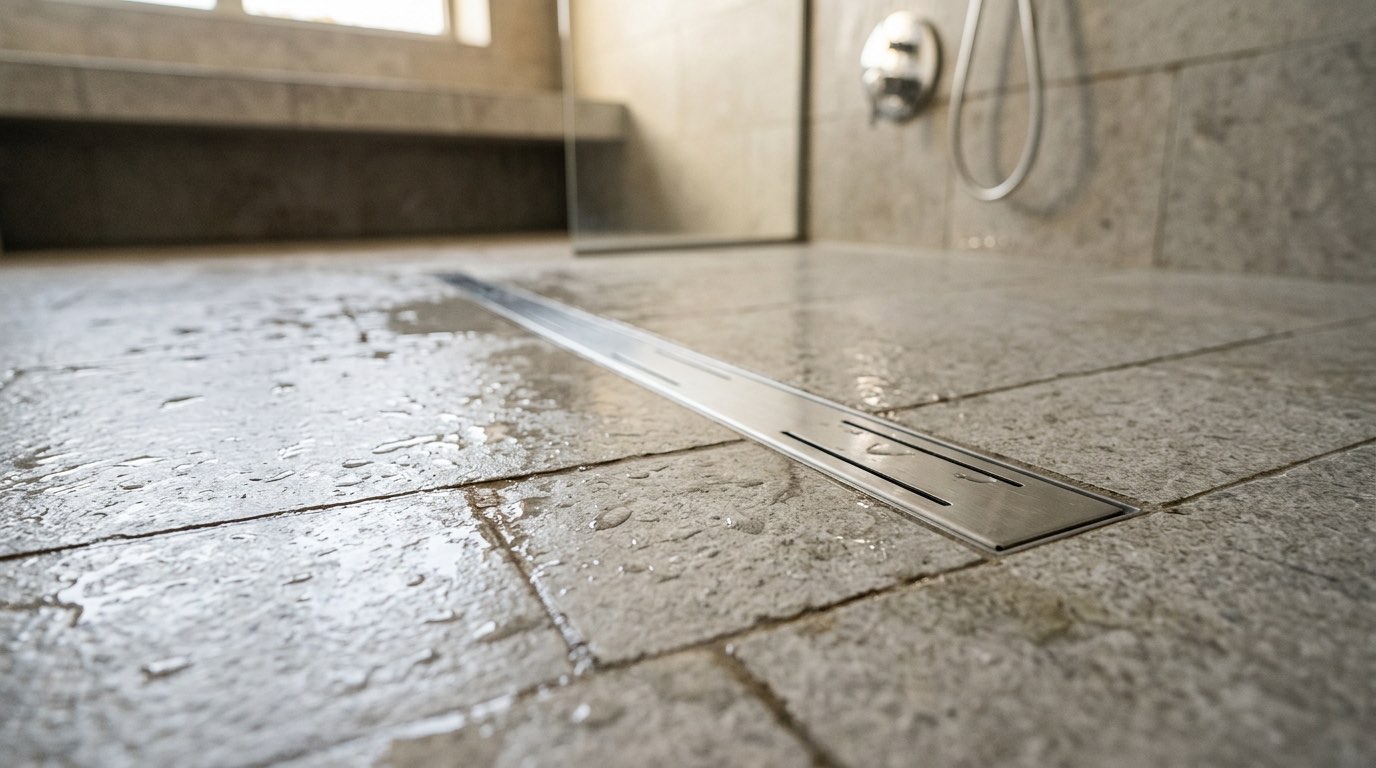
Spa floors are wet, warm, often soapy, and walked on with bare feet. A tile that looks matt in a showroom can behave very differently under those conditions, and a datasheet rating may describe a test that has nothing to do with them. Knowing which number to ask for, and how it was measured, is part of the design, not an afterthought for the tiler.
What does PTV 36 mean?
It is the threshold of low slip potential on the HSE classification. The pendulum swings a rubber slider across the floor and reports a pendulum test value: 36 and above is low slip potential, 25 to 35 moderate, 0 to 24 high. The value applies to the conditions tested, so a dry result says nothing about a wet floor.
| Pendulum test value (PTV) | HSE slip potential |
|---|---|
| 0–24 | High |
| 25–35 | Moderate |
| 36 and above | Low |
The pendulum test is set out in BS 7976, and HSE has adopted it as its standard method for floors in both dry and contaminated conditions. HSE also stresses that it must be run and interpreted by a trained operator, and that profiled floors need tests in more than 1 direction.
Which pendulum slider applies to barefoot spa floors?
Slider 55 for barefoot areas, Slider 96 for shod areas, and both for profiled floors, according to HSE. A spa has both: corridors and reception are walked in sandals, wet rooms and pool surrounds barefoot. A test report that does not name the slider cannot tell you which area it covers.
The two rubbers behave differently on the same surface, so a single PTV for a tile is incomplete. When we ask for test data for a spa floor, we ask for the slider, the contaminant (water at least, soapy water where relevant) and whether the sample was tested in the finish that will actually be installed. Honed, flamed, brushed or sandblasted versions of the same stone are different floors for this purpose.
What do R ratings and A, B, C ratings on tile datasheets mean?
They come from 2 German ramp tests. DIN 51130 uses safety boots and motor oil and grades R9 to R13; DIN 51097 uses barefoot walkers and soap solution and grades A, B and C. Only the second resembles a spa, and HSE warns that A, and often B, floors will be slippery when wet.
| Rating | Test | Conditions | What it tells a spa designer |
|---|---|---|---|
| R9 to R13 | DIN 51130 ramp | Safety boots, motor oil | Shod, oily workplaces; not barefoot wet areas |
| A (12–17°) | DIN 51097 ramp | Bare feet, soap solution | Slippery when wet, says HSE |
| B (18–23°) | DIN 51097 ramp | Bare feet, soap solution | Often slippery when wet, says HSE |
| C (over 24°) | DIN 51097 ramp | Bare feet, soap solution | The class to look for in wet barefoot zones |
HSE also notes how wide the R classes are: R10 covers a coefficient of friction from 0.18 to 0.34. That is why we treat a ramp rating as a starting point and ask for pendulum data with Slider 55 for any tile going into a barefoot wet zone.
Does surface roughness tell you how slippery a floor is?
It helps, in water-wet conditions. HSE classes surface microroughness, measured as Rz, below 10 µm as high slip potential, 10 to 20 µm as moderate and 20 µm and above as low. A hand-held meter gives a quick reading, so roughness is a useful check on an installed floor.
Roughness is a supplement to the pendulum, not a replacement. HSE's figures apply to water; thicker contaminants such as soap or oils need more roughness for the same grip. Roughness also changes in use: a textured floor can be worn smooth by heavy traffic, or filled in by cleaning residue and scale, and the reading taken at handover is only the first one.
Where in a spa does the floor need the most grip?
Wherever bare feet meet water and a change of direction or level: showers, the steam room, the hammam, pool and plunge surrounds, the ice fountain area and steps. These 6 zones carry the most risk, and transitions between them, where a guest steps from one finish onto another, deserve the same attention.
- Showers and experience showers. Constant water, soap and shampoo.
- Steam room and hammam. Condensation and soap on warm stone or tile, often in low light.
- Pool and plunge surrounds. Splash and dripping guests, and the step down into the water.
- Ice fountain and cold areas. Melting ice on the floor where guests stand.
- Steps, ramps and thresholds. A change of level is where a slip becomes a fall.
- Corridors between wet and dry zones. Wet feet carry water onto finishes chosen for dry use.
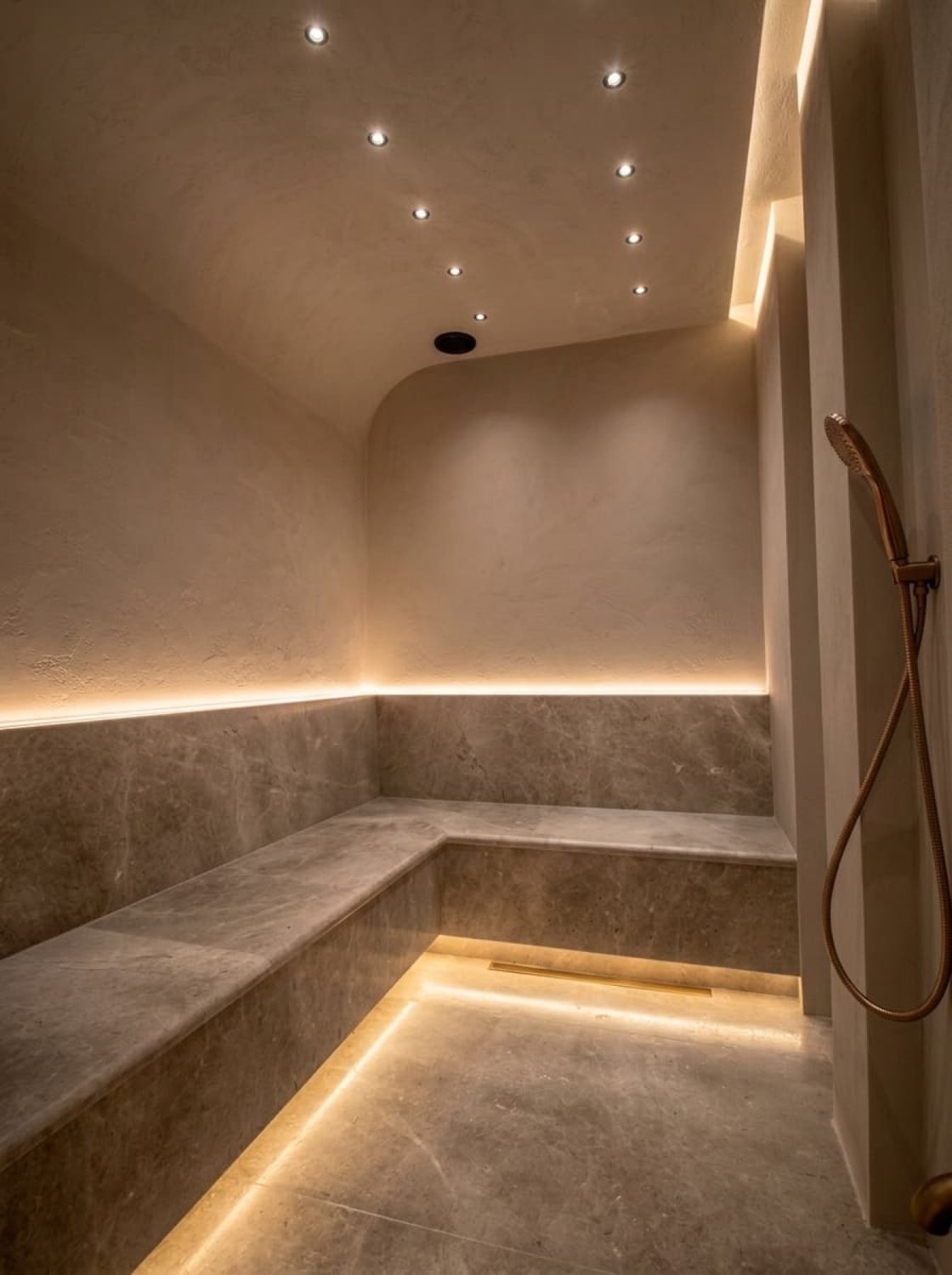
Lighting matters alongside grip. A slip-resistant floor in a dim steam room still needs edges and steps that guests can see, which is one reason bench and step edges are often lit from below.
Why does a spa floor become slippery after handover?
Because the surface changes. 3 things do most of the damage: cleaning products that leave a film, scale from hard water filling the texture, and sealers or polishes that were never part of the specification. Each lowers the pendulum value of a floor that tested well when new.
In the Gulf, hard water is the usual suspect. Limescale builds up in the texture of tiles and stone around showers and plunge pools, smoothing the surface. Acid descalers remove scale but can etch some stones, so the cleaning regime is agreed with the stone or tile supplier. Sealers are the other trap: a glossy sealer applied to "protect" a honed stone can turn a floor that met PTV 36 into one that does not. The cleaning and maintenance instructions in the handover file should say which products are allowed on each floor.
How should wet area design specify and check slip resistance?
In 4 steps: name the target, name the test, check it on site, and keep checking. The specification states the PTV target per zone, the slider and the contaminant; samples are tested in the installed finish; the installed floor is tested before handover; and the operator re-tests at intervals.
- Target per zone: for example, low slip potential (PTV 36 or more) with Slider 55 in wet barefoot zones.
- Test named in full: pendulum to BS 7976, slider, contaminant, direction for profiled floors, competent operator.
- On-site test: on the laid floor, after cleaning, before handover, recorded with photographs and locations.
- Re-test: after any change of cleaning product or sealer, and at intervals set by the operator.
For the showers that put the most water on a spa floor, our page on shower systems covers experience and rain showers, and our note on spa fit-out in Dubai explains how we coordinate finishes in a full spa project. Hammam floors are covered on our modern hammam page.
Who is writing this
Sauna Dekor Spa Solutions has designed and built spa wet areas, hammams, steam rooms, saunas and pools since 1987: 40 years of manufacturing in our own facility at İkitelli OSB, Istanbul, with 19 employees, 5,000+ projects and work delivered in 35+ countries. Our quality system is certified to TS EN ISO 9001:2015 (certificate no 202025106, EKOL Belgelendirme, valid to 19.06.2027).
We specify and lay floor finishes in the wet areas we build, including the hammam suite of a private villa in Dubai. We do not manufacture tiles or stone, and we are not a test laboratory: slip test reports come from the tile or stone supplier and from a competent tester. Warranty: 24-month warranty on workmanship and manufacturing; 24-month manufacturer's warranty on electrical and mechanical equipment; 5-year warranty on structure and waterproofing. Contact: +90 532 215 64 78.
Frequently asked questions about slip resistance in wet area design
What PTV is safe for a wet spa floor?
HSE classes a pendulum test value of 36 or more as low slip potential in the conditions tested. For a barefoot wet area, ask for that value measured wet with Slider 55 rubber, on the finish that will actually be installed.
Is an R11 tile suitable for a spa shower?
Not on that rating alone. R ratings come from DIN 51130, which uses safety boots and motor oil, not bare feet and soapy water. For a spa shower, ask for DIN 51097 class C or pendulum data with Slider 55.
What is the difference between Slider 55 and Slider 96?
They are the 2 standard rubbers for the pendulum test. HSE uses Slider 96 for shod pedestrians and Slider 55 for barefoot areas, and both on profiled floors. A spa needs Slider 55 results for its wet, barefoot zones.
Can a slippery floor be made safe after installation?
Sometimes. Removing a glossy sealer or cleaning residue can restore a floor's original grip, and some surfaces can be treated or re-finished. The result is checked with a new pendulum test, not by eye or by feel.
Why do spa floors get more slippery over time?
Cleaning products leave films, hard water leaves scale in the texture, and sealers or polishes smooth the surface. A floor that tested well at handover can drop into a lower class, so the operator re-tests after changes and at intervals.
Who carries out a slip resistance test?
A trained, competent operator with a pendulum and, often, a roughness meter, testing to BS 7976. HSE stresses that the pendulum must be operated and interpreted by a competent person, especially on profiled floors.
Sources
- Assessing the slip resistance of flooring (GEIS2) — Health and Safety Executive, UK. Pendulum classes (0–24, 25–35, 36+), Slider 55 and Slider 96, Rz roughness classes, DIN 51130 and DIN 51097 ramp ratings and HSE's reservations about them.
- Slips and trips at work — Health and Safety Executive, UK. Guidance on floor surfaces, contamination and cleaning.
- Friction — Wikipedia. The coefficient of friction, the quantity slip tests estimate.
- Surface roughness — Wikipedia. Roughness parameters including Rz and how they are measured.
- Hard water — Wikipedia. Calcium and magnesium in water and the scale they leave on surfaces.
- Limescale — Wikipedia. How scale forms and how it is removed.


Yorumlar
Yorum Gönder