"Steam sauna": one search term, two different rooms
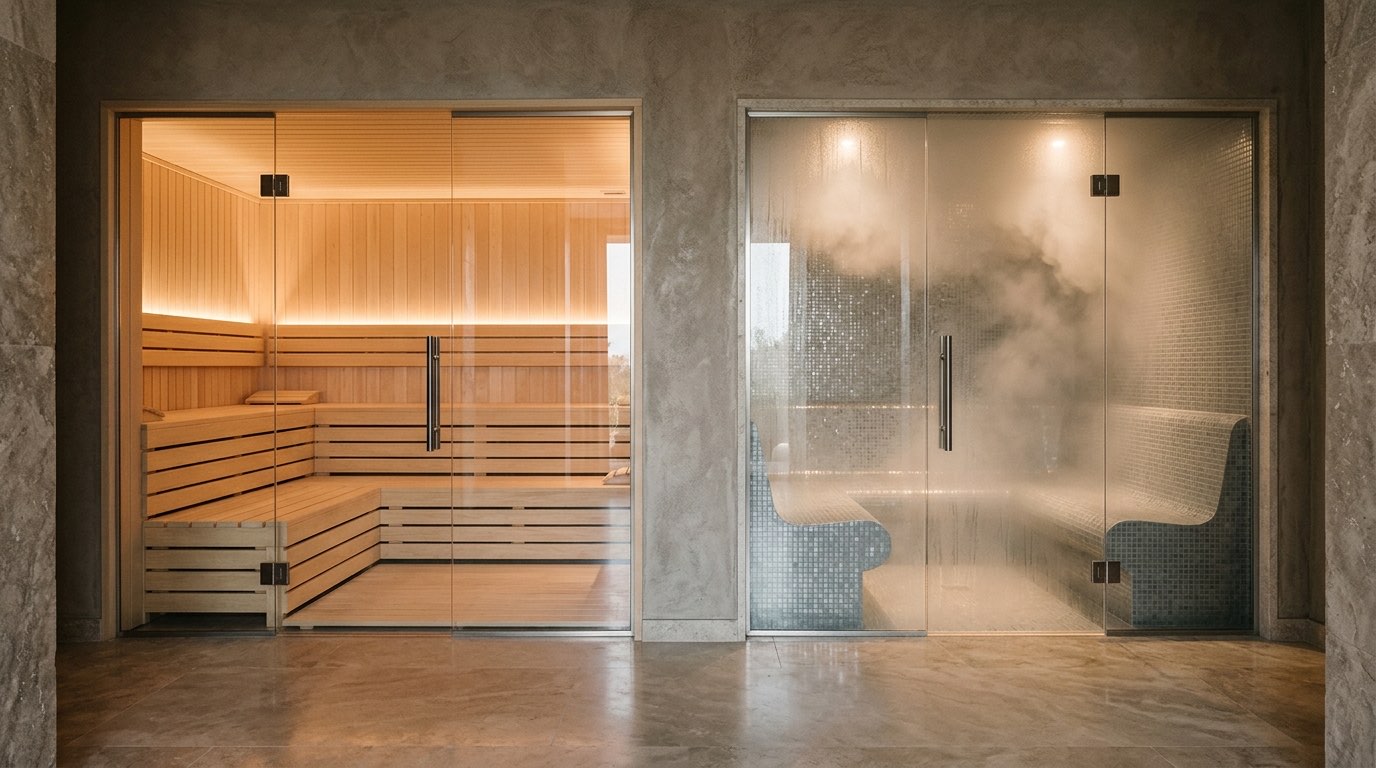
Short answer: "steam sauna" is used for 2 different rooms. Some people mean a Finnish sauna, a hot timber room where water thrown on the stones makes bursts of steam. Others mean a steam room, a tiled room filled with steam from a generator. They differ in temperature, humidity, heat source, materials and plumbing, so the first job on any steam sauna enquiry is to find out which one the client pictures. Sauna Dekor Spa Solutions builds both.
Updated: 14 October 2026
The term is common in Gulf searches and in enquiries we receive, and it is not wrong: both rooms involve heat and steam. But a client who asks for a steam sauna and receives the other room will be disappointed, and the 2 rooms cannot be converted into each other after they are built. Sorting out the meaning takes 5 questions and saves a redesign.
What does "steam sauna" usually mean?
1 of 2 rooms. In Finnish usage the steam is löyly, the burst that rises when water is ladled onto the hot stones of a sauna heater. In everyday English, especially in hotels and gyms, "steam sauna" often means a steam room. The words overlap; the rooms do not.
A third meaning turns up at home: a shower cubicle with a small steam generator, sold as a steam shower or steam cabin. And some suppliers use "steam sauna" for a bio sauna, a timber room run at a lower temperature with a humidifier. Each of these is a real product, which is exactly why the term needs pinning down before anyone draws a plan.
How hot and humid is a Finnish sauna compared with a steam room?
Very different. A Finnish sauna runs at 80–100 °C with dry air of about 10 to 20 % relative humidity, according to a 2018 systematic review, and a ladle of water raises the humidity for a moment. A steam room runs far cooler and is saturated, as the table shows.
| Finnish sauna (with löyly) | Steam room | |
|---|---|---|
| Air temperature | 80–100 °C | 40–50 °C |
| Relative humidity | about 10–20 %, rising briefly after water on the stones | close to 100 % |
| What heats the room | Electric or wood heater with stones | Steam from a generator outside the room |
| Where the steam comes from | Water ladled onto stones, by hand | Generator, continuously, under control |
| Interior | Untreated timber: ayous, aspen, low-resin pine and their thermo versions | Tiles, mosaic, stone or solid surface on a waterproof, vapour-tight base |
| Benches | Timber, slatted | Tiled or stone, often heated |
| Water connections | None required | Water feed, generator drain, floor drain |
A bio sauna sits between the two: a timber room at 50–65 °C with added humidity. It is a third room, not a compromise that serves both.
Why can a sauna not simply be turned into a steam room?
Because the materials are opposite. A sauna is built from untreated timber that must breathe and dry out between sessions; a steam room is a sealed, waterproof shell that stays wet. Timber in permanent 100 % humidity swells, stains and grows mould, so 1 room cannot do both jobs.
The heating is just as different. A sauna heater heats air and stones; a steam generator boils water outside the room and pipes steam in. Running a steam generator into a timber sauna, or pouring constant water on a heater, takes both pieces of equipment outside their makers' instructions. Where a client wants both experiences, the answer is 2 rooms side by side, sharing a corridor and a shower, each built for its own climate.
How are the two rooms built differently?
From the walls inwards. A sauna has insulation, a reflective vapour barrier and a timber lining with an air gap; a steam room has a waterproofing membrane that is also vapour-tight, a tiled or stone finish, a sloped ceiling to stop drips and a floor falling to a drain. The 2 share almost no materials.
Ventilation differs too. A sauna needs air supply and exhaust positioned around the heater so that the air changes while the room stays hot. A steam room is kept closed while it runs, with a door that seals, and is aired out after use. Power differs: a sauna heater and a steam generator are both large loads, but the generator also needs water and a drain, and its steam pipe has to be planned before the room is tiled.

Which questions tell you which steam sauna a client wants?
5 questions settle it. Should the room be timber or tiled? Should it feel dry and very hot, or humid and warm? Will you pour water on stones yourself, or should steam come on its own? Do you picture benches of wood or of stone? Is it for 1 or 2 people at home, or for a hotel?
- Timber or tiled? Timber points to a sauna; mosaic or stone to a steam room.
- Dry heat or wet heat? Very hot and dry with bursts of steam is a sauna; warm and fully saturated is a steam room.
- Ladle or generator? Pouring water on stones is a sauna ritual; a continuous cloud is a generator.
- Wood or stone benches? Slatted timber is a sauna; tiled or heated stone is a steam room.
- Home or hotel? A small home "steam sauna" may in fact be a steam shower cubicle.
If the answers point both ways, the client probably wants both rooms. That is a common villa brief, and the plan then needs space for 2 rooms and a shower between them.
Which one suits a villa in the Gulf?
Either, or both. In a Gulf villa the choice is about the experience and the space, not the climate outside. A steam room needs a waterproofed wet zone and 3 water connections; a sauna needs a dry room with ventilation and no water connections at all. Many villa spas combine them.
A steam room fits naturally into a bathroom suite, because it already sits in the wet zone, close to water and drains. A sauna can go into a dry room, a basement or, as a cabin, into a bathroom outside the shower zone. Where both are planned, they are placed so that a shower sits between them and the steam room's door never opens into the sauna.
For a side-by-side comparison of the two experiences, see our note on sauna vs steam room. If the client may actually mean a cubicle, our comparison of the steam shower and the sauna covers it, and our guide to traditional, infrared and steam rooms adds the infrared cabin to the choice.
Who is writing this
Sauna Dekor Spa Solutions has designed and built saunas, steam rooms, hammams and pools since 1987: 40 years of manufacturing in our own facility at İkitelli OSB, Istanbul, with 19 employees, 5,000+ projects and work delivered in 35+ countries. Our quality system is certified to TS EN ISO 9001:2015 (certificate no 202025106, EKOL Belgelendirme, valid to 19.06.2027).
We make sauna interiors and benches in our own joinery and build steam room shells, waterproofing and mosaic. We do not manufacture sauna heaters or steam generators: we install EOS sauna heaters and Condair steam generators, and their certification belongs to those makers. Warranty: 24-month warranty on workmanship and manufacturing; 24-month manufacturer's warranty on electrical and mechanical equipment; 5-year warranty on structure and waterproofing. Contact: +90 532 215 64 78.
Frequently asked questions about the steam sauna
Is a steam sauna the same as a steam room?
Sometimes. In hotels and gyms "steam sauna" usually means a steam room, a tiled room filled with steam from a generator. In Finnish usage it means a sauna where water is thrown on the stones. Ask which one is meant before planning.
Is a steam room hotter than a sauna?
No. A steam room runs at a lower air temperature but is saturated, so it feels intense in a different way. A Finnish sauna is much hotter, with dry air that only briefly becomes humid when water is ladled on the stones.
Can I add steam to my sauna?
Yes, in the traditional way: ladling water onto the heater's stones, within the heater maker's instructions. Connecting a steam generator to a timber sauna is a different matter; constant saturation damages untreated timber.
Can one room be both a sauna and a steam room?
Not well. A sauna needs breathable untreated timber and dry air; a steam room needs a sealed, waterproof, tiled shell. Combination products exist, but where a client wants both experiences, 2 rooms side by side serve them better.
What is a wet sauna?
Usually a Finnish sauna used with plenty of löyly, water on the stones, so the air becomes more humid than in a dry session. Some people use the phrase for a steam room. Like "steam sauna", it needs clarifying with the client.
Which needs more plumbing, a sauna or a steam room?
A steam room. It needs a water feed and a drain for the generator, a floor drain in the room and a steam pipe, all planned before tiling. A sauna needs no water connections, only power for the heater and ventilation.
Sources
- Clinical effects of regular dry sauna bathing: a systematic review — Hussain J, Cohen M. Evid Based Complement Alternat Med, 2018. Finnish sauna temperatures of 80–100 °C with relative humidity of 10–20 %.
- Sauna — Wikipedia. The Finnish sauna, löyly and the varieties sold as steam or wet saunas.
- Steam room — Wikipedia. How a steam room is built and supplied with steam from a generator.
- Relative humidity — Wikipedia. What relative humidity measures and why saturated air at a lower temperature feels different from dry air at a higher one.
- Hammam — Wikipedia. The other humid, tiled bath that is sometimes confused with a steam room.
- Condair steam bath generators — product overview — Condair UK. Steam bath generators that supply a steam room from outside it.


Yorumlar
Yorum Gönder