Steam Room Star Ceilings: Fibre Optics Without Power Inside
Short answer: A fibre-optic star ceiling lights a steam room without putting electricity inside it. The light source sits outside the room, in a ceiling void or plant room, and each fibre carries only light to a point in the ceiling. In a room held at 40–50 °C and close to 100 % relative humidity, that separation is the whole point.
Updated: 2 October 2026
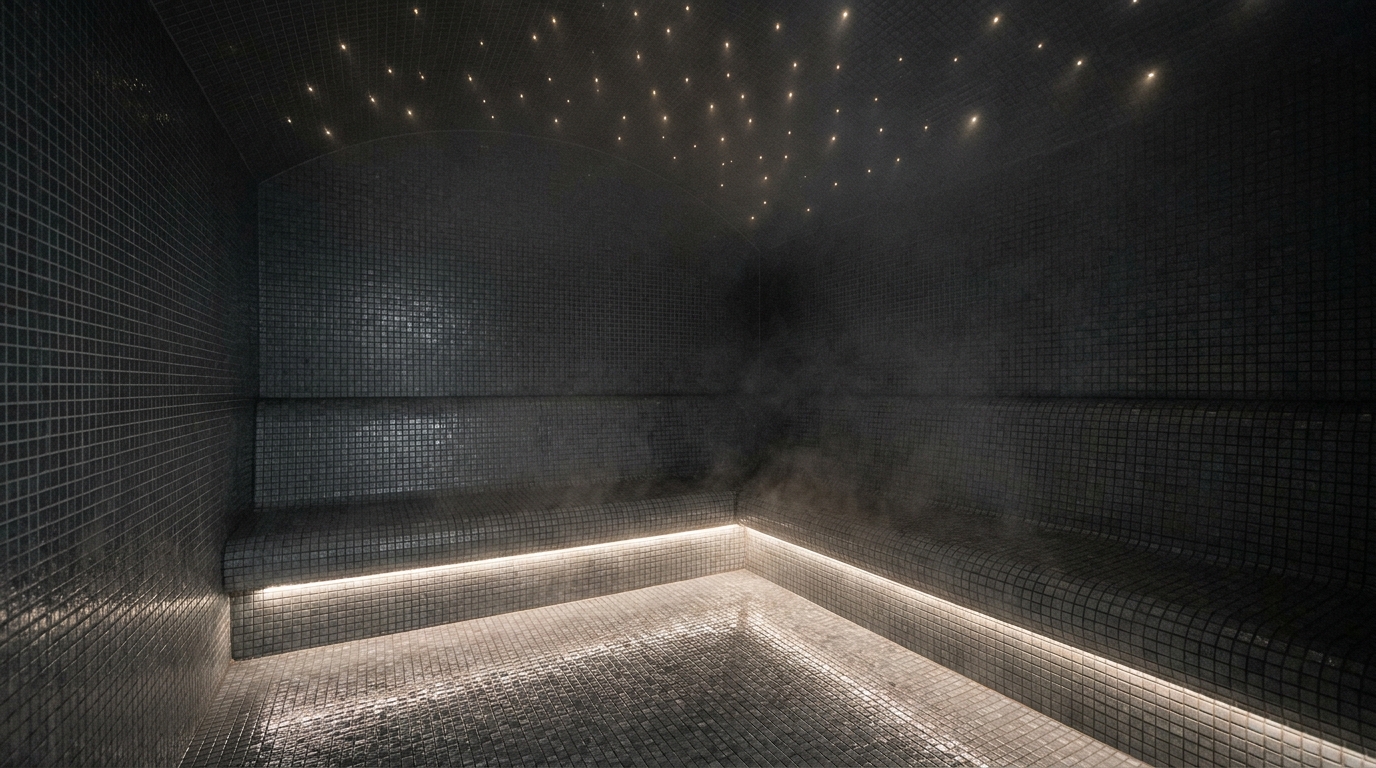
Star ceilings are one of the details guests remember in a steam room or a hammam, and one of the details that designers worry about most, because they put light in the wettest part of the room. This note explains how a fibre-optic ceiling keeps the electrical part out of the wet zone, what to specify, and how it compares with LED alternatives.
The same logic applies to a hammam. Its room air runs at 40–50 °C, the range we publish for a Turkish hammam. The heated marble platform is a separate surface, and we design its top for 40–45 °C.
Why is a steam room a difficult place for lighting?
Because it combines heat, saturation and constant condensation. A steam room runs at 40–50 °C and close to 100 % relative humidity for hours a day, so every fitting in it is wet on the outside, and any fitting that is not sealed will draw moisture inside as it cools after each session.
Condensation is the part designers underestimate. Warm, saturated air meets a cooler surface and leaves water on it; a light fitting that heats and cools every day pumps a little of that moisture in through any gap.
The second difficulty is cleaning. Steam rooms are washed daily, often with hoses, and the ceiling collects drips that run towards the walls. A fitting has to survive the water that reaches it from below as well as from above.
How does a fibre-optic star ceiling work?
A light source, called an illuminator or projector, sits outside the steam room and shines into the bundled ends of many thin fibres. The fibres run through the ceiling void and end flush with the ceiling finish. Each end appears as 1 point of light, and no current flows anywhere near it.
The fibres used for ceilings are usually plastic optical fibre, the same family of material used in illumination and short data links. They carry light by internal reflection and conduct no electricity.
Colour and brightness are set at the illuminator. Many projectors offer a colour wheel or a twinkle wheel, so the effect can change without anyone entering the wet room.
Where does the light source go?
Outside the wet room, somewhere a technician can reach it with the room in use. The usual positions are a ceiling void above the corridor, a technical room next to the steam generator, or a service cupboard. The fibres are cut to length from there, so a run of a few metres is normal.
The light source is the only electrical part of the system, and it needs ventilation of its own, because the lamp produces heat. A closed box above a hot ceiling is not a suitable home for it.
Keeping it outside the room also makes maintenance simple. A lamp or LED module is changed from the corridor side in a few minutes, without draining, drying or opening the steam room ceiling.
What does the electrical standard say about wet rooms?
IEC 60364, the international standard for low-voltage installations, has a Section 701 for rooms containing a bath or shower and a Section 703 for rooms with sauna heaters. Section 701 divides the space into zones and limits what equipment may sit in each. A fibre-optic ceiling places 0 electrical parts inside those zones.
Designers apply the same caution to steam rooms, which are wetter than any bathroom. Where a light fitting has to be inside the room, it is chosen by its IP rating, the code defined in IEC 60529.
In the IP code, the second digit is the water rating: 4 means splashing water from any direction, 5 means water jets from a 6.3 mm nozzle, and 7 means immersion up to 1 m. A steam room fitting that will be hosed needs at least the jet rating.
How is the ceiling itself built around the fibres?
The ceiling is built first and drilled after. Each fibre passes through a small hole in the board and the waterproofing layer, is sealed there, and is cut flush after the tiles or mosaic are laid. A typical design might use 100 to 200 points on a 3 × 2 m ceiling, set out on a drawing before drilling starts.
The waterproofing is the part that must not be compromised. Every hole is a penetration, so the membrane manufacturer's detail for small penetrations applies, and the seal is checked before the finish goes on.
Steam room ceilings are sloped or vaulted so that condensation runs to the walls instead of dripping on the benches. The fibre points follow that geometry, which is why the setting-out drawing matters more than on a flat ceiling.
How does a star ceiling compare with LED options?
Each option puts the electricity in a different place. The table compares the 4 lighting methods we see most often in steam rooms and hammams by where the powered part sits, what the room needs from it, and how it is maintained.
| Lighting method | Where the electricity is | What the room needs | Maintenance |
|---|---|---|---|
| Fibre-optic star ceiling | Outside the room, at the illuminator | Sealed penetrations through the waterproofing | Lamp changed from outside the room |
| Sealed LED strip under a bench | Inside the room, low voltage, in a sealed profile | Rating for water jets or immersion, sealed cable entries | Profile opened inside the dried room |
| Sealed downlight | Inside the room, in the ceiling | Rating for water jets, sealed housing | Fitting changed from inside or above |
| Light through a glass panel | Outside the room, behind glass | A sealed glazed panel in the wall | Light changed from outside the room |
Many rooms combine 2 of them: a fibre-optic ceiling for the stars and a sealed line under the bench edge for orientation, as in the photograph below.
Does a star ceiling change anything for the steam generator?
No. The fibres add no heat and no load to the steam room, so the generator is still sized for the room's volume, its wall construction and its ventilation. The illuminator and the generator often share the same technical room, which suits both, because each is reached for service from outside the wet area.
That shared room needs space for both, and a drain for the generator. Planning it once, at design stage, avoids a second service hatch.
Our steam generator page covers generator selection. The difference between the two hot rooms is set out in our comparison of sauna vs steam room, and our note on traditional, infrared and steam rooms adds the third type.
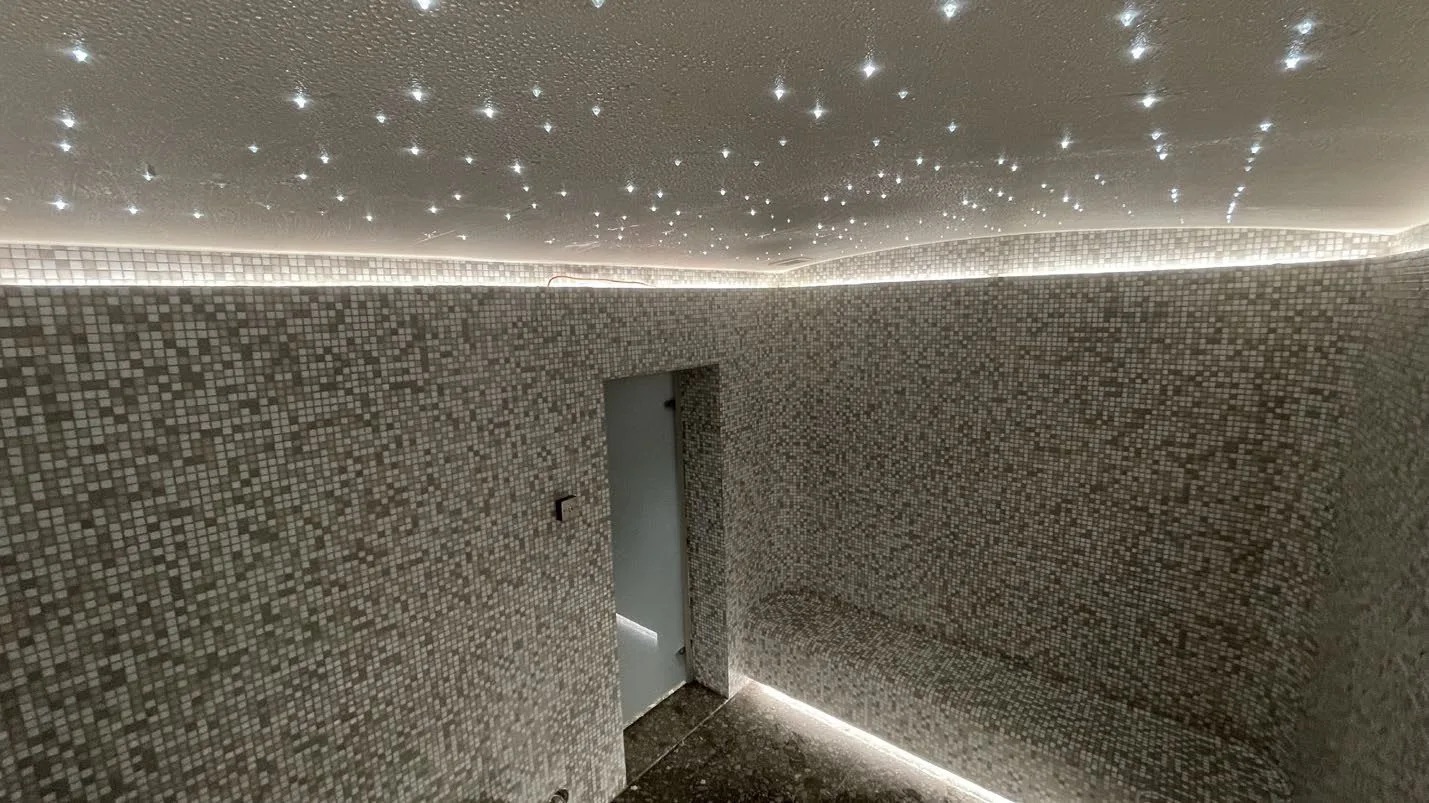
The project is shown on our Diplomatic Club spa and fitness page.
Who is writing this
Sauna Dekor Spa Solutions has manufactured and built steam rooms, hammams and saunas from its own facility in İkitelli OSB, Istanbul, since 1987: 40 years of manufacturing, a team of 19 employees, work under TS EN ISO 9001:2015, 5,000+ projects in 35+ countries and 731 named references. This article was reviewed by our Managing Director.
We give a 24-month warranty on workmanship and manufacturing; electrical and mechanical equipment carries a 24-month manufacturer's warranty; and we give a 5-year warranty on structure and waterproofing.
Steam generators and fibre-optic illuminators are not our products. They come from their manufacturers, and any CE marking or EN 60335 conformity of that equipment belongs to its manufacturer rather than to us.
Frequently asked questions about star ceilings in a steam room
Is a fibre-optic star ceiling safe in a steam room?
It keeps the electrical part outside the room. The illuminator sits in a void or technical room, and the fibres inside the steam room carry only light, so there is no current in a space held at 40–50 °C and close to 100 % humidity.
Where is the light source of a star ceiling installed?
Outside the wet room, in a ventilated ceiling void, a technical room or a service cupboard that a technician can reach while the steam room is in use. Fibre runs of a few metres from there are normal.
How many stars does a steam room ceiling need?
It is a design choice rather than a rule. A 3 × 2 m ceiling might carry 100 to 200 points, set out on a drawing that follows the slope or vault of the ceiling before any hole is drilled.
What IP rating do lights inside a steam room need?
Fittings inside the room are chosen by the water digit of the IP code. A rating of 5 covers water jets from a nozzle and 7 covers immersion up to 1 m; a room that is hosed daily needs at least the jet rating.
Can a star ceiling be added to an existing steam room?
Only by opening the ceiling. Every fibre passes through the waterproofing layer, so the ceiling has to be stripped, drilled, sealed and refinished. It is far simpler to plan the fibres before the ceiling is built.
Sources
- IEC 60364 — Wikipedia, 2026. The low-voltage installation standard, with Section 701 for rooms containing a bath or shower and Section 703 for rooms with sauna heaters.
- IP code — Wikipedia, 2026. The IEC 60529 ingress protection code: splashing water (4), water jets from a 6.3 mm nozzle (5) and immersion up to 1 m (7).
- Plastic optical fiber — Wikipedia, 2026. Materials of plastic optical fibre and its use in illumination.
- Optical fiber — Wikipedia, 2026. How a fibre carries light by total internal reflection.
- Condair steam bath generators — Condair. Steam generators for steam baths, with manuals published by the manufacturer. The documents belong to Condair.


Yorumlar
Yorum Gönder