Steam room mosaic, bench and grout
Short answer: a steam room is tiled in small mosaic because mosaic follows the curves of benches, backrests and vaulted ceilings. The price of that flexibility is thousands of joints, each of them grout that sits at 40–50 °C and close to 100 % relative humidity. That is why the grout has to be one made for heat and water, light enough in colour to show dirt, and rinsed every day. Epoxy grout is an optional upgrade we offer on request, not a standard part of every room. Sauna Dekor Spa Solutions builds steam rooms for hotels and villas; this is how we tile them.
Updated: 22 October 2026
Guests see the surface of a steam room and nothing behind it. They sit on it, lean against it, put their hands on it and look at it for 10 or 15 minutes at a time. The surface also does more work than anything else in the room: it takes heat, water, condensation, soap, body oils and daily cleaning, for years, without a dry day.
Why are steam rooms tiled in mosaic?
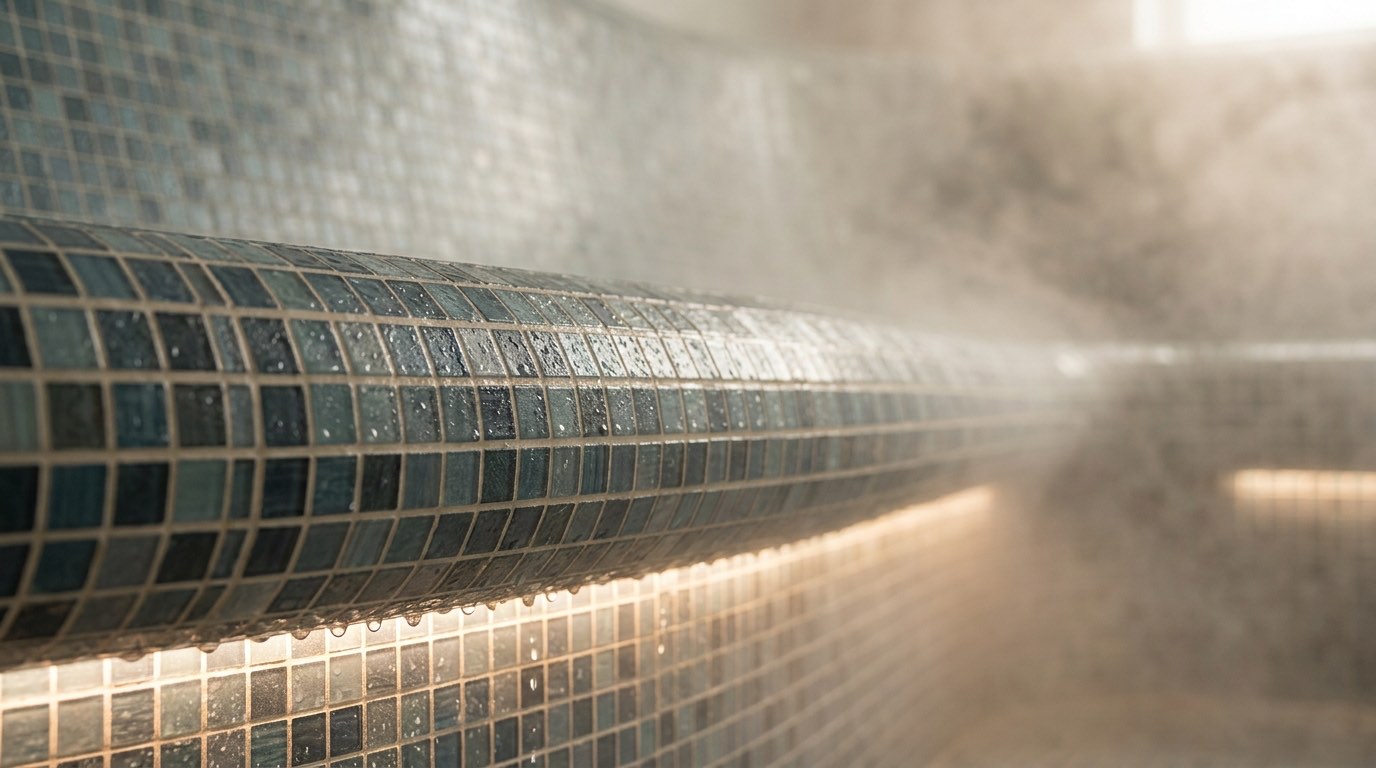
Because small tiles bend around curves. A contoured bench, a rounded backrest, a vaulted ceiling and the soft corner between wall and floor are all surfaces that large tiles cannot follow. Mosaic, usually glass or porcelain, wraps them in 1 continuous finish, with no cut edges to catch skin or dirt.
The Global Wellness Institute's hydrothermal guide is clear about the trade-off. It recommends continuous stone or large-area ceramics on benches where possible, to minimise the joints that bodies touch, and says that if mosaic is chosen, the grout must be specifically designed to withstand heat and water.
| Finish | Follows curves | Joints | Where we use it |
|---|---|---|---|
| Glass mosaic | Yes | Very many | Curved benches, vaults, niches |
| Porcelain mosaic | Yes | Very many | Benches and floors needing grip |
| Large-format porcelain | No | Few | Flat walls, straight benches |
| Stone slab | No | Few | Straight benches, wall panels |
Many of our steam rooms combine 2 of these: mosaic where the shape demands it, larger panels where the surface is flat.
What makes grout the weak point of a steam room?
Every joint is a narrow strip of a different material from the tile, and of the 2 materials it is the one that absorbs water and dirt first. The GWI guide lists "tiles poorly installed with incorrect grouting, so they easily pop off when exposed to heat and moisture" among the common mistakes in steam room builds.
A cement-based grout is porous. In a bathroom that dries between uses it can work well; in a room that stays warm and saturated for hours a day, it takes up water, body oils and soap, darkens, and can grow mould on the surface. Its weakness is not the colour change but what follows: once grout starts to wash out, water reaches the tile bed behind it.
When is epoxy grout worth choosing for a steam room?
Epoxy grout is optional. Where a client asks for it, the reason is that epoxy is a resin, not a cement. It hardens into a dense, non-porous joint that does not soak up water and stands up to cleaning chemicals better than cement-based grout. For a room at close to 100 % humidity for most of the day, that property is what some clients pay the extra work for; a grout designed for heat and water, laid and left to set as the maker's instructions, is the baseline in every case.
Epoxy is also harder to work with. It has a short working time, it has to be cleaned off the tile face before it hardens, and glass mosaic shows every smear. We plan the grouting in small areas, by an installer used to the product, and we follow the grout maker's instructions for mixing, working time and curing. The steam generator is not run until the grout maker's curing period has passed.
Not every joint is grout. Where 2 planes meet, such as wall and bench, bench and floor, or wall and ceiling, the tiling system needs a flexible sealant joint, as the adhesive and grout makers specify, so movement between surfaces does not crack the grout.
How is a mosaic steam room bench built?
As a formed shape that does 3 jobs: it is waterproof, it is insulated, and it is smooth enough for mosaic to sit flat. The core is cut and shaped to the contour of seat and backrest, coated, and then tiled. The mosaic is bedded fully, with no hollow spots behind the tiles, because voids collect water and let tiles loosen.
3 details decide whether guests like the bench:
- Shape. A contoured seat and a backrest that tilts back are more comfortable than a flat shelf against an upright wall.
- Edges. The front edge is rounded, so mosaic wraps it without a sharp corner.
- Rinse. The GWI guide lists failing to provide a way to flush benches, such as a hand-held hose, among common mistakes. A hand shower near the benches is optional and fitted on request; without one, the room still needs a planned way to rinse the benches.
What colour should steam room mosaic and grout be?
Colour is a design choice, but grout colour is also 1 of the cleaning choices. The GWI guide advises against very dark tiles so that cleaning staff can see the areas that need attention. A mid or light grout shows soap and scale early; a very dark one hides them until the deposit is thick.
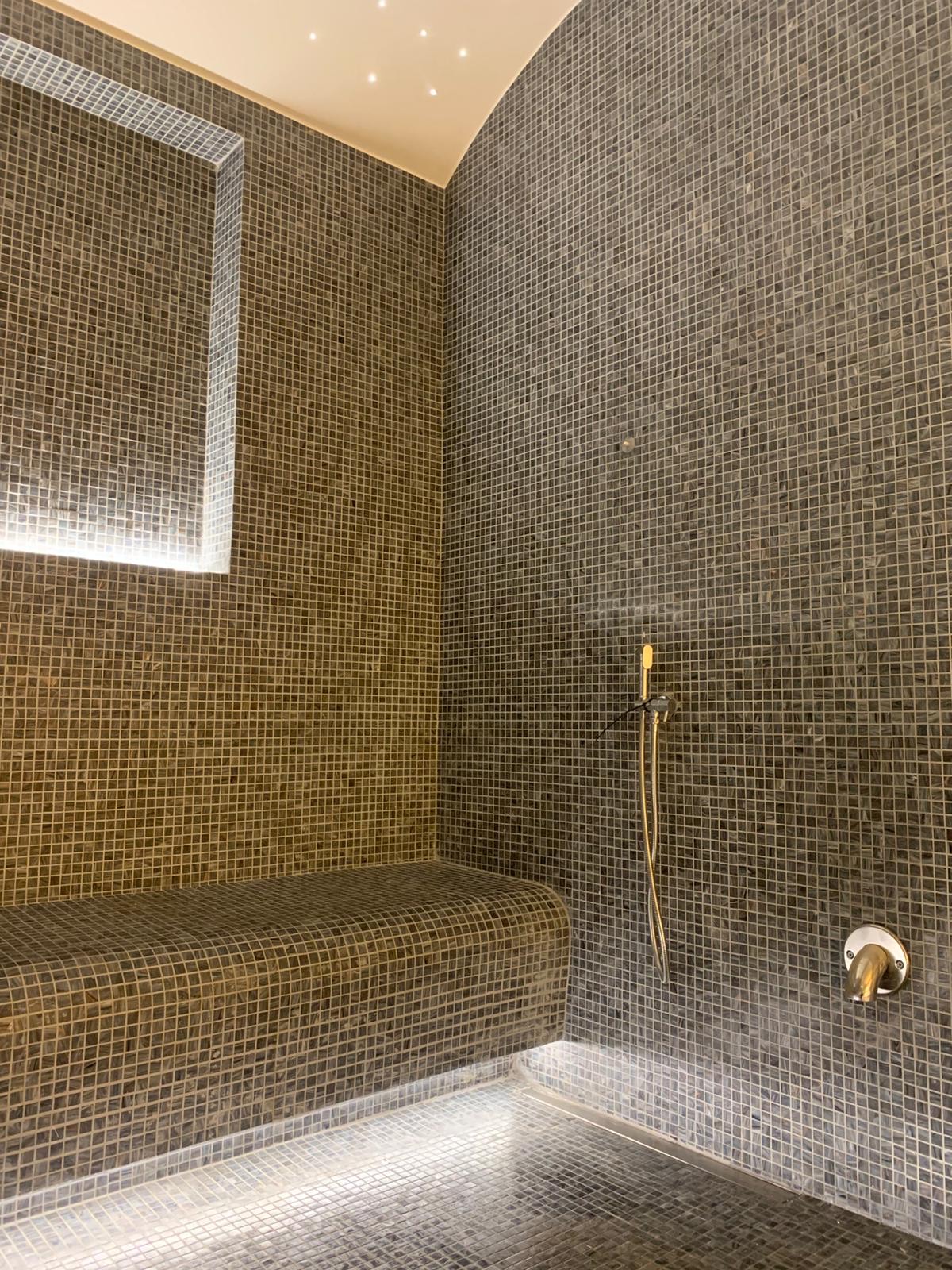
In the steam room shown above, the mosaic is dark and the effect depends on light: a strip under the bench, a lit niche and points of light in the ceiling. The ceiling itself curves down into the wall, which is part of the same idea. In a steam room the ceiling must be shaped to lead condensation to the walls rather than let it drip on guests.
How should a mosaic steam room be cleaned?
Daily, with a rinse and a mild cleaner, on a 4-step routine, and never with a pressure washer. The GWI guide warns that pressure washers and commercial steam cleaners can damage tile grout. Whatever the grout, the cleaner should be one the grout and tile makers approve.
- After each day: benches and floor rinsed (with a hand shower or hose where fitted), then wiped with a mild cleaner.
- Weekly: grout lines checked for staining and scale, especially along the bench front and around the drain.
- When scale appears: a descaler approved for the tile and grout, used as directed, then rinsed.
- At each service: sealant joints checked and renewed where they have split or stained.
Our note on steam room cost for homes and commercial builds in the UAE lists finishes among the main cost items, and custom steam rooms for Dubai homes shows how we build them. The room in the photograph is from a private villa in Dubai, and a hotel example in beige mosaic is the steam room at the Hyatt Regency Izmir Istinye Park.
Who is writing this
Sauna Dekor Spa Solutions has designed and built steam rooms, saunas, hammams and pools since 1987: 40 years of manufacturing in our own facility in Istanbul, with 19 employees, 5,000+ projects and work delivered in 35+ countries. Our quality system is certified to TS EN ISO 9001:2015 (certificate no 202025106, EKOL Belgelendirme, valid to 19.06.2027).
We build the steam room shell, bench and tiling, and we lay the mosaic and grout. We do not manufacture tiles, grout or steam generators: our steam rooms use Condair steam generators, and each product carries its manufacturer's own certification. Warranty: 24-month warranty on workmanship and manufacturing; 24-month manufacturer's warranty on electrical and mechanical equipment; 5-year warranty on structure and waterproofing. Contact: +90 532 215 64 78.
Frequently asked questions about steam room mosaic and grout
Can I use ordinary cement grout in a steam room?
Only a grout made for wet, hot rooms. A steam room stays warm and saturated for hours a day, and ordinary cement grout is porous: it absorbs water, oils and soap. The GWI guide says mosaic needs grout specifically designed to withstand heat and water; epoxy is one optional choice.
Is glass mosaic slippery on a steam room floor?
It can be. Glass mosaic suits walls, vaults and benches; for the floor, choose a mosaic or tile with a slip-resistant finish suited to wet, barefoot use, and ask the supplier for wet slip test data on that finish.
How long does grout need before the steam room is used?
As long as the grout maker's curing instructions say, for epoxy or any other grout. We do not run the steam generator until that period has passed. Before tiling, the waterproofed shell is water-tested for at least 24 hours.
Why do steam room tiles fall off?
Usually because of voids behind the tiles, the wrong adhesive or grout, or no flexible joints where surfaces meet. The GWI hydrothermal guide lists poor tiling with incorrect grouting among common steam room mistakes, because heat and moisture find every weakness.
Can a steam room bench be made of stone instead of mosaic?
Yes, if its shape is straight or gently curved. The GWI guide favours continuous stone or large-area ceramics on benches, because fewer joints help comfort and hygiene. Strongly contoured benches still need mosaic to follow the curve.
How do I clean mould from steam room grout?
Clean it with a product approved by the grout and tile makers, then rinse. With epoxy grout, surface mould usually wipes away; with cement grout it can return because the joint itself holds moisture. Daily rinsing and drying the room after closing help most.
Sources
- Guide to Hydrothermal Spa & Wellness Development Standards (2024) — Global Wellness Institute. Steam room materials, benches, grout for mosaic, common steam room mistakes and cleaning.
- Grout — Wikipedia. Cement-based and epoxy grouts and how they differ.
- Epoxy — Wikipedia. Epoxy resins and how they harden.
- Mosaic — Wikipedia. Small-tile surfaces and their history.
- Tile — Wikipedia. Ceramic, porcelain and glass tiles.
- Condensation — Wikipedia. Why warm, saturated air leaves water on cooler surfaces.


Yorumlar
Yorum Gönder