Steam room door: glass, seal, gap and outward swing
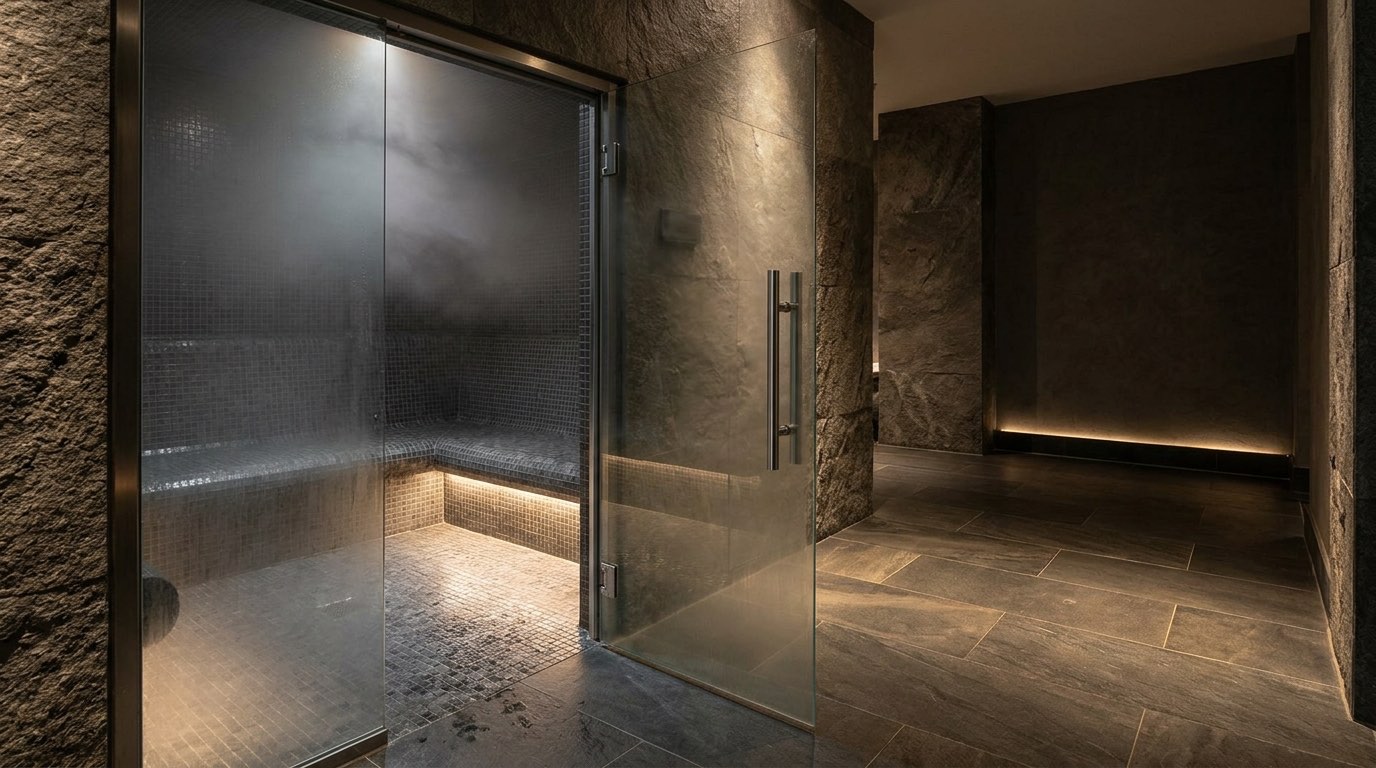
Short answer: a steam room door is usually clear tempered safety glass, it opens outward so a guest can push it to leave, and it is held shut by a simple roller catch or a magnetic strip rather than a lock. Its seals keep steam in a room running at 40–50 °C and close to 100 % relative humidity, and the gap under it is part of the room's air path. Sauna Dekor Spa Solutions builds steam rooms for hotels and villas; this is how we specify the door.
Updated: 23 October 2026
The door is the one part of a steam room that guests touch every time they use it, and the one part that moves. It has to hold steam in, let a tired guest out without effort, survive daily wet cleaning and still close properly after thousands of cycles. A door chosen from a bathroom catalogue rarely does all of that.
What glass should a steam room door be made of?
Tempered safety glass, and usually clear. The Global Wellness Institute's hydrothermal guide calls for tempered safety glass doors in clear glass so the room can be seen into, with stainless steel handles. Steam door ranges from makers such as Tylö are built the same way, in clear or tinted tempered glass, and Tylö's wide 101 G door hangs on 4 hinges.
Tempered glass is heat-treated so that it is much stronger than ordinary glass and, if it breaks, falls into small blunt pieces rather than shards. That matters in a wet room where people walk barefoot. Its weak point is the edge: the door maker Andres warns that the edges and corners of tempered glass must not hit a hard surface, because even a small knock there can break the whole pane. On site, that means protecting the door until handover and setting the hinges so the leaf never swings into tile or stone.
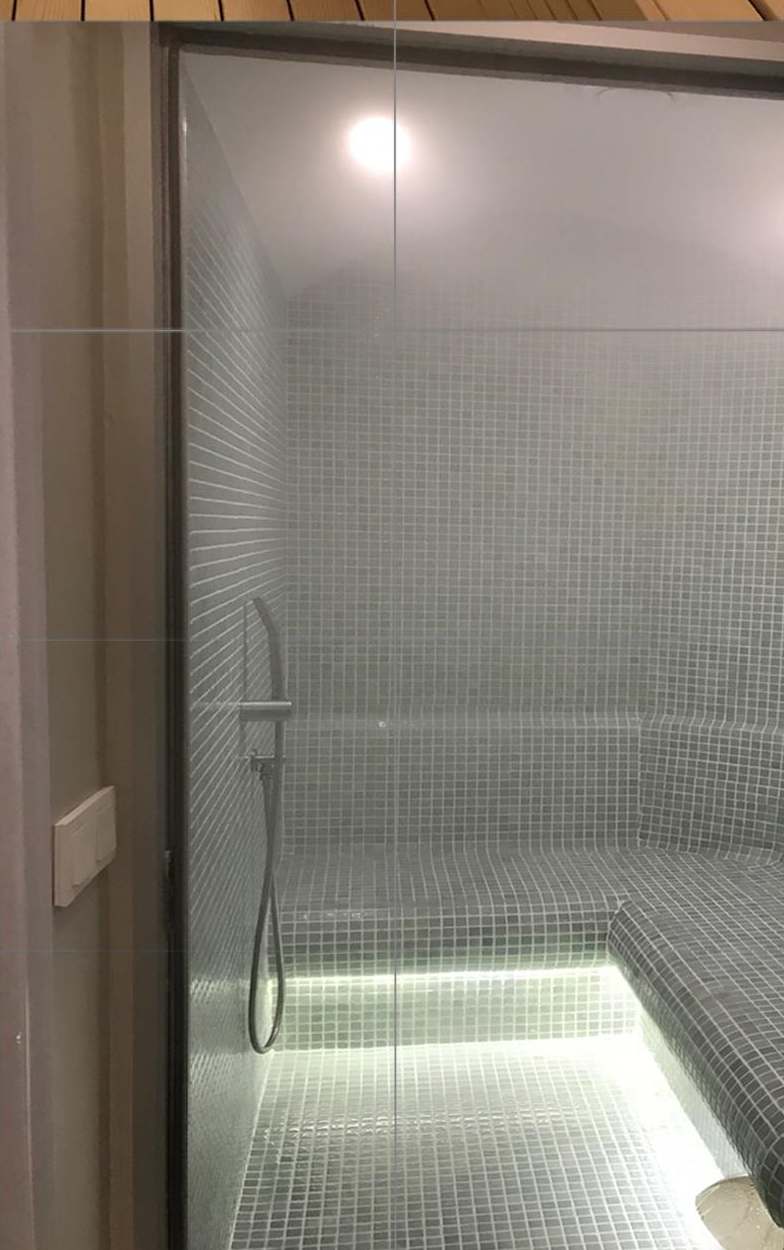
Clear glass also helps the operator. A full glass front lets staff check the room without opening it, which keeps steam in and lets them see a guest who is unwell.
Why does a steam room door open outward?
So that a guest can leave by pushing, not pulling. The GWI guide says steam room doors should push open for easy exit and be held closed by a simple roller catch. A guest who feels faint needs 1 movement to get out, and an outward door cannot be blocked by someone sitting or lying against it inside.
Outward swing changes the corridor as well. The leaf needs clear floor space outside, away from loungers, shower doors and the path of other guests. In a villa, we check that the swing does not clash with a vanity, a towel rail or the door of the shower next to it. In a hotel spa, we also check the swing against the route a guest in wet slippers takes from the steam room to the cold shower.
What holds a steam room door shut: a lock, a catch or a magnet?
A catch or a magnet, never a lock. The GWI guide names a simple roller-catcher mechanism, and Tylö's 60 G steam door closes with a magnetic strip. Both hold the door against a light draught and release with a firm push from either side. The guide lists "wrong closing mechanisms" among common steam room mistakes.
| Closing method | How it works | What to check on a steam room door |
|---|---|---|
| Roller catch | A spring-loaded roller clicks into a keeper | Stainless parts; catch force light enough for a guest to push open |
| Magnetic strip | Magnets in the frame pull the leaf shut | Strip sealed against water; door closes fully without slamming |
| Self-closing hinge | The hinge returns the door to the frame | Rated for wet rooms; does not stop short and leave the door ajar |
| Key or bolt lock | Locks the door | Not used on a steam room door |
Handles follow the same logic: stainless steel, a long pull outside, a push face or plate inside, and nothing on the inside that a guest could not operate with wet hands.
What do the seals around a steam room door do?
They stop steam leaking out at the sides and top of the leaf, where it would condense on the corridor ceiling and walls. Seals on steam doors are flexible strips fixed to the frame or the glass edge. Andres, which makes steam bath doors, asks owners to check glass mounting strips and seals periodically so they do not work loose.
A seal is a wearing part. Cleaning chemicals, heat and the constant movement of the door all age it, and a seal that has shrunk or come away leaves a line of escaping steam. We list the seals in the spare parts for the room, so the operator can change them without waiting for a full door. Andres also notes that acidic and alkaline cleaning agents are not permitted on its glass, so the cleaning schedule should name a product that suits both the glass and the seals.
How big should the gap under a steam room door be?
There is no single figure: the gap is set by the door maker's design and by the air path of the room. On Andres steam bath doors, the glass is 30 mm shorter than the frame, and the frame is 15 mm narrower than the opening it fits. The space under the leaf is therefore designed in, not left by accident.
The gap and the room's ventilation work together. The GWI guide describes fresh air coming in with the steam and an air outlet in the roof removing warm air, which keeps steam supply and temperature control stable. If the gap under the door is closed off by a raised threshold or a thick mat, or opened too wide by a badly hung leaf, the balance changes. We set the door, the steam inlet and the extract as one design, following the steam generator maker's instructions for the room.
Some steam doors are made without a threshold, so wheelchair users can roll in. Tylö offers thresholdless steam doors for that reason. A level entrance then needs the floor inside to fall away from the door, so water stays in the room.
What happens outside the steam room door?
Steam escapes every time the door opens, so the corridor needs a plan for it. The GWI guide recommends an exhaust duct directly above the outside of the steam room door to catch that steam. Without it, the corridor ceiling, light fittings and paint take the moisture, and in a Gulf villa the cold supply air makes it condense faster.
The floor outside the door matters too. Guests step out wet, so the finish in front of the door should be slip resistant when wet and should drain or be wiped easily. In our projects the corridor finish, the extract grille above the door and the steam room's own drain are drawn on the same plan, so the trades install them in the right order.
How is a steam room door maintained?
With a short routine that covers 4 things: glass, seals, hinges and the catch. Andres recommends adjusting the hinges and lubricating moving parts, tightening the fixings of handles and locks from time to time, and checking glass strips and seals. A door that drops on its hinges stops sealing and starts rubbing.
- Glass: cleaned with a product suitable for the glass, a soft cloth and no abrasive powders.
- Seals: checked for gaps, shrinkage and loose ends; replaced from spare stock.
- Hinges: checked for drop and adjusted so the leaf meets the seal evenly.
- Catch or magnet: tested so the door closes fully and still opens with a light push.
Our page on the steam generator covers the equipment the door has to work with, and our note on steam room cost for homes and commercial builds in the UAE lists what goes into a full room. If you are still deciding between rooms, sauna vs steam room compares the two; a sauna door is a different product, built for dry heat. One of our hotel steam rooms is shown in the Oran Hotel project.
Who is writing this
Sauna Dekor Spa Solutions has designed and built steam rooms, saunas, hammams and pools since 1987: 40 years of manufacturing in our own facility in Istanbul, with 19 employees, 5,000+ projects and work delivered in 35+ countries. Our quality system is certified to TS EN ISO 9001:2015 (certificate no 202025106, EKOL Belgelendirme, valid to 19.06.2027).
We build the steam room, its structure, tiling and bench, and we fit the door and set the air path. We do not manufacture steam generators: the generator is a specialist maker's product and carries that manufacturer's own certification. Warranty: 24-month warranty on workmanship and manufacturing; 24-month manufacturer's warranty on electrical and mechanical equipment; 5-year warranty on structure and waterproofing. Contact: +90 532 215 64 78.
Frequently asked questions about steam room doors
Can a steam room have a wooden door?
Wood swells and moves in a room close to 100 % humidity, which makes the door stick and the seals fail. Steam rooms almost always use tempered safety glass doors with metal hardware; wooden doors belong to saunas, which run dry.
Should a steam room door open inward or outward?
Outward. A guest leaving the room should be able to push the door open in 1 movement, and someone sitting against the inside cannot block an outward door. The GWI hydrothermal guide says steam room doors should push open for easy exit.
Do steam room doors have locks?
No. A steam room door is held shut by a roller catch or a magnetic strip that releases with a light push from either side. A lock or bolt would stop a guest leaving quickly and has no place on a room that hot and humid.
Why is there a gap under a steam room door?
The gap is part of the door maker's design and of the room's air path. On Andres steam bath doors, for example, the glass is 30 mm shorter than the frame. Closing the gap with a threshold or mat changes how air and steam move in the room.
How often should steam room door seals be replaced?
When they shrink, harden or come loose, which depends on use and cleaning products. Check them at every routine service, keep spare seals for the door on site, and replace them before steam starts marking the corridor ceiling.
Can a steam room door be frosted or tinted?
Yes, tinted and frosted tempered glass are both available, but clear glass lets staff see into the room without opening it. In a hotel spa we usually keep at least part of the door or front clear for that reason.
Sources
- Guide to Hydrothermal Spa & Wellness Development Standards (2024) — Global Wellness Institute. Steam room doors in clear tempered safety glass, push-open exit, roller-catch closing, exhaust above the door, common steam room mistakes.
- Tylö sauna and steam catalogue 2026 — Tylö. Steam doors in tempered safety glass, magnetic strip closure, thresholdless models.
- Steam bath and wet room door sizes — Andres Glass Solutions. Frame, opening and glass dimensions of steam bath doors.
- Use and maintenance instructions — Andres Glass Solutions. Care of tempered glass edges, seals, hinges and cleaning agents.
- Tempered glass — Wikipedia. How toughened glass is made and how it breaks.
- Door closer — Wikipedia. Mechanisms that return a door to its frame.


Yorumlar
Yorum Gönder