Steam Generator Not Working? Seven Causes and Checks
Short answer: A steam generator not working, or running without producing steam, usually has 1 of 7 causes: no water reaching it, water outside the conductivity range of an electrode unit, scale, a drain valve stuck open or blocked, controls or sensor, the electrical supply, or a steam line that traps water. Most can be narrowed down in the plant room before any part is changed.
Updated: 5 October 2026
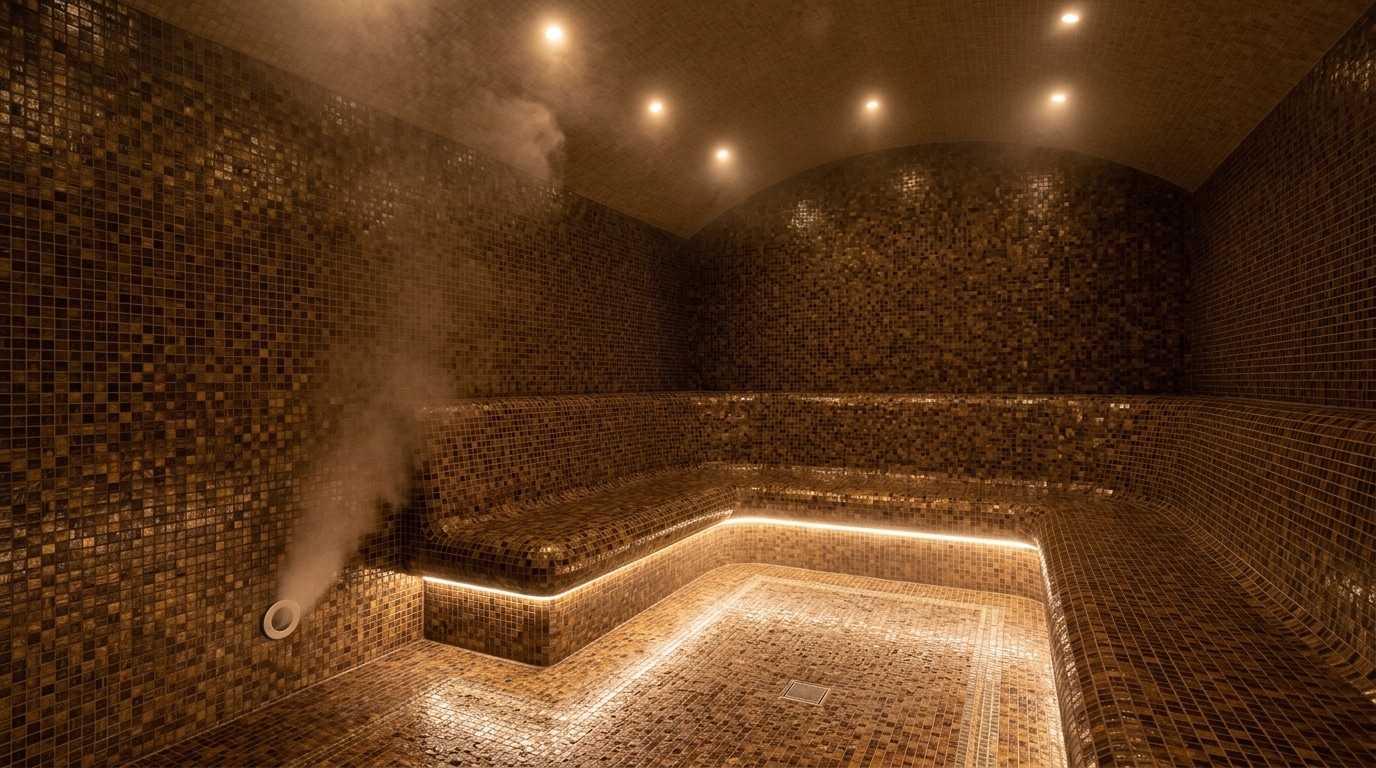
A steam room is designed to run at 40–50 °C and close to 100 % relative humidity, and the steam generator is what holds it there. When the room stays dry and cool, guests notice within minutes; the fault itself usually sits in a plant room a few metres away.
This note lists the 7 causes in the order they are usually checked on a service visit, from water to steam line. The generator's own manual always takes precedence: fault codes, reset procedures and safety checks differ between manufacturers and models, and electrical work belongs to a qualified technician.
Is water reaching the steam generator?
Check that first, because it is the most common and the simplest. A closed isolation valve, a blocked inlet strainer, low supply pressure or a failed fill solenoid valve all leave the cylinder empty. The generator may still show power and even call for steam, but with 0 water in the cylinder it cannot boil any.
Many generators report a water supply fault on their display. Where they do not, the check is to watch the fill during a start: the solenoid should open and water should be heard entering.
In villas with roof tanks, the supply pressure can fall at peak times of day. A generator that works in the morning and fails in the evening points to pressure before anything else.
Does the water suit the type of generator?
It matters for electrode generators. An electrode unit, such as the Condair Sigma or the Nordmann AT4D, passes current through the water itself, so its output depends on the water's conductivity. Very pure or fully demineralised water carries too little current, and the unit struggles to reach its rated 4 to 65 kg/h.
Resistive generators work differently. They heat the water with elements, and Condair describes its resistive Omega as producing steam regardless of water quality, between 2 and 20 kg an hour.
That difference is decided at design stage. A project on a water treatment system that produces very pure water should use the generator type its manufacturer recommends for that water.
Is scale blocking the cylinder or the elements?
In hard-water regions such as the Gulf, often. Calcium and magnesium in the water are left behind as steam leaves, and the scale builds on electrodes, elements and cylinder walls. An electrode cylinder loses output as its electrodes are covered, and the unit eventually signals that the cylinder needs replacing after a number of operating hours.
Resistive units scale too, but on their elements and in their tank. Their manuals set cleaning intervals, and many have automatic flushing to slow the build-up.
A water softener upstream reduces scale on resistive units. For electrode units, the manufacturer states whether softened water is allowed, because it changes the conductivity the unit depends on.
Is the drain valve stuck open or blocked?
Either fault stops steam. Generators drain part of their water at intervals to control the mineral content. A drain valve stuck open empties the cylinder as fast as it fills, so water runs to the drain and 0 steam reaches the room; a blocked drain lets the level rise until the unit shuts down on high water.
The check is to look at the drain outlet during operation. Water running continuously while the generator is heating points to a valve that will not close.
The drain line itself needs a fall and an air gap to the building drain. A drain that backs up into the generator produces the same symptoms as a blocked valve.
Are the controls and sensor calling for steam?
Sometimes the generator is fine and simply not being asked to run. A room sensor placed near the steam outlet reads high and switches the unit off early; a sensor in the wrong room or a timer set outside opening hours keeps it off. The check takes about 5 minutes with the control panel and a separate thermometer.
The sensor position is set by the generator manufacturer's installation manual, usually on a wall away from the steam outlet and at a stated height above the floor.
Control panels also hold settings that change after a power cut, such as the clock and the schedule. A generator that stopped after a power interruption points here.
Is the electrical supply complete?
A generator that powers up but produces little steam may be missing 1 phase of a 3-phase supply, or a contactor may have failed. Output then falls in proportion, and some units report a fault while others simply heat more slowly. A current reading on each phase against the rating plate answers the question.
Safety cut-outs belong in the same check. An over-temperature or high-level safety device that has tripped keeps the heating off until it is reset, and the manual explains why it tripped before it is reset.
Supply faults are the reason the generator is placed where a technician can reach it easily, in a ventilated plant room close to the steam room.
Is steam reaching the room, or condensing on the way?
Check the steam line. A hose or pipe that sags between the generator and the room collects condensate in the low point, and that water pocket blocks the steam. The line should fall continuously towards the room or back to the generator, as the manual shows, and runs are kept short, often a few metres.
A blocked steam outlet in the room gives the same result. Outlets are cleaned of scale and checked that nothing, such as a bench or a towel shelf, has been placed in front of them.
Condair's Omega, for comparison, produces steam in under 4 minutes from ambient temperature in its maker's description. A room that stays dry long after the generator has been heating points to the line rather than the unit.
Steam generator not working: how do the 7 causes compare by symptom?
The symptom usually points to 1 or 2 causes before any tools come out. The table lists what the room and the generator show for each cause, and the first check that separates it from the others, so that the service visit starts in the right place.
| Cause | What you see | First check |
|---|---|---|
| No water supply | Unit on, cylinder empty, supply fault | Isolation valve, strainer, pressure, fill solenoid |
| Water conductivity | Electrode unit slow to reach output | Water treatment against the manufacturer's range |
| Scale | Output falling over weeks | Cylinder or elements against the maintenance interval |
| Drain stuck open or blocked | Water running to drain, or high-level shutdown | Drain outlet during operation |
| Controls and sensor | Unit idle while the room is cool | Setpoint, schedule, sensor position |
| Electrical supply | Unit on, output low, or no heating at all | Current on each phase, safety cut-outs |
| Steam line | Unit heating, room stays dry | Line fall, water pockets, outlet |
Who is writing this
Sauna Dekor Spa Solutions has manufactured and built steam rooms, hammams and saunas from its own facility in İkitelli OSB, Istanbul, since 1987: 40 years of manufacturing, a team of 19 employees, work under TS EN ISO 9001:2015, 5,000+ projects in 35+ countries and 731 named references. This article was reviewed by our Managing Director.
We give a 24-month warranty on workmanship and manufacturing; electrical and mechanical equipment carries a 24-month manufacturer's warranty; and we give a 5-year warranty on structure and waterproofing.
Steam generators are not our products. They come from manufacturers such as Condair and EOS, and any CE marking or EN 60335 conformity of that equipment belongs to its manufacturer rather than to us.
Our steam generator page covers selection and sizing, our note on steam room cost in the UAE includes the plant room in the budget, and our comparison of sauna vs steam room explains how the two hot rooms differ.
Frequently asked questions about a steam generator not working
Why is my steam generator not producing steam?
Usually 1 of 7 causes: no water reaching it, water outside an electrode unit's conductivity range, scale, a drain valve stuck open or blocked, controls or sensor, the electrical supply, or a steam line that traps water. Check water and drain first.
How does hard water affect a steam generator?
Minerals stay behind as steam leaves, so scale builds on electrodes, elements and cylinder walls. Output falls over weeks until the cylinder is replaced or the elements cleaned, at intervals set in the manufacturer's manual.
What is the difference between electrode and resistive steam generators?
An electrode unit passes current through the water, so its output depends on conductivity. A resistive unit heats the water with elements; Condair describes its resistive Omega as producing steam regardless of water quality.
Why does water keep running to the drain from my steam generator?
A drain valve stuck open empties the cylinder as fast as it fills, so no steam reaches the room. Water running continuously from the drain outlet while the unit is heating points to that valve.
How hot should a steam room be?
We design steam rooms for 40–50 °C at close to 100 % relative humidity. A room that stays well below that range, or stays dry, points to one of the 7 causes above.
Sources
- Condair steam bath generators — Condair. Sigma electrode generator from 4 to 65 kg/h in 7 power levels, resistive Omega from 2 to 20 kg/h with steam in under 4 minutes regardless of water quality, and the Nordmann AT4D electrode generator from 5 to 65 kg/h. The data belong to Condair.
- Electrode boiler — Wikipedia, 2026. How current flowing through water produces steam, and why conductivity sets the output.
- Hard water — Wikipedia, 2026. Calcium and magnesium in water and the scale they leave on heated surfaces.
- Limescale — Wikipedia, 2026. Deposits formed when hard water is heated or evaporated.
- Solenoid valve — Wikipedia, 2026. The electrically operated valve used to fill and drain the generator.


Yorumlar
Yorum Gönder