Jacuzzi on a Villa Roof: Weight, Plant and Shade
Short answer: a jacuzzi on a villa roof is a structural decision before it is a design one. A filled tub with 6 bathers can put roughly 470 kg on every square metre under it, so a structural engineer checks the slab first. Then come the plant position, the drainage and overflow route, the waterproofing under the tub and shade from the Gulf sun. Sauna Dekor Spa Solutions builds jacuzzis and pools for villas; this note sets out the checks in the order we make them.
Updated: 8 October 2026
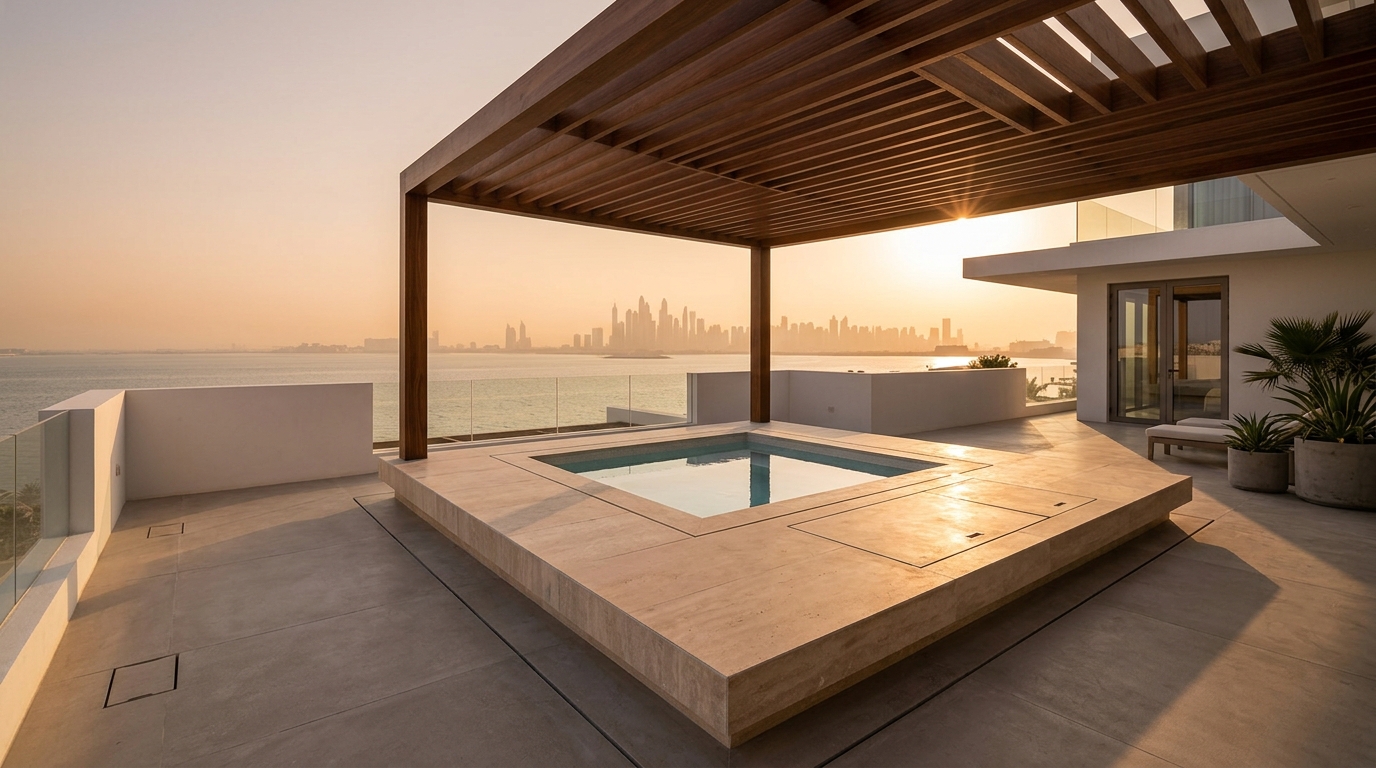
Roof terraces are where many villas in Dubai, Doha and Riyadh have their open space, so the roof is often the first place an owner pictures a jacuzzi. The idea is sound. What makes it work is treating the tub as a heavy, wet, mechanical load on a waterproofed slab, sitting in strong sun, rather than as a piece of furniture.
How much does a filled jacuzzi weigh on a roof?
About 2.3 tonnes in our example. Water weighs about 1 kg per litre, so a tub holding 1,400 litres carries 1,400 kg of water. Add an assumed 400 kg for the dry shell and frame and 6 bathers at 80 kg each, and the total is about 2,280 kg on the slab.
Every figure except the water is an assumption for illustration, and the maker's specification sheet replaces it on a real project. Dry weights vary widely between a moulded acrylic tub and a tiled concrete one, and the seat count sets how many bathers to allow for. The water does not vary: its density is a physical constant to within a few percent, so the litre figure on the specification sheet is, in practice, the kilogram figure.
| Item (example jacuzzi, 2.2 × 2.2 m) | Assumption | Load |
|---|---|---|
| Water | 1,400 litres at about 1 kg per litre | about 1,400 kg |
| Shell, frame and fittings, dry | maker's dry weight; 400 kg assumed | about 400 kg |
| Bathers | 6 seats × 80 kg | about 480 kg |
| Total on the footprint | 4.84 m² | about 2,280 kg, or about 470 kg/m² |
| Concrete plinth, if one is cast | 100 mm at about 2,400 kg/m³ | add about 240 kg/m² |
Can a villa roof carry a jacuzzi?
Only a structural engineer can say, and the answer is often yes with conditions. Our example puts about 470 kg/m², or roughly 4.6 kN/m², on its 4.84 m² footprint. The engineer compares that, plus any plinth and finishes, with the imposed load the roof slab was designed for, shown on the structural drawings.
Where the design load is lower, the usual answers are to place the tub over a beam or column line, to spread the load with a designed base, or to choose a smaller tub. The engineer also looks at point loads under the tub's feet or frame, because the load is not spread evenly across the footprint, and at the path the load takes down through the building. We do not size structure; we give the engineer the filled weight, the footprint and the support points, and we build to the base the engineer designs and signs off.
Where does the jacuzzi plant go on a roof terrace?
Within a few metres of the tub, in a ventilated, accessible position. The plant is at least 3 items: a circulation pump, a filter and a heater, plus a blower on many tubs. A self-contained tub keeps them inside its skirt; a built-in tub needs a separate plant cupboard or room nearby.
Short pipe runs keep the pump working less hard and keep the volume of water in the pipework down. The plant needs a service clearance on the side the panels open, which the equipment manuals set, and a dedicated electrical supply designed by the electrical engineer. On a roof, the cupboard also needs ventilation, because pumps and heaters give off heat, and the cupboard itself sits in the sun.
Noise is the item most often missed. A pump or blower bolted to a roof slab sends vibration into the room below, which on a villa is usually a bedroom. Anti-vibration mounts under the plant and flexible connections in the pipework stop most of it, and placing the plant cupboard over a corridor or a bathroom rather than a bedroom stops more.
How do you drain and empty a jacuzzi on a roof?
By planning 3 water routes: overflow, emptying and rain. When 6 bathers of about 80 kg step in, they displace roughly 480 litres, because a body is close to the density of water. That water has to go somewhere: into a skimmer and balance tank, into an overflow channel, or over the edge.
A self-contained tub is filled below its rim to allow for that displacement. A built-in tub with an overflow edge needs a balance tank sized for it, and the balance tank is one more filled weight for the structural engineer. Emptying is the larger flow: our example holds 1,400 litres, and the route for it, its rate and whether it may go to a foul drain or not are set by the building's drainage design and the local authority, not by the roof outlets. Rain still needs its own path to the roof outlets around the tub, which leads to the waterproofing.
What waterproofing does a roof need under a jacuzzi?
A continuous roof membrane under the tub, not interrupted by it. The membrane runs beneath the tub and any plinth, turns up at upstands typically about 150 mm high, and keeps its falls to the roof outlets. Fixings for the tub, the deck or a shade structure are designed so that none of them punctures it.
On a villa roof the waterproofing is already there, so the work is to protect it and to keep it continuous. A protection layer goes over the membrane before a plinth is cast or a tub is set down. Pipe and cable penetrations pass through sleeves sealed to the membrane, and the plant cupboard sits on the same waterproofed area rather than on a separate patch. The flat roof literature is clear that standing water is what finds a defect, so the area around the tub is laid to drain, and outlets are kept clear and accessible.
How strong is the sun on a jacuzzi in the Gulf?
Strong enough to plan shade from the start. On the WHO's Global Solar UV Index, 11 and above is the extreme band, and summer middays in the Gulf can reach it. Ultraviolet weathers acrylic, plastics, sealants and cover vinyl, and direct sun heats the shell surface and the deck around the tub.
Two things follow. The tub's exposed surfaces, its skirt and its cover should be specified for outdoor sun by their maker, and their warranty conditions read for UV. And bathers should not step onto a dark deck or rim that has stood in midday sun: pale finishes and shade keep both cooler to the touch. A cover that stays on when the tub is not in use shields the shell and the water surface from direct sun and from dust, which on a Gulf roof arrives every day.
Which kind of shade suits a rooftop jacuzzi?
A ventilated structure that the structural engineer has checked for wind. Any of 3 types works, a slatted timber or aluminium pergola, a fixed canopy or a retractable awning, as long as hot air can escape from under them. On a roof, wind is the governing load for the shade, not its weight.
A pergola on a roof is fixed through or onto a waterproofed slab and stands higher than anything around it, so its fixings and its wind design come from the engineer, and the waterproofing detail at each fixing comes from us or the roofing contractor. A retractable awning has to be retracted in high winds, which means someone has to do it, or a wind sensor has to. Orientation helps where cover is partial: shade on the west side cuts the hottest afternoon sun on the tub and on the deck.
What should an owner check before ordering a rooftop jacuzzi?
5 items, in order: the structural engineer's sign-off on the filled weight, the plant position and its access, the overflow and emptying routes, the waterproofing detail under and around the tub, and the shade and its wind design. Lifting access comes alongside: a tub that cannot reach the roof cannot be installed.
1. Structure. The engineer receives the filled weight, footprint and support points, and signs off the base.
2. Plant. Pump, filter, heater and blower within a few metres, ventilated, with service clearance and vibration isolation.
3. Water routes. Displacement and overflow, full emptying, and rain to the roof outlets, each with its own path.
4. Waterproofing. Continuous membrane, protection layer, sealed sleeves for penetrations, no fixings through it.
5. Sun and shade. UV-rated materials and cover, pale surfaces, a ventilated shade structure designed for wind.
6. Access. A crane or hoist route, or a tub that fits the stair and the lift, checked before the order.
If you are still choosing the type of tub, our note on what a jacuzzi is covers the jets, the pump and the shell, and our comparison of the hot tub and jacuzzi difference explains where the two terms overlap. For villas in the Emirates, our page on jacuzzi installation in Dubai sets out how we deliver indoor and outdoor tubs there.
Who is writing this
Sauna Dekor Spa Solutions has designed and built saunas, steam rooms, hammams, jacuzzis and pools since 1987: 40 years of manufacturing in our own facility at İkitelli OSB, Istanbul, with 19 employees, 5,000+ projects and work delivered in 35+ countries. Our quality system is certified to TS EN ISO 9001:2015 (certificate no 202025106, EKOL Belgelendirme, valid to 19.06.2027).
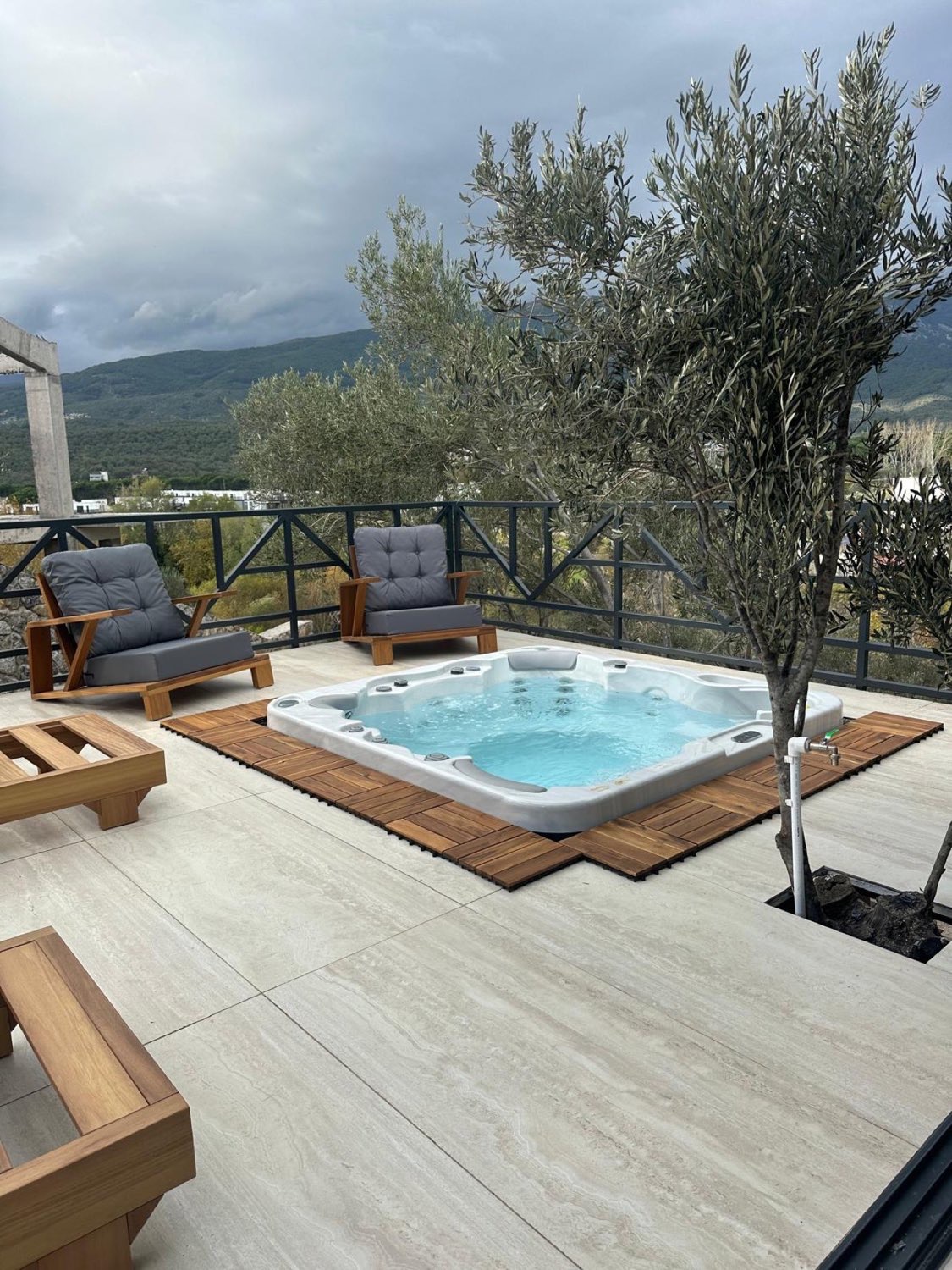
Our outdoor water work includes the terrace jacuzzi, sauna and cold plunge at a private forest retreat in the Kaz Mountains, Türkiye. We do not manufacture acrylic jacuzzi shells, pumps, heaters or blowers: each belongs to its maker, with that maker's certification. We are not structural engineers either; the structural sign-off belongs to the project's engineer. Warranty: 24-month warranty on workmanship and manufacturing; 24-month manufacturer's warranty on electrical and mechanical equipment; 5-year warranty on structure and waterproofing. Contact: +90 532 215 64 78.
Frequently asked questions about a jacuzzi on a villa roof
How heavy is a jacuzzi when it is full?
Mostly as heavy as its water, at about 1 kg per litre. A 1,400-litre tub with an assumed 400 kg dry weight and 6 bathers at 80 kg weighs about 2,280 kg. The maker's specification sheet gives the real figures for a given model.
Can I put a jacuzzi on any flat roof?
No. The roof slab has a design load, shown on the structural drawings, and a filled tub with bathers can exceed it several times over. A structural engineer checks the slab and designs any base or beam line before the tub is ordered.
Where should the pump and filter go on a roof terrace?
Within a few metres of the tub, in a ventilated cupboard with service access, on anti-vibration mounts. On a self-contained tub they sit inside its skirt. Avoid placing plant directly over a bedroom, because pump and blower vibration travels through the slab.
What happens to the water when people get in?
They push it up. 6 bathers of about 80 kg displace roughly 480 litres. A self-contained tub is filled below its rim to allow for that; a built-in tub with an overflow edge needs a balance tank sized for it.
Does a rooftop jacuzzi need a cover in the Gulf?
Yes. A cover kept on when the tub is not in use shields the shell and the water surface from direct sun, ultraviolet and daily dust. The cover material should be rated by its maker for outdoor sun.
Will the jacuzzi damage the roof waterproofing?
Not if the membrane runs continuously under the tub, is protected before anything is set on it, and is not pierced by fixings. Pipe and cable penetrations need sealed sleeves, and the area around the tub must drain to the roof outlets.
Sources
- Properties of water — Wikipedia. Density of water close to 1 kg per litre, the basis of the filled-weight figures.
- Structural load — Wikipedia. Dead loads, imposed (live) loads and how they are combined in structural design.
- Eurocode 1: Actions on structures — Wikipedia. EN 1991 parts on self-weight, imposed loads for buildings and wind actions, the framework the engineer's check sits in.
- Flat roof — Wikipedia. Drainage falls, blocked outlets and ponding water as the cause of flat roof failures, and UV degradation of roof materials.
- Hot tub — Wikipedia. Cast acrylic shells on a frame structure, seat counts and cover types.
- Global Solar UV Index: a practical guide — World Health Organization. The UV Index scale and its exposure categories.
- Ultraviolet index — Wikipedia. How the index is calculated and the 11+ extreme band.


Yorumlar
Yorum Gönder