Ice fountain in a hotel spa: water supply, drain and the ice machine room
Short answer: an ice fountain is the visible end of a small refrigeration and plumbing system. Behind the bowl sit 1 water feed, 1 flake ice machine that has to reject its heat somewhere, a way to move ice to the bowl, and 3 separate drains: the bowl's meltwater, the machine's own drain and the station floor. Sauna Dekor Spa Solutions builds ice fountains into hotel thermal suites; this note sets out what has to be planned behind the wall.
Updated: 12 October 2026
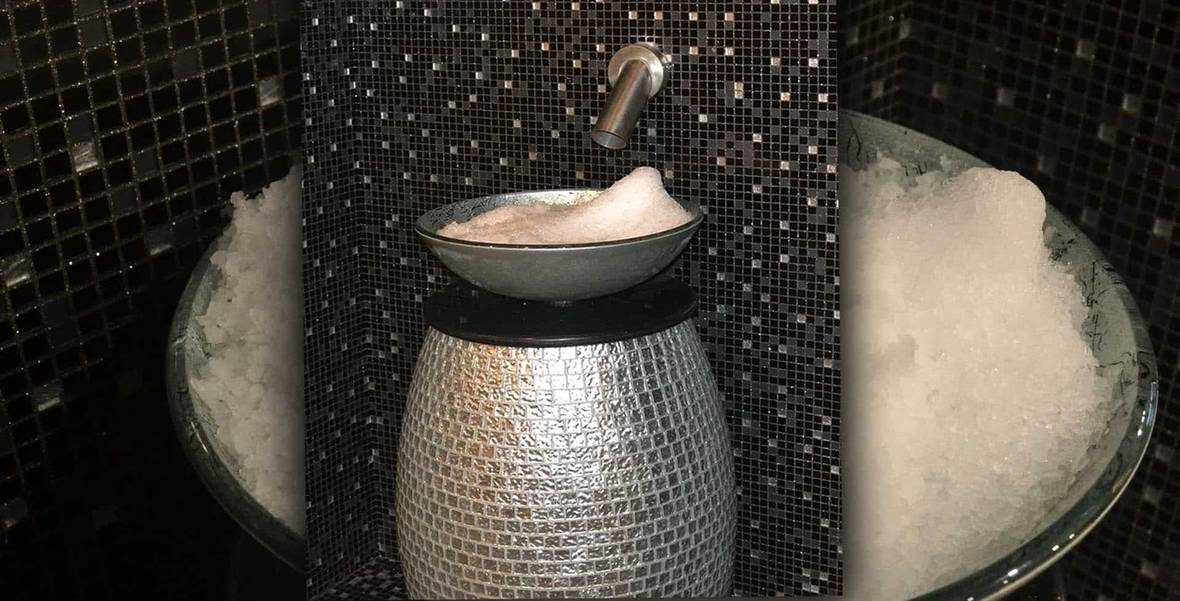
Guests see a bowl of flake ice in a niche of the thermal suite and take a handful between hot rooms. The station looks simple, and the pedestal and bowl are the easy part. What decides whether an ice fountain works every day is the chain behind it: clean water in, ice made and delivered, heat and meltwater taken away, and access for the technician who keeps the machine running.
What does an ice fountain need behind the wall?
5 things: a potable cold water feed, a flake ice machine, a route for ice from the machine to the bowl, drains for meltwater and machine water, and a dedicated electrical supply. The machine also needs air or water to carry its heat away, which decides where it can go.
| Element | What it does | Where it usually sits |
|---|---|---|
| Water feed with filter and backflow protection | Supplies the ice machine | Plant room or service void |
| Flake ice machine | Makes the ice | Plant room, ventilated, or above the station |
| Ice route: gravity chute or storage bin | Gets ice to the bowl | Directly above the bowl, or a bin filled by hand |
| Bowl drain | Takes meltwater from the bowl | Through the pedestal |
| Machine drain | Takes the machine's waste water | To an air gap or tundish |
| Station floor drain | Takes water dropped around the bowl | At the foot of the pedestal |
| Power and controls | Runs the machine | Dedicated circuit, isolator at the machine |
Each line is a separate trade item on the drawings. Missing any one of them is usually discovered only when the station is commissioned.
What water supply does the ice machine need?
Potable cold water, through 1 isolating valve, a filter chosen by the machine's maker and a backflow device or air gap so that machine water can never return to the drinking supply. Guests touch the ice and put it on their skin, so the feed comes from the drinking-water system, not from pool or recycled water.
Water quality affects the ice and the machine. Hard water leaves scale on the evaporator surface where the ice forms, and the maker's manual gives the limits and the filter or softener it expects. The feed pressure also has to sit within the maker's range. Like any cold water branch serving a fixture used intermittently, the pipe to the machine is kept short so that water does not stand warm in it, and the pipework is insulated where it passes through warm spaces such as the thermal suite's plant room.
Where does the flake ice machine go?
In a ventilated plant room or service space, as close to the bowl as the ice route allows. Wherever it goes, it needs 2 things: cool air or a cooling-water circuit for its condenser, and front access for service. It must never sit in a hot, humid space such as a steam room plant area without its own ventilation.
A flake ice machine is a refrigerator that freezes water on a cold drum or cylinder and scrapes it off as flakes. All the heat it removes from the water, plus the electricity it uses, leaves through its condenser. An air-cooled machine puts that heat into the room it stands in; a water-cooled one sends it into a water circuit. In a compact hotel plant room already holding steam generators and pool equipment, the machine's heat is added to the ventilation load, so the mechanical engineer counts it. The technician also needs space to open the front panel, clean the machine and change filters.
How much heat does the ice machine give off?
More than the ice suggests. Freezing water takes 334 kJ per kilogram, and cooling it first from 20 °C takes about 84 kJ more. In our example a station using 240 kg of ice a day removes about 100 MJ from water, close to 1.2 kW on average, before compressor losses.
| Example, stated as assumptions | Figure |
|---|---|
| Ice used per day, one station | 240 kg (10 kg bowl refill every 30 minutes over 12 hours) |
| Heat to remove per kg, water at 20 °C to ice | about 84 + 334 = 418 kJ |
| Heat removed per day | about 100 MJ |
| Average heat removal rate | about 1.2 kW |
| Heat rejected by the condenser | higher: the heat removed plus the machine's own electrical input |
The figures are an example to show scale, not a sizing. The machine's real output is given by its maker, usually in kilograms per 24 hours at stated water and air temperatures, and the output falls when the air around the machine is hot. That is why a machine placed in a warm, poorly ventilated cupboard delivers less ice than its label says.
How does the ice get from the machine to the bowl?
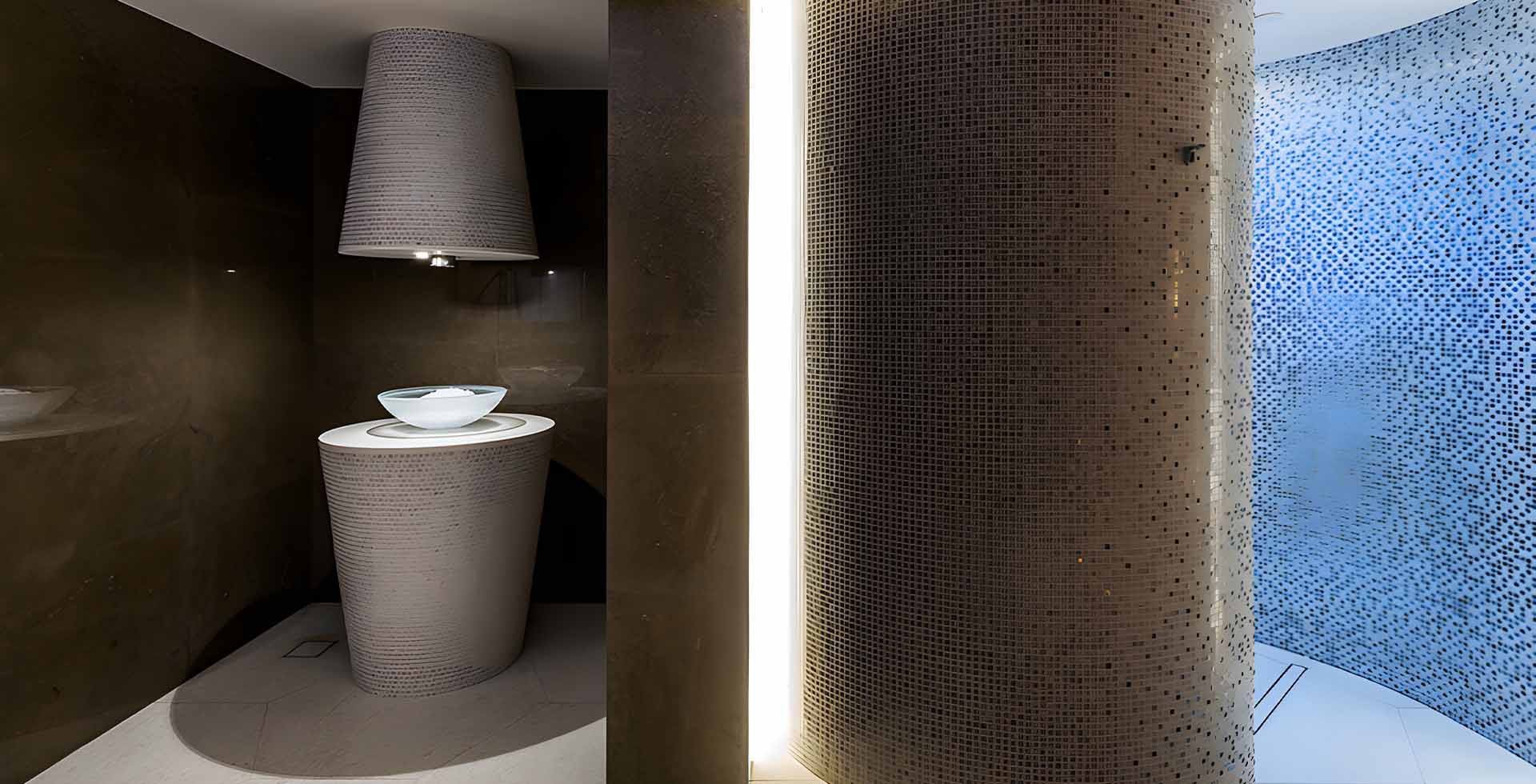
By 1 of 2 routes: a gravity chute from a machine mounted above the station, which drops fresh ice into the bowl on demand, or a storage bin in the plant room from which staff refill the bowl by hand. The chute needs the machine directly above; the bin needs a staff route and a routine.
The gravity arrangement is the tidier one for guests: ice arrives fresh and the bowl is never empty. It needs a service space above the station with access for maintenance, a sealed and insulated chute, and a ceiling detail that keeps the thermal suite's humid air out of that space. The hand-filled arrangement suits sites where the machine cannot sit above the bowl; it works when refilling is written into the attendants' schedule with clean, dedicated scoops and containers.
Which drains does an ice fountain need?
3, kept separate until they reach the building drainage. The bowl drain takes meltwater continuously, about 1 litre for every kilogram of ice; the machine drain takes its waste water; and a floor drain at the foot of the pedestal takes ice and water dropped by guests.
Each drain discharges through an air gap or a trapped connection so that drain air and water cannot come back into the bowl or the machine. The bowl drain runs through the pedestal with a fall all the way, because a cold, slow trickle that stands in a pipe is where slime and smells start. The floor around the station is laid to fall to its drain and finished in a slip-resistant surface, since dropped ice melts into a wet patch exactly where guests stand. Where the ice comes down a chute, the chute's own condensate is collected too.
What maintenance access does an ice fountain need?
Front access to the machine, 1 removable panel to reach the bowl drain and chute, and a cleaning routine set by the machine's maker. A machine that cannot be opened in place gets cleaned less often than its manual asks, and an ice station is a food-contact surface in everything but name.
The maker's manual gives the cleaning and sanitising interval for the machine and its water path, the filter change interval and the descaling routine. The spa's operator turns those into a schedule, and the plant room layout has to make them possible: a tap and a drain near the machine for cleaning, space to remove the panels and a clear route for the technician that does not pass through the guest areas of the thermal suite.
For the rest of the cold side of a thermal suite, our snow room page covers the refrigerated room itself, and our cold plunge selection guide covers chilled pools. Our guide to Roman thermal rooms shows where an ice station sits in a full warm-to-cold circuit.
Who is writing this
Sauna Dekor Spa Solutions has designed and built thermal suites, saunas, steam rooms, hammams and pools since 1987: 40 years of manufacturing in our own facility at İkitelli OSB, Istanbul, with 19 employees, 5,000+ projects and work delivered in 35+ countries. Our quality system is certified to TS EN ISO 9001:2015 (certificate no 202025106, EKOL Belgelendirme, valid to 19.06.2027).
Our ice fountain work includes a station in the wet area of a hotel spa in Doha, one at Gumush Residence in Baku and one in a branded residence tower in Istanbul. We build the pedestal, bowl, cladding, drains and chute and coordinate the plant. We do not manufacture ice machines: the machine, its refrigerant circuit and its certification belong to its maker. Warranty: 24-month warranty on workmanship and manufacturing; 24-month manufacturer's warranty on electrical and mechanical equipment; 5-year warranty on structure and waterproofing. Contact: +90 532 215 64 78.
Frequently asked questions about an ice fountain in a hotel spa
What kind of ice does an ice fountain use?
Flake ice: thin, soft, irregular pieces made by freezing water on a cold drum or cylinder and scraping it off. It is easy to pick up by hand and spreads on skin, unlike hard cubes. A dedicated flake ice machine makes it.
Does an ice fountain need a drain?
Yes, 3 of them: one through the pedestal for meltwater from the bowl, one for the ice machine's waste water, and a floor drain at the foot of the station. Each discharges through an air gap or trapped connection.
Where should the ice machine be installed?
In a ventilated plant room or service space close to the bowl, with front access for cleaning. It rejects heat while it runs, so it needs cool air or a water-cooled condenser, and its output falls in a hot, enclosed cupboard.
Can the ice machine sit above the ice fountain?
Yes, if there is an accessible service space above the station. A machine above the bowl can drop fresh ice down a sealed, insulated chute on demand. Otherwise ice is stored in a bin in the plant room and the bowl is refilled by hand.
How much water does an ice fountain use?
Roughly the weight of ice it delivers, since 1 kilogram of ice melts to about 1 litre of water, plus the machine's own waste water. Our worked example of 240 kg a day means about 240 litres of meltwater through the bowl drain.
Does an ice fountain need its own electrical circuit?
Yes. The ice machine gets a dedicated circuit sized to its rating, with an isolator next to it for servicing, designed by the electrical engineer under local rules. Lighting in the niche is separate and rated for a wet area.
Sources
- Flake ice — Wikipedia. How flake ice machines freeze water on a cold surface and scrape it off, and the properties of flake ice.
- Icemaker — Wikipedia. Commercial ice machines, their refrigeration cycle, water supply and condenser types.
- Enthalpy of fusion — Wikipedia. The latent heat of freezing water, about 334 kJ per kilogram, used in the worked example.
- Specific heat capacity — Wikipedia. The heat needed to cool water before it freezes, about 4.2 kJ per kilogram per kelvin.
- Air gap (plumbing) — Wikipedia. Why an appliance drain discharges across an open gap into the drainage system.
- Backflow prevention device — Wikipedia. How the drinking water supply is protected from water returning from an appliance.
- Installation and User's Manual, modular flake and nugget ice machines — Scotsman. Water filtration, the 1-inch air gap against backflow, vented drains and where air-cooled machines reject their heat.
- The Water Supply (Water Fittings) Regulations 1999 — UK Government. Schedule 2 sets the backflow prevention rules for fittings connected to the drinking-water supply.


Yorumlar
Yorum Gönder