Hot Tub Water: Bromine, Chlorine and Turnover
Short answer: a shared hot tub is a small pool with a very heavy bather load, and its water is held by 3 things: fast turnover through the filter, a continuous disinfectant residual and regular water replacement. UK guidance for spa pools (HSE HSG282) sets turnover at 6 to 15 minutes, free chlorine at 3–5 mg/l or bromine at 4–6 mg/l, and pH at 7.0–7.6. Sauna Dekor Spa Solutions builds hot tubs and spa pools for hotels and villas; this note explains those numbers.
Updated: 9 October 2026
A hot tub holds a small volume of warm, aerated water shared by several bathers at a time. Every one of those conditions makes water treatment harder: warm water and aeration use up disinfectant faster, a few bathers in a small volume add a lot of organic load, and spa pools are a recognised source of infection when they are poorly managed. The numbers below come from the UK Health and Safety Executive's guidance on spa-pool systems and apply to hot tubs used commercially, in hotels, clubs and rental villas.
What does turnover mean for a hot tub?
Turnover is the time it takes for the tub's whole volume to pass through the filter and treatment plant and back. HSE sets a maximum design turnover of 15 minutes for lower bather loads and 6 minutes for commercial spa pools with higher bather loads. A short turnover keeps clean, dosed water reaching every bather.
Turnover sets the pump and filter size. It is a design figure: once the tub is built, the pipework, filter and pump decide it, and it cannot be improved with chemicals. The table works it through for an example tub.
| Example hot tub | Turnover target | Flow needed through filter |
|---|---|---|
| 1,400 litres, lower bather load | 15 minutes | about 5,600 litres per hour |
| 1,400 litres, commercial bather load | 6 minutes | about 14,000 litres per hour |
| 3,000 litres, commercial bather load | 6 minutes | about 30,000 litres per hour |
The volumes are assumptions for illustration. The point is the jump between the 2 targets: a commercial tub needs 2.5 times the filtration flow of a lightly used one of the same size.
Should a hot tub use chlorine or bromine?
Either works; HSE gives a residual for both. At pH 7, free chlorine should be 3–5 mg/l or total active bromine 4–6 mg/l. Bromine is often chosen for hot tubs because many bromine products have little effect on pH, while hypochlorite and some stabilised chlorine products move pH and need correcting.
The choice is made with the incoming water supply in mind, since its chemistry affects which disinfectant and which pH adjuster are needed. Chlorine reacts with sweat and other organic matter to form combined chlorine, which disinfects slowly and causes the familiar chlorine smell; HSE treats less than 1 mg/l of combined chlorine as normally acceptable, and never more than half the free chlorine. A rising combined chlorine reading is a sign that the tub's bather load is outrunning its treatment.
Why does pH matter so much in a hot tub?
Because the disinfectant's effectiveness depends on it. HSE gives a pH range of 7.0–7.6 for spa pools. Heating the water drives off carbon dioxide, so pH tends to rise in a hot tub, and above the range chlorine loses much of its effect even when the residual reading looks correct.
That is why pH and disinfectant are read together, never one without the other. In practice, an automatic controller measures both and doses both: disinfectant to hold the residual, and an acid or alkali to hold the pH. The choice of pH adjuster follows the disinfectant: sodium and calcium hypochlorite raise pH and need an acid, some stabilised chlorine products lower it and need an alkali, and bromine products are close to neutral.
Can a hot tub be dosed by hand?
Not a commercial one. HSE expects spa-pool chemicals to be dosed continuously, with automatic control on high-bather-load tubs, and limits hand dosing to emergencies such as plant failure, or to shock treatment. 1 controller with probes for residual and pH, and dosing pumps, does the routine work.
Hand dosing fails for a simple reason: the bather load arrives in waves. A tub that is correct at opening can be short of disinfectant within an hour of a busy session, and nobody pours the right amount at the right moment. A controller reads continuously and doses in proportion. It still needs a person: HSE's checks for commercial spa pools include reading pH and residual disinfectant at opening and every 2 hours, and recording them.

How often should hot tub water be replaced?
By bather numbers, with a weekly floor. HSE says a commercial spa pool should be completely refilled at least when the bathers since the last refill reach 100 times its volume in cubic metres. Where a hot tub is used as a business activity, the whole volume is replaced each week, or after each group of users if sooner.
For our 1,400-litre example, 100 × 1.4 m³ gives 140 bathers. A hotel tub used by 30 guests a day reaches that in under 5 days, so in practice it is drained and refilled about twice a week; the 30 a day is an assumption for the example. HSE also uses total dissolved solids as a check: the tub's water should not rise more than 1,000 mg/l above the fill water. A drain and refill sized to empty the tub quickly, to a drain that can take the flow, makes this routine rather than a chore.
Which checks keep hot tub water in range day to day?
A short list, recorded every day: water clarity, pH and disinfectant residual at opening and through the day, the dosing system and its chemical stock, and cleaning of the waterline, overflow channels and surround. The filter is backwashed after the last user. Each of these 6 items is on HSE's routine schedule for commercial spa pools.
1. Clarity. Checked at opening and through the day; cloudy water closes the tub.
2. pH and residual. Read at opening and every 2 hours, and recorded.
3. Dosing system. Working, with chemical stock in date and sufficient.
4. Waterline and channels. Cleaned daily, where biofilm and scum build up first.
5. Filter. Backwashed after the last user of the day, never during use.
6. Records. Readings, refills and incidents logged, so trends show before problems do.
The weekly and longer tasks, from cleaning the balance tank to disinfecting the whole circulation system, follow HSE's schedule and the tub maker's manual.
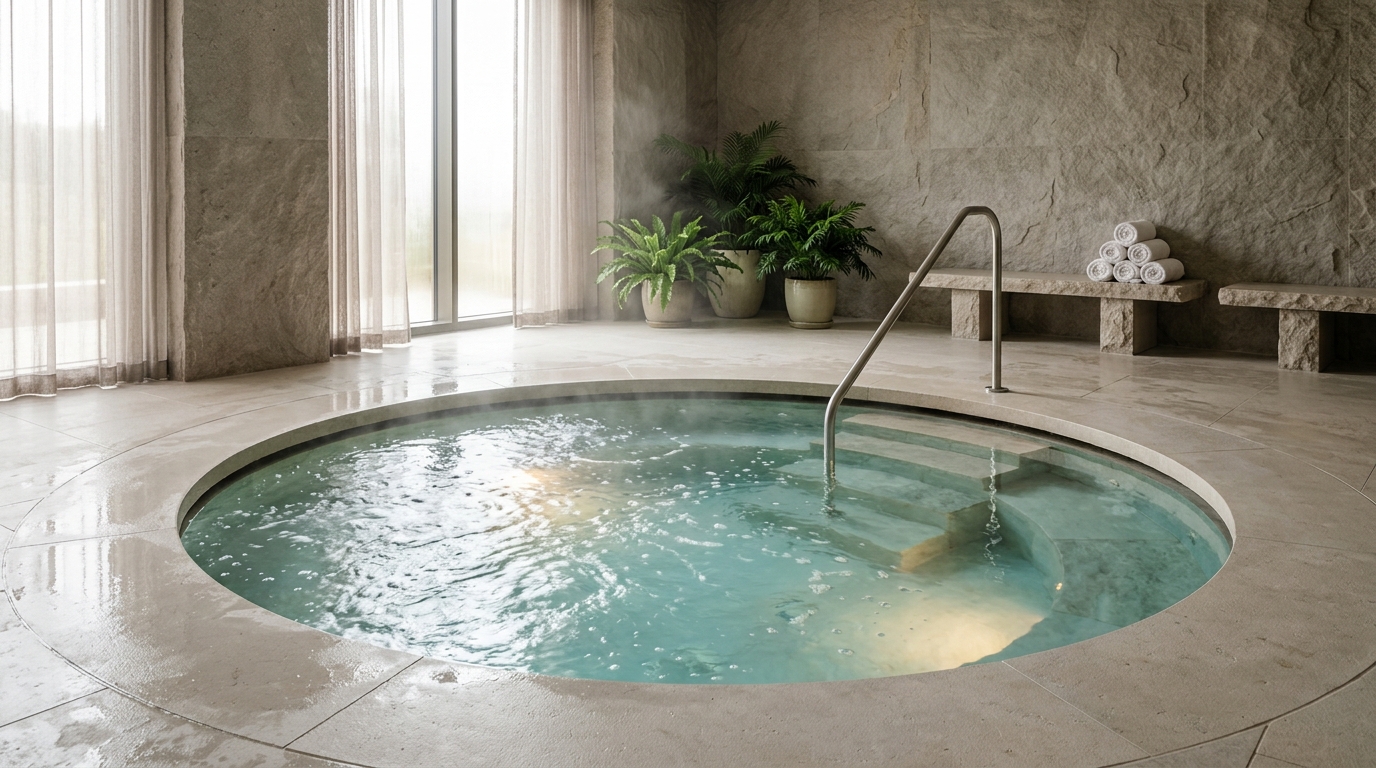
If you are choosing a tub, our comparison of the hot tub and jacuzzi difference explains the two terms, and our note on what a hot tub is used for covers the uses we design for. For villas and hotels in the Emirates, our page on jacuzzi installation in Dubai sets out how we deliver them, and the tub in the photograph is part of our Oran Hotel project in Istanbul.
Who is writing this
Sauna Dekor Spa Solutions has designed and built hot tubs, pools, saunas, steam rooms and hammams since 1987: 40 years of manufacturing in our own facility at İkitelli OSB, Istanbul, with 19 employees, 5,000+ projects and work delivered in 35+ countries. Our quality system is certified to TS EN ISO 9001:2015 (certificate no 202025106, EKOL Belgelendirme, valid to 19.06.2027).
We build tiled spa pools and install hot tubs with their filtration and dosing plant. We do not manufacture pumps, filters, dosing controllers or chemicals: each belongs to its maker, with that maker's certification, and the water-treatment regime is the operator's to run under local rules. Warranty: 24-month warranty on workmanship and manufacturing; 24-month manufacturer's warranty on electrical and mechanical equipment; 5-year warranty on structure and waterproofing. Contact: +90 532 215 64 78.
Frequently asked questions about hot tub water
What chlorine level should a hot tub have?
HSE's spa-pool guidance gives a free chlorine residual of 3–5 mg/l at pH 7, measured by the DPD1 method. Combined chlorine should be under 1 mg/l and never more than half of the free chlorine.
What bromine level should a hot tub have?
Total active bromine of 4–6 mg/l at pH 7, according to HSE's spa-pool guidance. Bromine products tend to be close to neutral, so they move pH less than many chlorine products do.
What pH should hot tub water be?
Between 7.0 and 7.6 for spa pools, according to HSE. Heating drives carbon dioxide out of the water, so pH tends to rise in a hot tub and is corrected with an acid adjuster through the dosing system.
How fast should a hot tub's water be filtered?
HSE's maximum design turnover is 15 minutes for lower bather loads and 6 minutes for commercial spa pools with higher loads. For a 1,400-litre tub at 6 minutes, that means about 14,000 litres an hour through the filter.
How often should a hotel hot tub be drained?
At least weekly, and sooner when the bathers since the last refill reach 100 times the volume in cubic metres. A 1,400-litre tub reaches that limit at 140 bathers, which a busy hotel tub can reach in a few days.
Is a hot tub the same as a jacuzzi?
In everyday use, mostly. Jacuzzi is a brand name that became a common word for a hot tub with jets. The water treatment rules are the same for both whenever the tub is shared by guests.
Sources
- Control of legionella and other infectious agents in spa-pool systems (HSG282) — Health and Safety Executive, UK. Turnover of 6 and 15 minutes, chlorine 3–5 mg/l and bromine 4–6 mg/l at pH 7, pH 7.0–7.6, combined chlorine, water replacement and the routine check schedule.
- Hot tub — Wikipedia. Hot tubs, jets, filtration and the word jacuzzi.
- Swimming pool sanitation — Wikipedia. Filtration with chlorine or bromine residuals, combined chlorine and pH control.
- Bromine — Wikipedia. The element and its use as a disinfectant in hot tubs.
- Legionella — Wikipedia. The bacterium behind the HSE guidance and why warm, aerated water needs control.
- Guidelines for safe recreational water environments, Volume 2: Swimming pools and similar environments — World Health Organization. Operator duties for water treatment and monitoring in pools and spa pools.


Yorumlar
Yorum Gönder