Gym sauna in a hotel fitness club: heater duty and cleaning cycle
Short answer: a gym sauna works far harder than a home sauna. It may heat for 12 to 16 hours a day, its door opens every few minutes, and dozens of guests use it after training. The heater must be rated for commercial use, the controls must give it at least 6 hours without power in every 24, and the cleaning cycle runs daily. Sauna Dekor Spa Solutions builds saunas for hotels and fitness clubs; this is how we plan the duty.
Updated: 20 October 2026
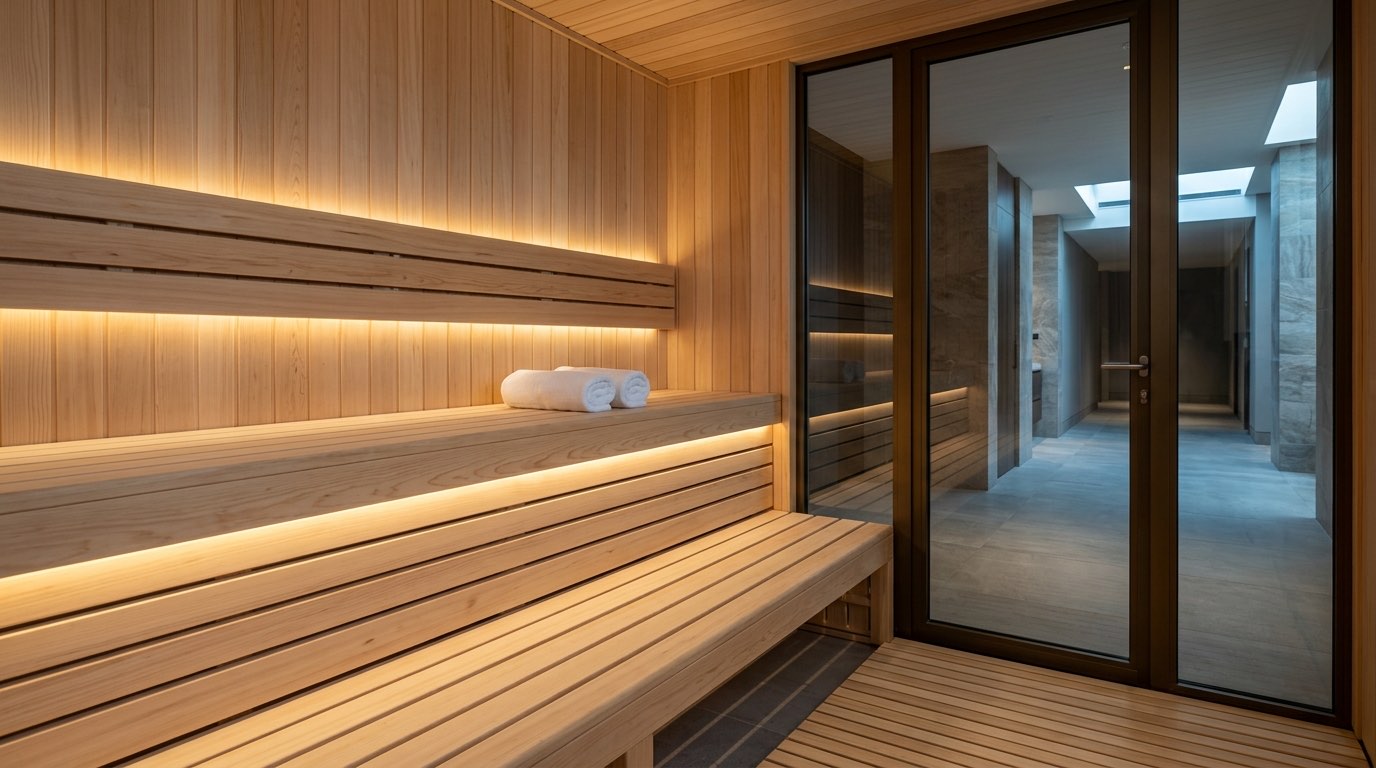
A sauna in a villa might run for an evening a few times a week. The same cabin in a hotel fitness club, or in a gym attached to a residential tower, runs from the first morning class to closing. That difference changes the heater, the controls, the stones, the cleaning plan and the spare parts list, even if the cabin looks the same.
Why is a gym sauna different from a home sauna?
Because of its duty. A home sauna runs a few hours at a time; a gym sauna may stay hot for 12 to 16 hours a day, every day. The Global Wellness Institute's hydrothermal guide lists buying a residential sauna for a commercial setting among common sauna mistakes, because such saunas are not designed to the same standard.
| Factor | Home sauna | Gym or hotel fitness sauna |
|---|---|---|
| Daily heating time | A few hours | Most of the opening day |
| Door openings | Few | Every few minutes at peak times |
| Users | A family | Members and hotel guests |
| Heater | Domestic or commercial rating | Commercial rating required |
| Stones | Checked once a year | Checked every 2–3 months |
| Cleaning | Weekly | Daily, with a deeper weekly clean |
The cabin itself is built the same way. What changes is the equipment inside it and the routine around it.
What does "rated for commercial use" mean for a sauna heater?
It means the manufacturer has declared the heater suitable for public or commercial saunas, in its manual. EOS, for example, states that its Cubo 2+ heater is intended for private and commercial sauna cabins. A heater sold for home use only is not, whatever its power, and may come with a built-in timer sized for domestic bathing.
The timer is a useful clue. On Harvia's The Wall heaters, which have a built-in timer, the heater runs for about 4 hours when switched on and then turns off. That suits an evening at home and would not suit a club open all day. We choose gym sauna heaters from ranges the manufacturer approves for commercial cabins, and we read the manual's operating rules before the control unit is specified. Our page on types of sauna heaters compares heater types.
How long can a commercial sauna heater run each day?
As long as its manual allows, and that always includes a rest period. The EOS manual says the operating time of a public sauna must be limited so that the heating elements are without power for at least 6 consecutive hours in every 24-hour period. A club open from 06:00 to 22:00 heats for 16 hours and rests for 8.
The same manual explains why the timer matters. All sauna heaters, except those in public saunas operated under staff supervision, must have a timer that fully disconnects the heater, mounted outside the cabin and not able to be overridden. A private sauna is limited to 6 hours of operation without automatic restart. In a gym, the control unit is programmed to the club's hours, and staff supervision is part of the operating plan, not an assumption.
How do constant door openings affect the heater?
Each time the door opens, hot air leaves and the heater has to make it back. At peak times, after a class, that can happen every minute. The heater output is chosen for the cabin volume and its glass, as the manufacturer's table sets out, and a busy gym sauna should not be specified at the bottom of that range.
We look at 3 things when a sauna will see heavy traffic:
- Door position. Where the door opens relative to the heater changes how much heat is lost each time.
- Glass area. Glass fronts and doors raise the heat load, and the heater table accounts for them.
- Seating pattern. Benches that guests reach quickly mean the door is open for less time.
The goal is a cabin that recovers between groups without the heater running at its limit all day. Specifying kW for a given cabin is covered in our commercial sauna specification note.
How often do sauna stones need attention in a gym?
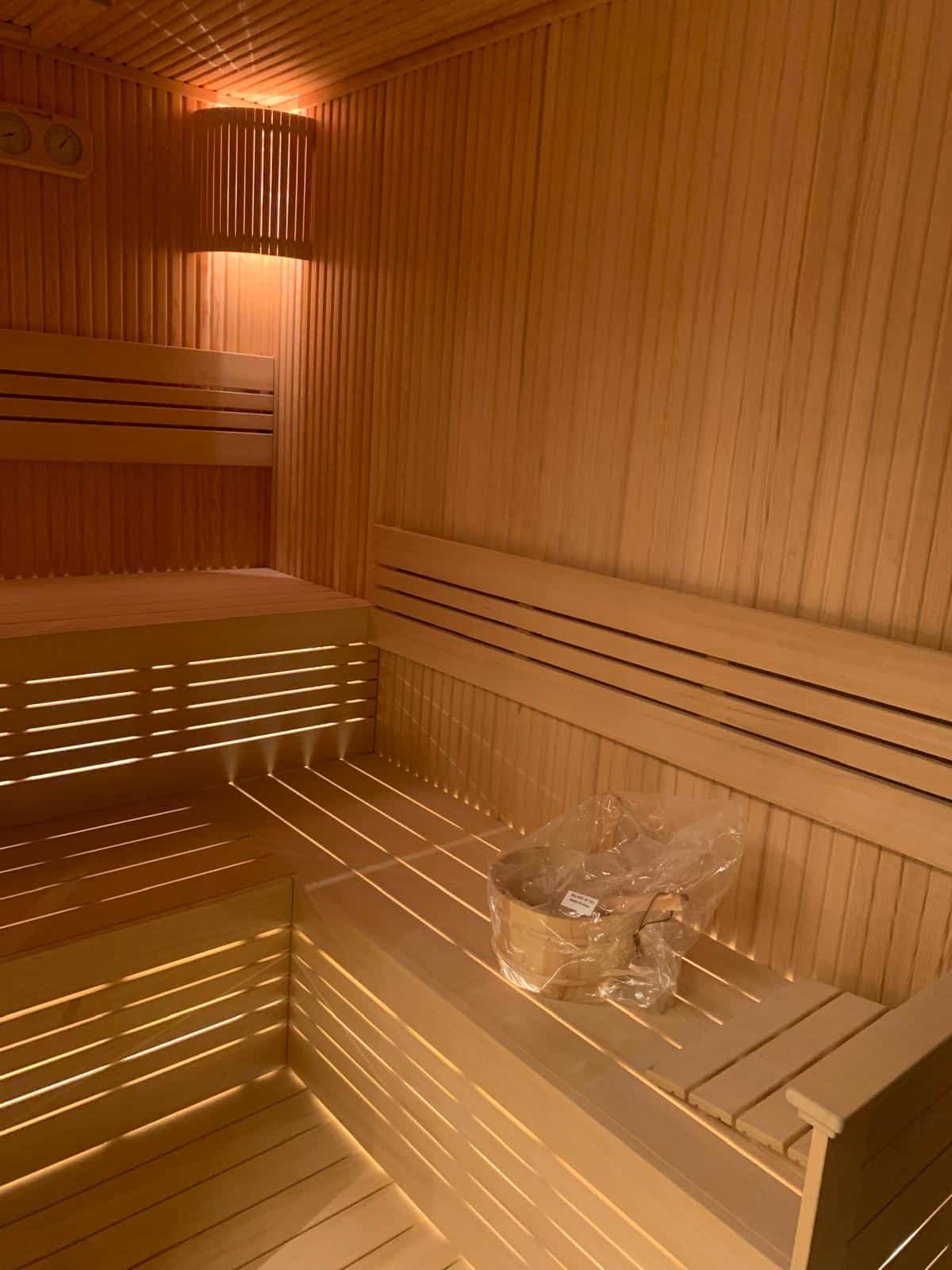
Every 2–3 months in commercial use, compared with once a year in a private sauna, according to the EOS manual. Heating and cooling make stones brittle, small pieces break off, and the gaps between stones close up, so hot air can no longer rise through them. The stones are taken out, rinsed, sorted and stacked loosely again.
The same manual asks for damaged stones to be replaced with natural sauna stones, and for the heater's air intake and heat reflectors to be kept free of lint and dust, which are drawn in with the fresh air. In a gym, where towels are used in large numbers, lint is a real load. A blocked intake limits convection and can lead to excessive temperatures, so the intake check belongs in the weekly routine.
What does a daily and weekly cleaning cycle look like?
Daily surface cleaning, weekly deeper cleaning, and a stone and heater check on its own schedule. The GWI guide describes cleaning sauna surfaces with soapy water and then cleaning the benches with 3 % hydrogen peroxide. It warns against commercial steam cleaners and pressure washers, which can damage grout and strip the wood's natural surface.
A simple plan we hand over to operators:
- Every day, after closing: heater off and cooled; benches, backrests and floor duckboards wiped with soapy water, then the benches with 3 % hydrogen peroxide; door glass and handle cleaned; cabin left open to dry.
- Every week: duckboards lifted and the floor beneath cleaned; heater air intake checked for lint and dust; lamps and sensors inspected.
- Every 2–3 months: stones taken out, checked, rinsed and restacked, with damaged stones replaced.
- As needed: low-pressure domestic steam cleaner for residual dirt and body oils, never a pressure washer.
Towel rules help as much as cleaning products. A towel on the bench under every guest keeps sweat off the timber, and a clear sign about it at the door does more than any chemical.
What should a gym operator keep in stock?
Spare stones, the heater's replacement elements, a spare temperature sensor, and lamp parts. The EOS manual describes replacing the tubular heating elements, so they are a normal service item, not a failure. Holding them on site turns a breakdown in a busy club into a short service visit.
For the wider fit-out of gym wet areas, see our page on the fitness and sport centre and the overview of the gym sauna.
Who is writing this
Sauna Dekor Spa Solutions has designed and built saunas, steam rooms, hammams and pools since 1987: 40 years of manufacturing in our own facility at İkitelli OSB, Istanbul, with 19 employees, 5,000+ projects and work delivered in 35+ countries. Our quality system is certified to TS EN ISO 9001:2015 (certificate no 202025106, EKOL Belgelendirme, valid to 19.06.2027).
We build the sauna cabin, its benches and lining, and we install the heater and control unit to their makers' instructions. We do not manufacture heaters or control units: each belongs to its maker, with that maker's certification and operating rules. Warranty: 24-month warranty on workmanship and manufacturing; 24-month manufacturer's warranty on electrical and mechanical equipment; 5-year warranty on structure and waterproofing. Contact: +90 532 215 64 78.
Frequently asked questions about a gym sauna
Can a home sauna heater be used in a gym?
Only if its manufacturer approves it for commercial or public saunas. Many home heaters are not, and some have timers that switch off after a few hours. Check the intended use stated in the heater manual before specifying it for a gym.
How many hours a day can a gym sauna stay on?
Its heater manual sets the limit. EOS, for example, requires a public sauna heater to be without power for at least 6 consecutive hours in every 24, so a club open 16 hours a day leaves 8 hours of rest.
How often should a gym sauna be cleaned?
Daily. Benches, backrests, floor boards, door and handle are cleaned after closing, the benches with 3 % hydrogen peroxide after soapy water, as the GWI guide describes. A deeper clean and heater intake check follow weekly.
Can a sauna be pressure washed?
No. The GWI hydrothermal guide warns that pressure washers and commercial steam cleaners can damage grout and strip the wood's natural surface. A low-pressure domestic steam cleaner can remove residual dirt before normal cleaning.
How often should sauna stones be changed in a gym?
EOS asks for stones in commercial saunas to be checked, rinsed and restacked every 2–3 months, with damaged stones replaced. In a private sauna the same manual asks for once a year.
Why does a gym sauna take longer to heat up after a busy hour?
Frequent door openings let hot air out, and a heater close to its limit recovers slowly. Lint blocking the heater's air intake has the same effect, so check the intake before assuming the heater is too small.
Sources
- EOS Cubo 2+ installation and operating instructions — EOS Saunatechnik. Commercial use, heating time limits, stone intervals, cleaning the air intake, replacing heating elements.
- Harvia The Wall heater installation and operating instructions — Harvia (manual hosted by a retailer). Built-in timer and stone maintenance.
- Guide to Hydrothermal Spa & Wellness Development Standards (2024) — Global Wellness Institute. Common sauna build mistakes and sauna cleaning.
- Sauna — Wikipedia. Sauna types and heating.
- Hydrogen peroxide — Wikipedia. The disinfectant named for bench cleaning.
- Duty cycle — Wikipedia. Operating time against rest time for a device.


Yorumlar
Yorum Gönder