Contrast Shower in the Gulf: When the Cold Tap Runs at 35 °C
Short answer: A contrast shower alternates warm and cold water, and in a Gulf summer the cold side is the hard part. Dubai's August air averages 37.0 °C and the sea 33 °C, so the "cold" line can arrive above 30 °C. Chilling a 10 litre per minute shower from 35 to 15 °C in real time needs about 14 kW; a 200 litre chilled buffer tank and a small chiller do the same job with a tenth of the power.
Updated: 1 October 2026
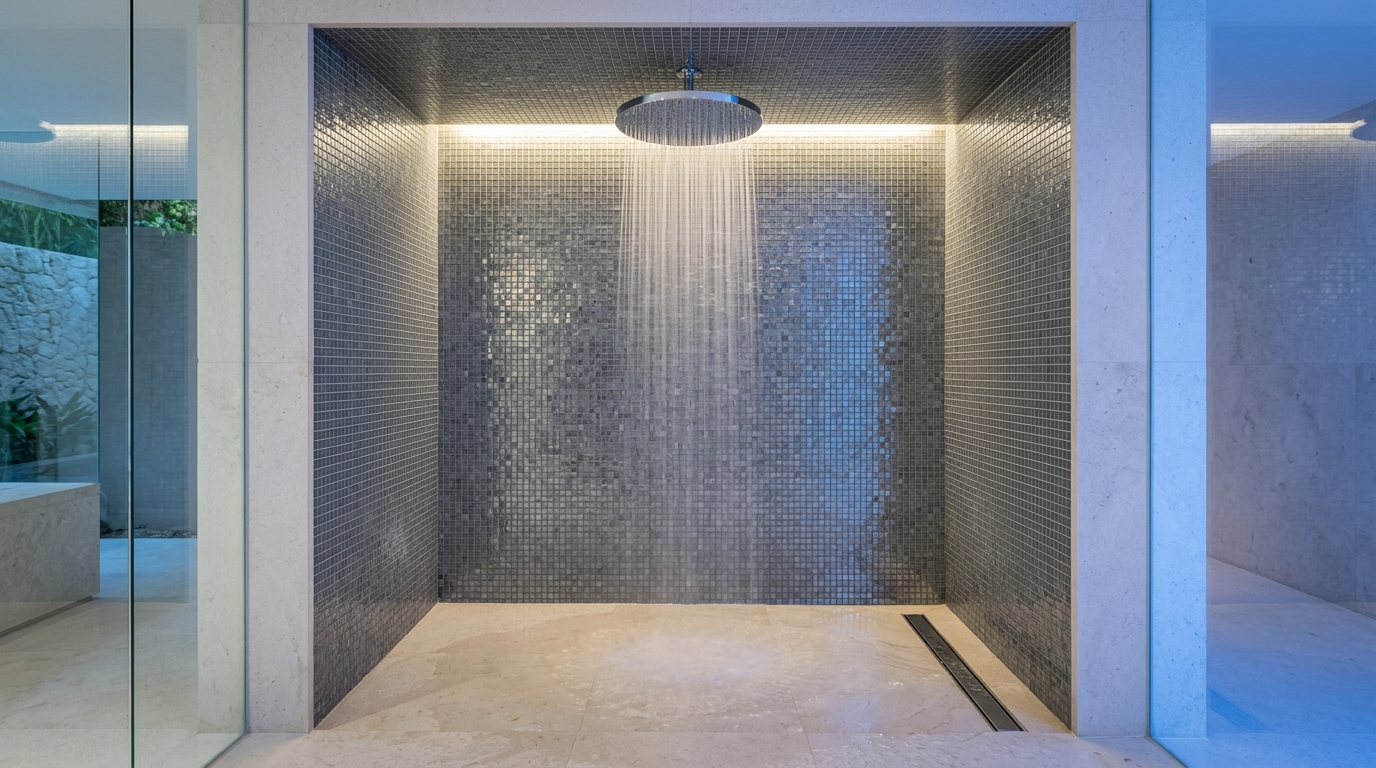
This note is about the plumbing behind a contrast shower in a Gulf villa, hotel spa or club: where the cold water comes from, how cold it can be kept, and what that does to the energy, the hygiene and the pipework. It does not deal with how the shower is used; that is the operator's and the guest's business.
The same problem applies to every cold outlet in a spa in a hot climate: the bucket shower, the cold station of an experience shower and the top-up of a plunge pool. The contrast shower is simply where guests notice it first.
Why is the cold water not cold in a Gulf summer?
Because the water sits in warm places before it reaches the shower. Dubai's climate table gives an August daily mean of 37.0 °C and a sea temperature of 33 °C. Water stored in roof tanks and run through ceiling voids drifts towards the temperature around it, so we estimate the "cold" supply at 30 to 35 °C in summer.
That estimate is the planning assumption, not a measured value for any given building. The real figure depends on tank location, insulation and how long the water stands, and on a project we measure it at the outlet in August before sizing anything.
The consequence is the same either way. A contrast shower fed straight from the cold main in July delivers two warm phases, and the guest notices at once.
Why does warm "cold" water matter for hygiene?
Because it sits in the growth range of Legionella. The World Health Organization gives 20 to 50 °C as the range in which Legionella lives and grows in water systems, with an optimum around 35 °C. A cold line running at 30 to 35 °C is close to that optimum.
The UK Health and Safety Executive's guidance for water systems asks for incoming and stored cold water to stay below 20 °C, checked at sentinel taps after two minutes of running. In a Gulf summer that figure cannot be met by the supply alone; it has to be designed for.
So chilling the cold line to a shower is not only about comfort. Short, insulated pipe runs, no dead legs, a flushing routine for outlets that are used rarely, and water kept below 20 °C wherever it stands are all part of the same design.
How much power does it take to chill shower water on demand?
About 14 kW for one shower. A flow of 10 litres per minute is 0.167 kg per second, and cooling it by 20 K, from 35 to 15 °C, takes 0.167 × 4.186 × 20 = 14 kW of cooling, continuously, for as long as the cold phase runs. Two showers running together need 28 kW.
That is the size of a small building's air-conditioning plant, reserved for a few minutes of use at a time. An instantaneous chiller that large spends most of the day idle and most of its cold phases starting up.
The numbers change with the flow rate and the target. At 8 litres per minute and a target of 18 °C the load is about 9.5 kW; at 12 litres per minute and 12 °C it is about 19 kW. None of these is a sensible load for a single outlet.
How does a chilled buffer tank solve it?
By storing cold water between uses. A 200 litre insulated tank chilled from 35 to 12 °C holds 200 × 4.186 × 23 = 19,256 kJ, or about 5.4 kWh of cooling. At 10 litres per minute it supplies 20 minutes of cold flow before its temperature starts to rise.
A small chiller then rebuilds the store between uses. At 1.5 kW of cooling, 5.4 kWh takes about 3.6 hours to recover, so a tank sized for the busiest hour and recharged overnight and between sessions covers a villa or a small spa with a chiller a tenth the size of the instantaneous one.
The table compares the options for one shower at 10 litres per minute, using the arithmetic above.
| Option | Cooling capacity needed | Cold water available | What limits it |
|---|---|---|---|
| Cold main, no chilling | none | at supply temperature, 30–35 °C estimated in summer | not cold; in the Legionella range |
| Instantaneous chiller | about 14 kW per shower | unlimited, at 15 °C | size, starts and electrical supply |
| 200 l buffer tank + 1.5 kW chiller | 1.5 kW | 20 minutes at 12 °C, then recovery in about 3.6 h | tank size against peak use |
| 400 l buffer tank + 3 kW chiller | 3 kW | 40 minutes at 12 °C, recovery about 3.6 h | plant space for the tank |
All four lines use the same example flow; a project repeats the arithmetic with its own outlets and schedule.
How is the chilled water mixed at the shower?
Through a thermostatic mixing valve fed by the chilled line and the hot line. The valve blends the two to the set temperature and holds it when pressures change. European valves of this type are specified under EN 1111, and the valve's own limits on supply temperatures and pressures come from its manufacturer.
For a contrast shower, the control switches between two setpoints rather than asking the guest to turn a handle from hot to cold. The cold phase draws mostly on the chilled line, the warm phase mostly on the hot line, and the valve keeps each one stable.
The chilled line needs its own insulation, down to the valve. A chilled pipe running through a warm ceiling void sweats, and in a Gulf building with humid ceiling spaces the condensation drips onto the ceiling below unless the pipe is insulated with a continuous vapour-tight jacket.
Where does the chiller for a contrast shower go?
Where its heat can leave the building. A 1.5 kW chiller rejects its cooling plus its own electrical input at the condenser, roughly 2 kW, and in a closed plant cupboard in the Gulf that heat stays in the cupboard. The condenser needs outdoor air or a dedicated extract.
The tank goes as close to the shower as the plan allows. Every metre of chilled pipe is a metre of heat gain and a metre of pipe that must be insulated and flushed, so the tank and the shower are drawn together rather than in separate parts of the building.
In a spa that already has a cold plunge, the plunge's chiller is sometimes asked to serve the shower as well. That can work, but the two loads peak at the same time, when guests are cycling between them, so the combined chiller is sized for both at once.
What else in a spa needs the chilled line?
Every outlet that is meant to be cold. The cold station of an experience shower, a bucket shower, a foot basin and the make-up water of a cold plunge all share the same problem. On a Gulf project they are drawn as one chilled circuit from one store rather than solved one outlet at a time.
The flows are small but the hygiene rules are the same. A cold outlet that is used twice a day is a dead leg for the other twenty-two hours, so the circuit is looped back to the tank or flushed on a timer, and the water in it stays below 20 °C.
Our shower systems page shows the showers we install in spas and villas. The heat side of the same wet area, sauna and steam, is compared in our note on steam shower versus sauna, and the wider family of water treatments is set out in our hydrotherapy guide.
Who is writing this
Sauna Dekor Spa Solutions has manufactured and built saunas, steam rooms, hammams and wet areas from its own facility in İkitelli OSB, Istanbul, since 1987: 40 years of manufacturing, a team of 19 employees, work under TS EN ISO 9001:2015, 5,000+ projects in 35+ countries and 731 named references. This article was reviewed by our Managing Director.
We give a 24-month warranty on workmanship and manufacturing; electrical and mechanical equipment carries a 24-month manufacturer's warranty; and we give a 5-year warranty on structure and waterproofing.
Chillers, mixing valves, shower controls and tanks are not our products. They come from their manufacturers, and any CE marking or conformity of that equipment belongs to its manufacturer rather than to us.
Frequently asked questions about the contrast shower
What is a contrast shower?
A shower that alternates between warm and cold water, usually in set phases. In a spa it is often one station of an experience shower, controlled by a panel that switches between 2 setpoints rather than by a hand-turned tap.
Why is cold shower water warm in Dubai in summer?
Because it stands in roof tanks and ceiling voids in air that averages 37.0 °C in August. We estimate summer supply at 30 to 35 °C for planning, and measure it at the outlet on each project.
How much power does a chilled shower need?
About 14 kW to cool 10 litres per minute from 35 to 15 °C on demand. A 200 litre buffer tank chilled to 12 °C by a 1.5 kW chiller gives 20 minutes of cold flow instead.
Is warm cold water a hygiene risk?
It can be. The WHO gives 20 to 50 °C as the range where Legionella grows, and the UK HSE asks for cold water below 20 °C. Short insulated runs, no dead legs and flushing are part of the design.
Can the cold plunge chiller also cool the shower?
Sometimes, if it is sized for both. The plunge and the contrast shower tend to peak together, when guests move between them, so a shared chiller is selected for the combined load rather than for either one alone.
Sources
- Climate of Dubai — Wikipedia, 2026. August daily mean of 37.0 °C and sea temperature of 33 °C used for the supply estimate.
- Legionellosis fact sheet — World Health Organization. Legionella growth between 20 and 50 °C with an optimum near 35 °C.
- Legionnaires' disease: things to consider — Health and Safety Executive, UK. Cold water to remain below 20 °C, checked at sentinel taps after two minutes.
- EN 1111 — Sanitary tapware, thermostatic mixing valves (PN 10) — BSI. The European specification for the thermostatic valves that blend the chilled and hot supplies. The standard belongs to CEN and BSI.
- Specific heat capacity — Wikipedia, 2026. The 4.186 kJ/kg·K of water behind the chilling and storage figures.
- Chiller — Wikipedia, 2026. How a chiller removes heat from water and rejects it with its own input at the condenser.


Yorumlar
Yorum Gönder