Turkish Bath House: What It Takes to Run One for an Hour
Short answer: a turkish bath house is an operating problem wearing a marble coat. Eight bathers an hour, roughly 100 litres of water each and about 40 kW of continuous hot water are the 3 numbers that decide whether the building works, and all 3 are settled before anybody chooses a stone.
Most briefs for a turkish bath house are written as a room list and a finishes schedule. Neither tells you how many people the place can serve, and that is the only number the operator will care about after the first month. Below are the 17 operating questions we put to a turkish bath house brief, in the order the answers arrive, each with the figure we design to.
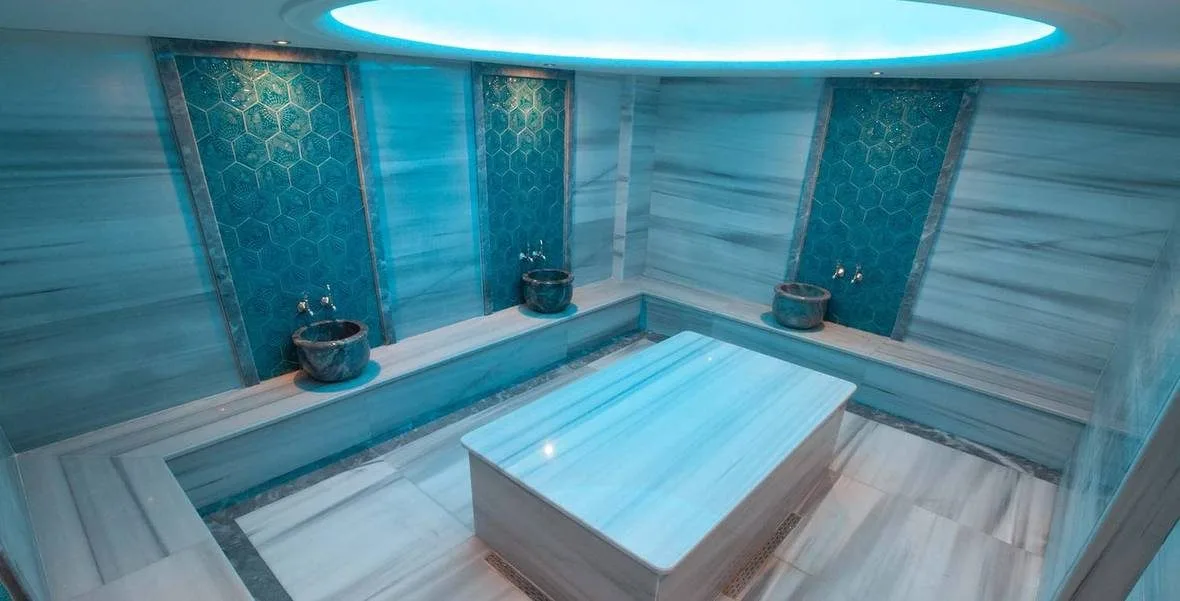
What is a turkish bath house, as a building rather than a word?
Three rooms and a plant room. A turkish bath house is a cool room for undressing and resting, a warm room for the transition, and a hot room with a heated central slab and basin stations around it. The plant room behind them is roughly 25 to 30 % of the total area and it is the part the brief usually omits.
The 3 rooms are not decoration. Each one holds a different air condition, and a guest who passes from 22 °C straight into 48 °C at 95 % relative humidity leaves quickly, which is why the warm room exists at all.
The plant room carries the whole operating cost. Hot water generation, the slab heating circuit, the dosing for the basin supply and the extract plant all live there, and a turkish bath house designed without one ends up with its water heater in a corridor.
How many bathers an hour can a turkish bath house serve?
Between 6 and 10 an hour for a room with 3 basin stations and 1 heated slab, and we plan on 8. That is not a room-size figure; it comes from the length of the service, the number of attendants and the turn-round, and any of those 3 can be the binding constraint.
The slab is usually what limits it. A heated slab of 2.0 by 1.2 m takes 1 person at a time for the scrub and the foam, so with a 45 minute service and a 10 minute turn-round the slab alone allows about 1.1 guests an hour per position.
Basin stations raise the number because they serve the self-directed part of the visit. Three stations let 3 guests wash and rest while 1 is on the slab, so the room holds 4 at once and the hourly figure rises to 8 as long as the staffing keeps up.
How long does one full service take?
Between 60 and 75 minutes from the cool room back to the cool room, of which about 45 minutes is inside the hot room. The split matters: 15 minutes acclimatising, 20 minutes of scrub and foam on the slab, 10 minutes rinsing at a basin and 15 to 20 minutes resting afterwards.
Only 20 of those minutes need an attendant. The rest of the service is the guest's own time, which is why a turkish bath house with 1 attendant can still serve 8 people an hour, provided there are enough basin stations for the unattended parts.
Cutting the service to 45 minutes does not raise throughput proportionally. The scrub and foam cannot be shortened below about 18 minutes without the guest noticing, so the saving comes out of the resting time, and the resting time is what makes people book again.
How much water does each bather use?
Between 80 and 120 litres for a full service, and we design to 100. A basin holding 15 to 20 litres is filled and emptied 6 to 10 times during a visit, which is where most of the volume goes; the rinse at the end accounts for perhaps 25 litres of it.
That figure is high compared with a shower, which uses about 45 litres in 7 minutes, and it is the reason a turkish bath house cannot be served by the hot water plant that was sized for the hotel bedrooms above it.
Foam service adds a little and recovers some. The soap used in the foam stage arrives in about 8 litres of water, but the guest then rinses with less at the basin, so the net addition is closer to 5 litres a service than to 8.
How much hot water does the plant have to make?
About 800 to 1,000 litres an hour at 45 °C for 8 bathers, which is roughly 35 to 45 kW of continuous heat input from a cold feed at 15 °C. That is the number that decides the calorifier, and it is usually 3 to 4 times what the architect's services allowance contains.
The calculation is short. Raising 1,000 litres by 30 K needs about 34.9 kWh, so over 1 hour it is a 34.9 kW duty, plus distribution losses. A turkish bath house running 10 hours a day therefore moves around 350 kWh of hot water heat a day.
Storage changes the plant rather than the total. A 1,500 litre store with a 20 kW input handles the same 8 bathers an hour if the load is even, but a turkish bath house load is not even: it comes in blocks as the sessions start, so we size the recovery on the block rather than on the average.
How long does the göbek taşı take to come up to temperature?
Between 40 and 60 minutes from cold with a correctly sized circuit. A 6 m² slab in 60 mm marble is about 970 kg of stone, and raising it by 25 K takes roughly 5.9 kWh, so a 7.2 kW heating circuit at 1.2 kW per square metre gets there in about 50 minutes.
That warm-up time is an opening-hours decision, not a plant decision. A turkish bath house opening at 09:00 has to have the circuit on by 08:00, and on a 7 day operation that is 7 hours a week of heating that nobody is in the room for.
Bringing it up faster costs more than it saves. Doubling the circuit to 14.4 kW halves the warm-up but doubles the peak electrical or hydronic demand, and the slab then overshoots on the surface while the core is still cold, which guests feel as an uneven stone.
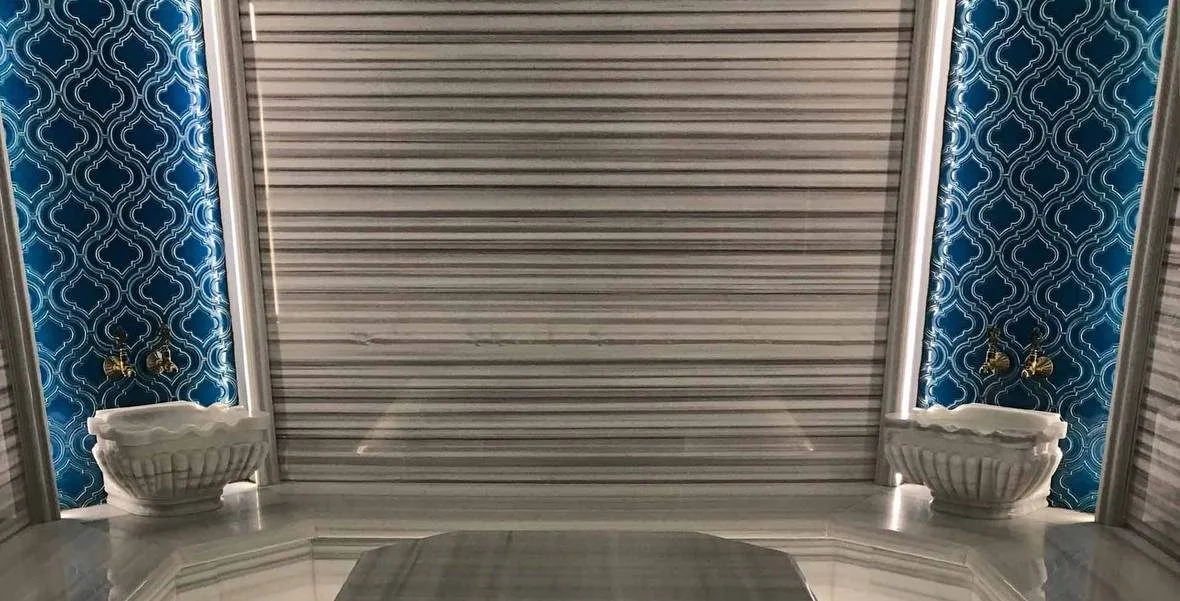
How warm should the marble surface be?
Between 38 and 42 °C on the slab, and never above 45 °C. Skin contact above 45 °C becomes uncomfortable within a couple of minutes, and because a guest lies still on the stone for about 20 minutes, the slab is the one surface in a turkish bath house where the ceiling on temperature is absolute.
Surface temperature is not the same as flow temperature. A circuit running at 55 °C under 60 mm of marble delivers roughly 40 °C at the surface, and the difference across the stone is what makes the control sensor position matter more than the setpoint.
Edges run cooler than the middle. A slab loses heat at its perimeter to the floor and the air, so the last 150 mm of every edge sits 3 to 5 K below the centre unless the circuit is laid out with a tighter pipe spacing there.
What air condition does the hot room hold?
Between 45 and 50 °C at 90 to 100 % relative humidity. A turkish bath house hot room is deliberately saturated, so the extract is not there to dry the room during the session; it is there to clear it afterwards, at 10 to 15 litres per second for every square metre of wetted surface.
The warm room sits at 35 to 40 °C and around 60 % humidity, and the cool room at 22 to 26 °C. Those 3 bands are what the guest actually experiences as a sequence, and they are held by 3 separate control zones rather than by 1.
Under-ventilating the hot room during the session is deliberate; under-ventilating it afterwards is a fault. The run-on has to continue for about 30 minutes after the last session or the room stays above 90 % humidity into the next morning.
How many basin stations does the room need?
One for every 2 bathers in the room at once, which for a design occupancy of 6 means 3 stations. Fewer than that and the unattended parts of the service queue behind the attended part, which shows up as guests sitting on the benches waiting rather than washing.
Each station consumes about 1.2 m of wall. Three stations plus the bench runs between them is roughly 6 m of perimeter, which with a 2.0 by 1.2 m slab in the middle sets the hot room at about 30 to 36 m² before the door and the corner losses.
Stations also drive the drainage. Three basins each discharging up to 0.2 litres a second is a 0.6 l/s floor load at the worst moment, which a single 50 mm outlet will not take, so the room gets a channel rather than a gully.
What does the cool room do for throughput?
It holds the resting half of the visit, which is 15 to 20 minutes per guest. Without it, those guests rest in the hot room and occupy a bench that the next arrival needs, and the throughput of a turkish bath house drops from 8 an hour to about 5 without anything else changing.
The area needed is small. Six loungers at 2.0 by 0.8 m with circulation is roughly 20 m², against the 30 to 36 m² of the hot room, and it is the cheapest square metre in the building because it has no water, no tanking and no heated slab.
It also carries the service. Tea, water and towels are served in the cool room, and that is the part of the visit that most affects whether people come back, which makes it a commercial decision rather than a technical one.
How many staff does a turkish bath house need on the floor?
One attendant for every 2 guests under service and 1 floor supervisor for the room. At 8 bathers an hour with 20 minutes of attended time each, that is about 2.7 attendant-hours per operating hour, so 3 attendants on shift and 1 supervisor.
Staffing is what actually caps the hourly figure in most operations. The building can hold 4 guests at once and make hot water for 8 an hour, but if only 1 attendant is rostered the slab serves 1.3 guests an hour and the rest of the plant idles.
Attendants also need their own route and their own space. A linen store, a changing area and a back-of-house door add roughly 12 m², and leaving them out means towels and staff cross the guest circulation all day.
How long is the turn-round between sessions?
Between 8 and 12 minutes. The slab is rinsed, the basins are emptied and wiped, the floor is flushed towards the channel and the towels are cleared, and none of that can be compressed much below 8 minutes without the next guest arriving to a wet bench.
Turn-round is why the hourly figure is 8 and not 12. A 45 minute service plus a 10 minute turn-round is a 55 minute cycle per slab position, and the extra guests come from the basin stations rather than from working the slab harder.
A second slab changes the arithmetic more than a bigger room does. Two slabs at 55 minute cycles serve about 2.2 guests an hour between them on the attended part, which with 4 basin stations lifts the room to roughly 12 an hour.
What does the drainage have to carry?
About 0.8 litres a second at the worst moment: 3 basins discharging together plus a slab rinse. A turkish bath house therefore gets a channel of at least 100 mm width with a removable grating, falls of 1 in 60 towards it, and a trap seal of 75 mm rather than 50.
The 75 mm seal matters because the room is hot. Warm air moving through the extract can pull a 50 mm seal down over a long closure, and when the seal goes the drain vents into the room, which in a saturated space is immediately noticeable.
Hair and soap decide the maintenance interval. Foam service puts fat and hair into the same channel every day, so the grating has to lift by hand without tools and the channel has to be reachable along its whole length, not just at the outlet.
What does hard water do to the marble?
It scales the taps and etches the stone. Water above about 200 mg per litre as calcium carbonate leaves a visible deposit on brass within weeks, and the acidic descalers used to remove it are exactly what marble cannot tolerate, which is why the softener is a stone-protection item rather than a plant item.
We treat the basin supply rather than the whole building. Softening the supply to the basin stations and the slab washdown removes most of the deposit at a fraction of the plant a whole-building softener needs.
The limit works in both directions. Water softened below about 50 mg per litre becomes aggressive to the cement in the joints, so the target band is roughly 50 to 120 mg per litre, checked at commissioning and again each year.
Where does the capacity actually run out?
At the attendant, then the hot water, then the slab, in that order. Of the turkish bath house projects we have commissioned, the binding constraint at opening is almost always staffing, and the second complaint 6 months later is hot water recovery during the evening block.
The room itself is rarely the limit. A 34 m² hot room with 3 stations and 1 slab is comfortable at 4 occupants and tolerable at 6, and no operator we have worked with has been held back by floor area before they were held back by the other 2.
That order is useful when a budget is cut. Reducing the marble specification changes the appearance; reducing the calorifier changes the throughput after 90 minutes of trading, and the second cut is the one that shows up in the reviews.
What does a turkish bath house plan not settle?
The water treatment for anything with standing water. Where the brief adds a plunge or a heated pool next to the hot room, the turnover, the dosing and the suction arrangement are a separate discipline, and we set them out in our notes on the pump, the jets and the suction line rather than here.
The construction sequence is the second thing. A heated slab, a tanked floor and a marble finish have to be built in one order and one order only, and that sequence belongs with the commercial hammam drawings alongside the guidance in how to build a hammam.
The third is the cultural brief. Whether the room follows the Turkish bath sequence, how mixed or separated the sessions are and what the service includes are operator decisions that change the room schedule, and they have to be answered before the area is fixed rather than after.
Who is writing this
Sauna Dekor has designed and built wellness and thermal facilities since 1987 and is now in its 40th year, manufacturing in its own Istanbul facility with 19 employees, working under TS EN ISO 9001:2015, with projects delivered in more than 35 countries. On a turkish bath house we work turnkey through our spa design and installation services: the stone, the slab circuit, the tanking, the falls, the basin stations, the plant interfaces and the commissioning.
What we do not make is equally clear. Water heaters, softeners, extract fans, dosing skids and control panels are not our products; they come from the equipment manufacturers we buy from, and any CE marking or EN 60335 conformity on that equipment belongs to its manufacturer rather than to us. The TS EN ISO 9001:2015 certificate is ours; the rest are theirs.
Frequently asked questions about a turkish bath house
How many people an hour can a turkish bath house serve?
Between 6 and 10 with 3 basin stations and 1 heated slab, and we plan on 8. The slab handles about 1.1 attended guests an hour; the basin stations carry the unattended parts of the visit in parallel.
How long does a full turkish bath house service take?
Between 60 and 75 minutes door to door, of which about 45 minutes is in the hot room. Roughly 20 of those minutes need an attendant; the remaining time is acclimatising, rinsing and resting.
How much water does one bather use in a turkish bath house?
Between 80 and 120 litres, and we design to 100. A basin holding 15 to 20 litres is filled 6 to 10 times during a visit, and the final rinse accounts for about 25 litres of the total.
How long does the heated marble slab take to warm up?
Between 40 and 60 minutes. A 6 m² slab in 60 mm marble weighs about 970 kg, needs roughly 5.9 kWh for a 25 K rise, and a 7.2 kW circuit at 1.2 kW/m² reaches temperature in about 50 minutes.
How hot should the marble slab be?
Between 38 and 42 °C at the surface and never above 45 °C. Guests lie still on it for about 20 minutes, so the contact limit governs, and the circuit typically runs at 55 °C under 60 mm of stone to achieve it.
What water hardness suits a turkish bath house?
Between roughly 50 and 120 mg per litre as calcium carbonate. Above 200 mg per litre brass scales within weeks and the acidic descalers used to clean it damage marble; below 50 mg per litre the water attacks the joints.
How much hot water plant does a turkish bath house need?
About 800 to 1,000 litres an hour at 45 °C for 8 bathers, which is a continuous duty of roughly 35 to 45 kW from a 15 °C cold feed. Size the recovery on the session block, not on the daily average.
Sources
- Approved Document G, Sanitation, hot water safety and water efficiency — HM Government, England. Reference for hot water storage and distribution temperatures, for scald limits at outlets and for the sanitary provision assumed behind the per-bather water figures. The document belongs to the UK government.
- HSE, HSG282: The control of legionella and other infectious agents in spa-pool systems — Health and Safety Executive, January 2017, ISBN 978 0 7176 6681 2. Source for the wet-area extract band of 10 to 15 l/s per m² of wetted surface, for stagnation control and for post-session run-on.
- CIBSE Guide B2: Ventilation and ductwork — Chartered Institution of Building Services Engineers, 2016. Reference for zoning of spaces held at different temperatures and humidities and for the treatment of extract in saturated rooms.
- Specific heat capacity of materials, The Engineering ToolBox — the density and specific-heat values for marble and water behind the 970 kg slab mass, the 5.9 kWh warm-up and the 34.9 kWh per 1,000 litre hot water arithmetic used above.
- Hard water and its effect on plumbing and stone — reference for the calcium carbonate concentration bands quoted, for scale formation on brass fittings and for the aggressiveness of over-softened water towards cementitious joints.
- WHO Guidelines for safe recreational water environments, volume 2 — World Health Organization. Reference for bathing-load principles, cleaning intervals and the hygiene management of heavily used wet facilities. The guidance belongs to WHO.
- DIN 51097 and DIN 51130, slip resistance ramp tests — Deutsches Institut für Normung. Source for the barefoot slip classes applied to a saturated marble floor with a fall of 1 in 60; both standards belong to DIN rather than to us.


Yorumlar
Yorum Gönder