Sauna Maintenance: What Wears Out and When
Short answer: sauna maintenance is a wear schedule, not a cleaning routine. Stones are finished first, at 6 to 12 months of commercial use. Heating elements follow at 3,000 to 5,000 operating hours, and temperature sensors drift 1 to 2 K every year. Everything else in the cabin outlives those 3 items by a factor of 4 or more.
That ordering is the whole point. A cabin cleaned every evening but never opened at the heater still loses 30 % of its heat-up speed inside 2 years. Below are the 18 questions we work through on a sauna maintenance schedule, each with the interval and the figure behind it.
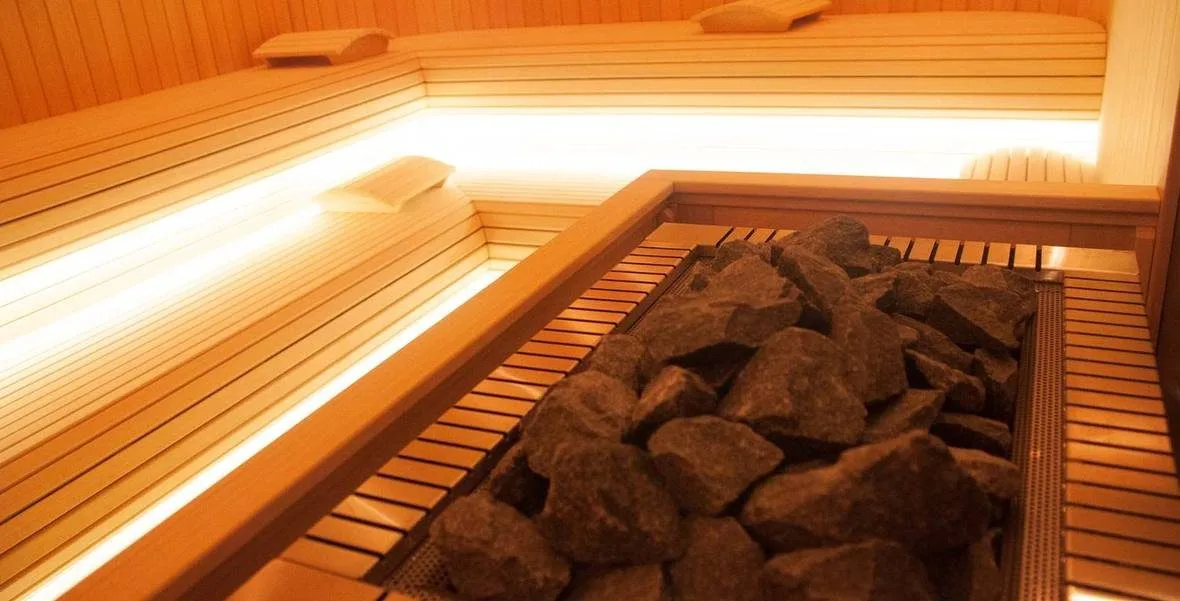
What wears out in a sauna, and in what order?
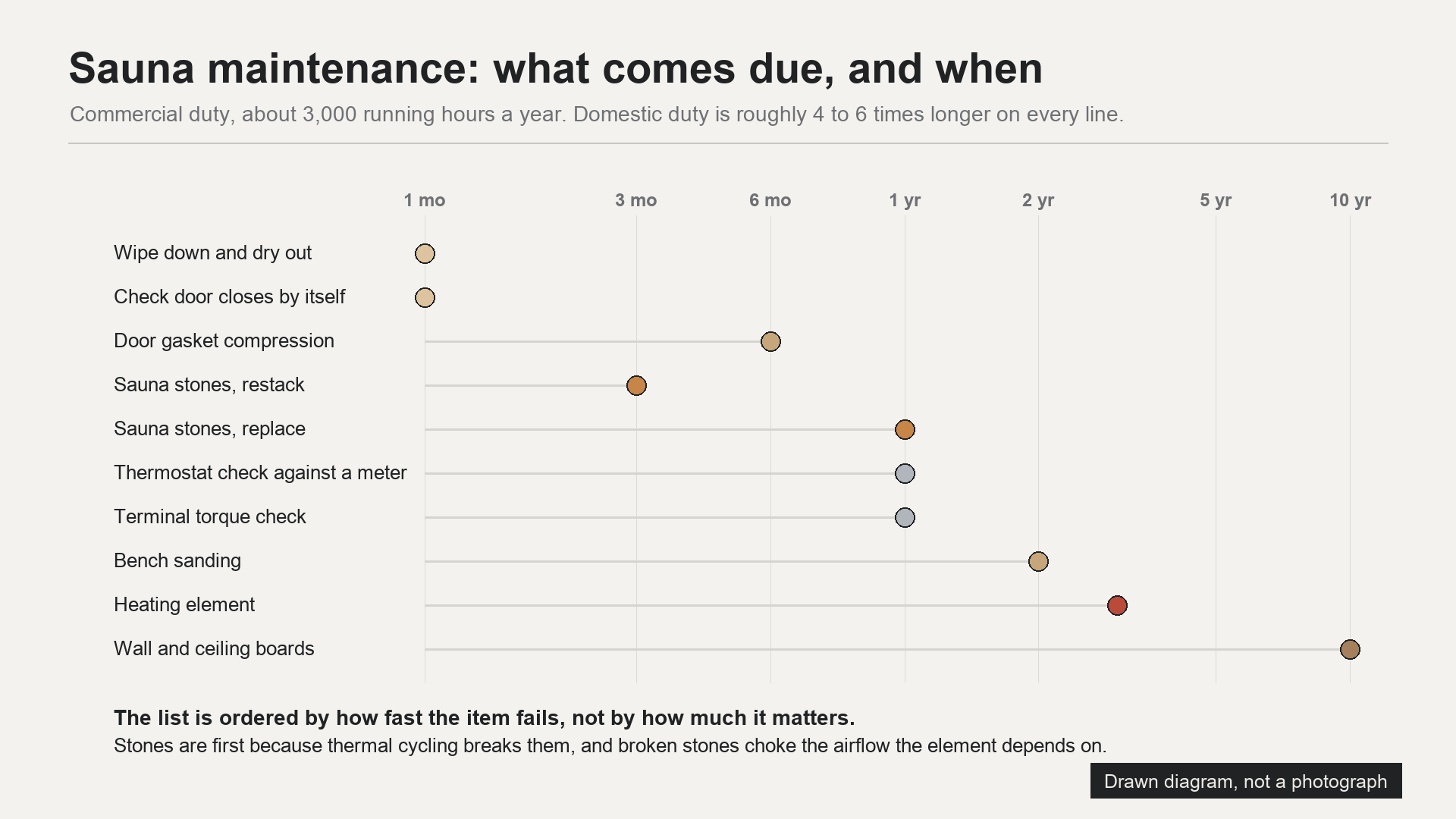
In wear-rate order: stones, door seal, heating element, temperature sensor, bench surface, bench frame, wall panelling, hinges, control panel. The spread is wide. Stones can be finished at 6 months of commercial use while a control panel runs 10 years, so a single annual visit cannot be the whole plan.
The list is worth reading as a sequence rather than a set, because each item fails into the next one. Broken stones raise the element temperature, a hot element ages the sensor beside it, and a sensor reading 4 K low holds the cabin at a temperature the operator never asked for.
- Sauna stones — 600 to 1,200 operating hours
- Door seal — 1,500 to 3,000 hours, or 2 years on calendar
- Heating element — 3,000 to 5,000 hours
- Temperature sensor — 4 to 6 years, drifting from year 1
- Bench surface — sanded at 12 to 24 months, not replaced
- Bench frame and backrest — 8 to 10 years
- Wall and ceiling panelling — 10 to 15 years
- Door hinge — adjusted every 6 months, replaced at 8 to 12 years
- Control panel — 8 to 12 years, relays rated around 100,000 cycles
How many operating hours does each part survive?
Between 600 and 5,000 hours, depending on the item, which in a commercial cabin running 10 hours a day, 6 days a week — about 3,000 hours a year — compresses into intervals of months. A domestic cabin used twice a week for 90 minutes accumulates roughly 150 hours a year, so the same parts last years.
| Item | Commercial interval | Domestic interval | Symptom that calls it in | Service time |
|---|---|---|---|---|
| Sauna stones | 6 to 12 months | 2 to 3 years | Split faces, fines in the tray, slow heat-up | 45 min |
| Door seal | 12 to 24 months | 5 to 7 years | Visible gap, draught along the hinge edge | 15 min |
| Heating element | 2 to 3 years | 8 to 12 years | Heat-up time up 30 %, uneven glow | 60 min |
| Temperature sensor | 4 to 6 years | 8 to 10 years | 3 K or more against a reference | 20 min |
| Bench surface | Sand at 12 to 24 months | Sand at 4 to 6 years | Raised grain, grey patches, splinters | 90 min |
| Bench frame, backrest | 8 to 10 years | 20 years and over | Movement over 3 mm, loose fixings | 30 min |
| Wall and ceiling panelling | 10 to 15 years | 20 to 25 years | Cupping over 2 mm, dark staining | 30 min |
| Door hinge | Adjust at 6 months | Adjust at 2 years | Door will not swing free, rubbing | 15 min |
| Control panel | 8 to 12 years | 12 to 15 years | Relay chatter, setpoint missed by 5 K | 15 min |
Read the table by column. The commercial column is a service diary, and the symptom column is what an operator can be trained to report in 5 seconds without any instrument.
Why do sauna stones break, and how often are they replaced?
Thermal cycling plus water shock. The upper stones sit at 350 to 450 °C, and water poured on at 15 °C drops the contact surface by more than 200 K in under 2 seconds. That differential cracks the stone from the surface inward, and commercial sets are replaced every 6 to 12 months.
Igneous stones such as olivine diabase are chosen because they take the cycle better than most, not because they are immune to it. A stone survives perhaps 800 to 1,200 water pours before the surface network of cracks reaches the core, and after that it sheds fines into the tray at the base of the heater.
Domestic replacement runs at 2 to 3 years for the same reason on a longer clock. The pour count governs, not the calendar, so a home cabin used hard at weekends can reach the commercial interval.
How should sauna stones be stacked, and how many kilograms are needed?
Loosely, largest at the bottom, with 10 to 20 mm of air between pieces. A 6 kW heater takes about 20 kg, a 9 kW heater 25 to 30 kg, and a 15 kW commercial unit 50 to 60 kg. Stones of 50 to 100 mm across suit nearly every cabin.
Stacking is a 45 minute job done by hand, not a pour. Every stone comes out, is rinsed and inspected, split pieces go out, the tray is vacuumed, and the stones go back one at a time. A stone wedged against the sheath is a short-life element.
The bed should sit about 10 mm above the upper edge of the element and no more. Burying it under an extra 40 mm of stone feels generous and stalls convection through the heater, which is the same failure a collapsed bed produces.
A collapsed bed is worth recognising early. Fragments fill the voids, free air area through the stones falls from roughly 40 % to under 15 %, the element runs 80 to 150 K hotter than design, heat-up lengthens by 10 to 20 minutes and the body cut-out at 130 to 150 °C starts tripping on long sessions.
What happens to a heating element as it ages?
Its resistance rises. The heating wire oxidises across thousands of hours at 700 to 900 °C, resistance climbs by 3 to 8 % over life, current falls by the same proportion, and a 10 m³ cabin that reached 90 °C in 35 minutes when new takes 45 to 55 minutes at end of life.
Measured current is the honest test. Clamping each phase during a cold start and comparing against the rating plate gives a percentage that maps directly onto remaining life, and a reading 8 % or more below nameplate on any phase is a planned replacement rather than an emergency.
Visual signs arrive later than electrical ones. Uneven glow along the loop, a dull grey or blistered patch on the sheath, and any sag that brings the element within 5 mm of a neighbouring loop all mean the part is at the end of its 3,000 to 5,000 hour band.
How far does a temperature sensor drift in a year?
Typically 1 to 2 K a year in saturated hot air, so a 5 year old sensor can read 5 to 10 K away from the truth. That is enough to hold a cabin at 78 °C while the panel displays 90 °C, and neither the operator nor the guest has any way of noticing.
Drift is not a fault, it is a rate. Sensors in sauna cabins sit within 150 to 200 mm of the ceiling in still, humid air at 90 to 110 °C, and the combination ages both the element and its junction faster than the same part would age in a dry duct.
Verification is annual in commercial cabins and every 2 years in domestic ones. Hold a calibrated reference at the sensor height, 1,700 to 1,900 mm above the floor, for a settled 15 minutes and compare at 70 °C and 90 °C. Height dominates the result: a cabin holds 30 to 40 K between floor and ceiling.
Tolerance is ±3 K. Outside that the sensor is replaced rather than trimmed, because a part that has drifted 4 K in 3 years will drift further in the next 3, and 2 years of paired readings in the log give a drift rate for that specific cabin.
When is a sauna door seal worn out?
When compression set passes about 30 %. A silicone or PTFE seal starts at 8 to 10 mm and is designed to compress 2 to 3 mm in service. Once it stays flattened by more than 30 % of its free height after the door opens, it no longer closes the gap and is replaced.
The field test needs no instrument beyond a strip of paper. Close the door on an 80 g/m² sheet at 5 points around the frame and pull; the sheet should drag at every point. Anywhere it slides free, the seal has set or the hinge has moved, and those 2 causes are told apart at the hinge.
A failed seal costs timber as well as heat. Air leaving at 90 °C along a 3 mm gap carries moisture into the wall behind the frame, so a seal left 6 months past its interval becomes a panelling repair too.
How is a sauna door adjusted so that it closes on its own?
By setting the hinge pivot 2 to 3 mm off the frame face so that gravity carries the leaf shut from any position. Released from 300 mm open, the door should close fully in 2 to 4 seconds, and it should open outward under a push of less than 50 N with no latch resisting it.
The self-closing test belongs in every visit because it is a safety function, not a convenience. A sauna door has no lock and no latch by design, and the same 50 N push that lets a guest leave is what stops a door standing 50 mm ajar and bleeding the cabin down to 70 °C.
Glass gets its own 60 second check. Toughened panels of 6 to 8 mm fail from edge damage rather than from face impact, so we run a fingernail along the full perimeter, and any chip over 1 mm deep takes the panel out of service the same day.
When do benches need sanding, and how much wood comes off?
About 0.3 to 0.5 mm per sanding with 80 grit followed by 120 grit. A 28 mm bench slat tolerates 8 to 10 of those passes across its life, so the surface is renewable roughly 10 times before the slat is too thin. Commercial benches are sanded every 12 to 24 months.
The trigger is grain, not colour. Repeated wetting raises the fibres, and when a flat palm dragged across the seat catches, the slat is ready. Grey patches under the same test can be surface only, and 0.3 mm removes them completely.
Domestic cabins go 4 to 6 years between passes. The arithmetic still holds: 10 passes at 5 year intervals is a 50 year bench, longer than the cabin around it is likely to keep its original layout.
Why is the interior wood never varnished or lacquered?
Because a film-forming coating softens above 70 to 80 °C and seals moisture into the timber behind it. Bench surfaces reach 45 to 60 °C under a seated guest and wall panelling reaches 90 °C, so the film goes tacky, then crazes, and the wood beneath it cannot dry between sessions.
The alternative is a penetrating paraffin-based bench oil, applied thin, 2 coats, wiped back after 15 to 20 minutes and left 12 hours before use. It sits inside the first 1 to 2 mm of the timber rather than on top of it, so vapour still leaves the wood freely.
Untreated is also a valid answer for wall and ceiling panelling. Aspen, alder and thermally modified timbers are specified for those surfaces precisely so that no coating is needed, and adding one converts a 20 year panel into a 5 year maintenance item.
What cleaning chemistry is safe inside the cabin?
A neutral detergent at pH 6 to 8, diluted, on a damp cloth. Chlorine-based cleaners are the single most damaging thing that enters a sauna: sodium hypochlorite at 1,000 ppm bleaches lignin, greys the surface within 3 or 4 applications and never recovers, and it also attacks the stainless fixings.
Grade 304 stainless is vulnerable to chloride stress corrosion above roughly 25 ppm chloride once the metal is over 50 °C, and a sauna is over 50 °C for most of its working day. Pitting appears around bench brackets and heater guards first, months before anyone connects it to the cleaning routine.
Pressure washing is out for the same reason. Water at 100 bar is driven 10 to 20 mm into the timber, surface moisture content jumps from 7 or 8 % to over 20 %, and a lance held within 300 mm of a silicone seal cuts the bead out of its groove in one pass. Use a cloth, a soft brush and 4 to 6 litres of water for a 10 m³ cabin.
Drying is part of the chemistry. After any wet clean, the heater runs at 40 to 50 °C with the extract open for 45 to 90 minutes, and the cabin is not used again until the benches are dry to the hand.
How long should the ventilation run after the last session?
For 20 to 30 minutes at full extract, which for a 10 m³ cabin at 6 to 8 air changes an hour is 60 to 80 m³/h. The run-on exists to pull the cabin from 90 °C and saturated down towards room condition while the timber is still warm enough to release moisture.
Wood moisture content is the target that run-on is serving. Panelling should return to 6 to 9 % between sessions; a cabin that sits above 16 % for days at a time will develop dark staining within a season, and sustained readings over 20 % bring decay into the frame behind the panel.
A pin-type moisture meter read at 3 fixed points — under the lower bench, behind the door frame and at the far ceiling corner — takes 4 minutes and turns this into a logged number.
Why does the floor drain trap dry out, and what happens then?
Because the cabin is warm. A 50 mm water seal in a room that spends 8 hours a day above 60 °C evaporates in 14 to 21 days, against 2 to 3 months in a cold plant room. Once the seal is gone, the drain vents into the cabin and the odour is immediate and unmistakable.
The fix is administrative. Half a litre of water down every gully once a month keeps the seal, and a cabin closed for a holiday gets the same on the day it closes and the day it reopens.
Where the closure is longer than 4 weeks, a trap primer or a membrane trap insert removes the task altogether. On a commercial spa floor with 6 or 8 gullies across the thermal area, that is the difference between a monthly round and a forgotten one.
Which electrical checks belong in the annual visit?
Two, and they are short. Terminal tightness is checked with a torque screwdriver to the heater manufacturer's figure, typically 1.2 to 2.5 Nm, because thermal cycling loosens connections. Insulation resistance is then measured at 500 V DC and recorded; anything under 1 MΩ is investigated before the cabin goes back into service.
Both are annual in commercial cabins and every 3 years in domestic ones. They are recorded as numbers, not as ticks, because a terminal that needed a quarter turn this year and a half turn next year is telling you something that a tick box cannot.
What goes into a 12-item annual maintenance package?
Twelve tasks, about 320 minutes, so roughly 5.3 man-hours for a commercial cabin and about 2.5 for a domestic one. Two technicians finish it in a little under 3 hours elapsed, which for most operators means one closed morning rather than a full day out of service.
1. Remove, inspect, rinse and restack the stones — 45 min
2. Vacuum the heater body and inspect the element — 20 min
3. Measure element current on each phase against nameplate — 15 min
4. Verify the sensor against a reference at 2 setpoints — 20 min
5. Function-test the control panel and over-temperature cut-out — 15 min
6. Torque-check the terminals — 15 min
7. Measure and record insulation resistance — 15 min
8. Test seal compression and the self-closing door — 15 min
9. Adjust hinges, handle and glass edge check — 15 min
10. Sand and oil benches and backrests — 90 min
11. Inspect panelling, fixings and frame movement — 30 min
12. Check drain seal, grilles and measure extract flow — 25 min
Item 10 is 28 % of the package on its own. Move bench sanding to a separate visit and the remaining 11 items fit into a 4 man-hour morning.
Which 6 fields belong in the maintenance log?
Six: date, cumulative operating hours at that date, item worked on, part identification or batch, the measured value, and the technician's name. Five of those 6 take 10 seconds to write. The measured value is the one that carries all the future information and it is the one most often left blank.
Operating hours matter more than dates, because every interval in this article is really an hours interval wearing a calendar disguise. A run-hour counter on the heater circuit costs nothing to read and converts a vague "serviced last spring" into 2,840 hours since the last stone change.
The log is also a transfer document. Warranty claims on a heater or a panel are settled on evidence of maintenance, and a building that changes hands with 6 years of paired sensor readings hands the next operator a working schedule instead of a guess.
Why are commercial intervals 4 to 6 times shorter than domestic ones?
Because the hours are 12 to 20 times higher but not all wear is hours-driven. A commercial cabin runs about 3,000 hours a year against 150 to 250 at home, yet the intervals only shorten by 4 to 6 times, because seals, timber and fixings age on the calendar as well as under load.
Stones sit at the hours-driven end and show the full ratio: 6 to 12 months against 2 to 3 years. Door seals sit in the middle, and panelling sits at the calendar end, where a commercial cabin gets 10 to 15 years against a domestic 20 to 25 despite 15 times the use.
Cabin design changes the ratio too. A sauna cabin built with a serviceable heater surround, removable bench slats and an accessible sensor route will hold longer intervals than an identical specification where every check begins by taking something apart.
What does a sauna maintenance schedule not replace?
The equipment manufacturer's own instructions. Every interval above is a planning figure drawn from our own service records across cabins in more than 35 countries; where a heater maker states 4 months on stones or 1.5 Nm on a terminal, their figure governs and ours is set aside.
It also does not extend to every cabin type. Radiant cabins wear differently because there are no stones and no water, and we keep those intervals separate in our notes on infrared sauna maintenance rather than folding them into this schedule.
The third gap is the wet area around the cabin, where drainage, falls and surface treatment follow a different clock — we set that out alongside the safety items a steam room has to carry. Where the cabin is part of a larger installation, the schedule is written into the handover by our spa design and installation services so that it arrives with the building rather than after it.
Who is writing this
Sauna Dekor has designed and built wellness and thermal facilities since 1987 and is now in its 40th year, manufacturing in its own Istanbul facility with 19 employees, working under TS EN ISO 9001:2015, with projects delivered in more than 35 countries. On sauna maintenance we work on what we built: the cabin, the benches, the panelling, the door and frame, the ventilation route and the commissioning record that the intervals above are written against.
What we do not make is equally clear. Sauna heaters, control panels, sensors, fans and stones are not our products; they come from the equipment makers we buy from, and any CE marking or EN 60335 conformity on that equipment belongs to its manufacturer rather than to us. The TS EN ISO 9001:2015 certificate is ours; the rest are theirs.
Frequently asked questions about sauna maintenance
How often do sauna stones need replacing?
Every 6 to 12 months in commercial use and every 2 to 3 years at home, which is about 600 to 1,200 operating hours. Replace earlier if split faces or fines appear in the tray under the heater.
How long does a sauna heating element last?
Between 3,000 and 5,000 operating hours, so 2 to 3 years in a commercial cabin running 3,000 hours a year and 8 to 12 years at home. A current reading 8 % below nameplate means a planned replacement.
How much does a sauna thermostat drift?
Typically 1 to 2 K a year, so 5 to 10 K after 5 years. Verify annually against a reference thermometer at 1,700 to 1,900 mm above the floor; replace the sensor if the gap exceeds ±3 K.
Can you varnish or lacquer the inside of a sauna?
No. Film-forming coatings soften above 70 to 80 °C and trap moisture in the timber. Use a penetrating paraffin-based bench oil, 2 thin coats wiped back after 15 to 20 minutes, or leave panelling untreated.
What cleaner is safe for a sauna cabin?
A neutral detergent at pH 6 to 8 on a damp cloth. Chlorine cleaners at 1,000 ppm grey the wood within 3 or 4 applications and pit grade 304 stainless above roughly 25 ppm chloride at over 50 °C.
How long should a sauna run its ventilation after use?
For 20 to 30 minutes at full extract, roughly 60 to 80 m³/h in a 10 m³ cabin. The timber should return to 6 to 9 % moisture content; sustained readings over 20 % bring decay into the frame.
How many hours does annual sauna maintenance take?
About 5.3 man-hours for a commercial cabin across 12 tasks, or 2.5 for a domestic one. Bench sanding is 90 of the 320 minutes, so moving it to a separate visit leaves a 4 man-hour morning.
Sources
- EOS Saunatechnik — EOS Saunatechnik GmbH, heater manufacturer. Reference for stone quantity per heater rating, bed depth above the element and body cut-out behaviour; those figures belong to the manufacturer.
- Harvia — Harvia Plc, heater and stone supplier. Source for stone size bands, replacement intervals in commercial versus domestic use and the restacking procedure; the intervals are the manufacturer's own figures.
- Thermal shock — reference for the mechanism behind stone failure: the surface temperature drop when water meets stone at 350 to 450 °C and the differential expansion that cracks it inward.
- Forest Products Laboratory — USDA Forest Service. Source for wood moisture content bands and the 20 % threshold above which decay becomes a risk in service.
- Health and Safety Executive — HSE, United Kingdom. Reference for planned maintenance records and the practice of recording measured values rather than ticks. The guidance belongs to HSE.
- DIN, Deutsches Institut für Normung — the standards body behind EN 60335-2-53 for sauna heating appliances, where conformity belongs to the equipment manufacturer rather than to the installer.


Yorumlar
Yorum Gönder