Russian Banya vs Finnish Sauna: What Actually Differs
Short answer: a Russian banya and a Finnish sauna are not separated by the number on the thermostat. Published measurements put Finnish sauna air at 80 to 100 °C with 10 to 20 % relative humidity, and a Russian-type wet sauna at 50 to 60 °C with 40 to 70 %. Yet a banya in use is regularly reported near 90 °C. The variable that actually separates the 2 rooms is stored stone mass, and what it lets you do with water.
Most briefs we receive for a banya specify a sauna and add the word. This is what the measurements say the difference is, and what it costs in kilowatts, kilograms and minutes to build the right one.
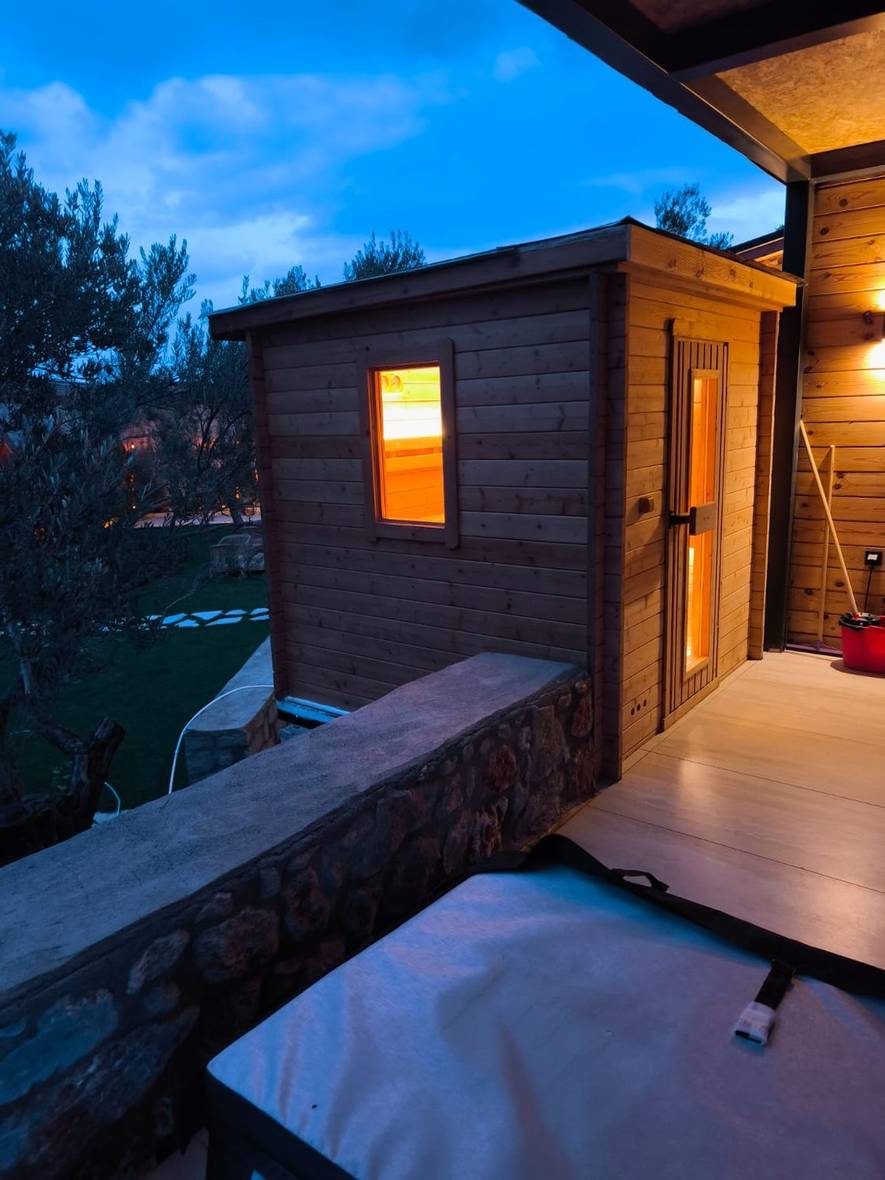
What temperature and humidity does each room actually run at?
Different bands, measured rather than claimed. A 2024 review in Temperature puts the Finnish sauna at 80 to 100 °C with 10 to 20 % relative humidity and the Russian type at 50 to 60 °C with 40 to 70 %. A Turkish hammam sits lower again, at 40 to 50 °C and 100 % humidity.
A controlled comparison from 2014 measured both in the same study. The dry room ran at about 91 °C with 5 to 18 % humidity; the steam room at 59 °C with 60.5 % humidity. Subjects did three 15-minute exposures with 5-minute breaks, 60 minutes in total, cooling in 22 °C water for 2 minutes between rounds.
So the published Russian figure is 30 K below the Finnish one. That is the first thing most people get wrong, because it contradicts the second thing: a banya in use is routinely described as approaching 90 °C. Both statements are true, and the reason they are both true is the whole article.
Why does the same room report 2 different temperatures?
Because a banya is run in cycles, not held at a setpoint. Reporting from a working Russian bathhouse describes the parilka nearing 90 °C, with about 20 minutes before the first cool-down. That is the peak after a steam burst, not the baseline the room is maintained at between them.
The Finnish room is the opposite. It is held near its setpoint continuously and the water on the stones produces a short spike. Instruments confirm this: 8 Finnish saunas measured in 2024 ran between 74 and 120 °C air temperature, with average wet-bulb temperatures of 35 to 46 °C across sessions of 15 to 26 minutes.
Wet-bulb is the number that reconciles the 2 traditions. Dry-bulb air temperature tells you almost nothing about what the room does to a body, because it ignores the water in the air. Once you measure wet-bulb, a 90 °C Finnish room after a ladle and a 60 °C banya under steam land far closer together than their thermostats suggest.
What is a Russian banya actually made of, room by room?
Three rooms, in a fixed sequence. The traditional Russian bathhouse has a parilka for steam, a moyka for washing and a predbannik for changing and resting. Seating in the parilka is traditionally aspen, and the stove is fed from outside the hot room rather than from inside it.
That 3-room plan is the part most Gulf and European projects lose, because floor area gets allocated to the hot room and the other 2 are compressed into a corridor. The sequence is not decoration: it is what lets a bather leave the steam, wash, cool and return without dressing, which is how the cycle works.
The stove has 3 compartments in the traditional form: a firebox fed from the entrance room, a rock chamber with a small opening for the water, and a water tank above. Compare that with an electric cabin heater and you have already found the real difference between the 2 rooms.
Why does stone mass decide the room, not the kilowatts?
Because water thrown on a small charge of stones cools them, and water thrown on a large charge does not. The Finnish Sauna Society's own heaters at Vaskiniemi carry approximately 1 tonne of stones. Heat-storing heaters generally run from a few dozen to several hundred kilos and take a few hours to charge.
Domestic electric heaters live at the other end of that scale. Published manufacturer data shows a compact 2.3 to 3.5 kW unit for 1.3 to 4.5 m³ carrying 12 kg of stones and weighing 7 kg; a heat-storing electric model at 4 to 9 kW for 5 to 15 m³ carries 100 kg of stones and weighs 30 kg. Same room size band, 8 times the stone.
That ratio is the banya decision in a single line. 12 kg of stone will take 1 small ladle before the temperature collapses; 100 kg will take repeated bursts and recover between them. If the brief says banya and the schedule says 12 kg, the room has already been decided against the brief.
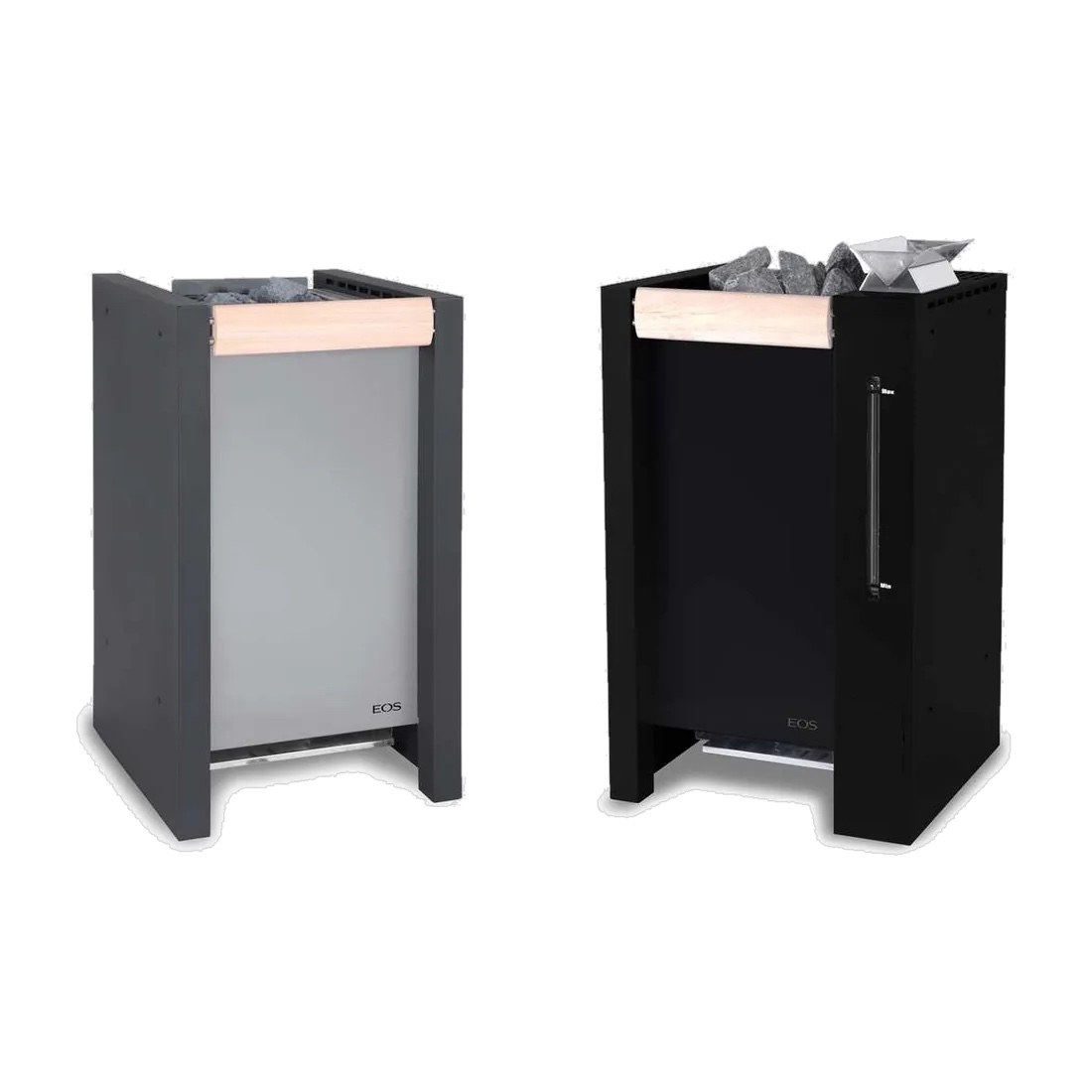
How much energy does a stone charge actually hold?
Enough that the material choice is a design variable. Measured values put granite at 2,228 kg/m³ with a specific heat of 1.07 J/g·K and a thermal conductivity of 1.69 W/(m·K); soapstone at 2,785 kg/m³, 1.074 J/g·K and 2.56 W/(m·K). Soapstone stores about 3.28 MJ per cubic metre per kelvin against granite's 2.4.
Run that on a real charge. 100 kg of granite cooling from 350 °C to 300 °C releases roughly 5.4 MJ, which is about 1.5 kWh delivered in the seconds after the water lands. No 6 kW element can deliver that rate; only stored mass can.
This is also why the stone specification is not a detail. Manufacturer instructions are explicit that light ceramic, soft soapstone and smooth rounded stones cause problems in electric heaters in particular, and their use is prohibited. Split stones of 5 to 10 cm and 10 to 15 cm are supplied in 20 kg boxes for a reason.
How is the heater sized for each room?
By volume first, then by everything that is not insulated timber. The standard rule of thumb is approximately 1 kW of heater power for each cubic metre of cabin volume. Each square metre of stone, glass or other uninsulated surface then counts as if the room were 1.2 m³ larger, and uninsulated log walls at 1.5.
A banya breaks that rule in the direction people do not expect. Because the room is run cooler but wetter, the peak demand is not the air temperature, it is recharging the stone between bursts, which is a mass problem rather than an output problem.
Commercial units show where the mass ends up. Published data for a 36 kW heater lists approximately 100 kg of stones for 60 to 75 m³, and a 72 kW unit approximately 150 kg for 130 to 160 m³. Stone per cubic metre falls as rooms get larger, which is exactly why big hotel cabins feel thin under water.
What does the venik actually do to the air?
It moves it, which is the point. Birch and oak are the 2 most commonly used, with spruce, juniper, eucalyptus and maple also in regular use. The dried branches are soaked in very hot water before use, and the bundle is then worked through the hottest layer of air near the ceiling.
That makes the venik a piece of air-handling equipment as much as a ritual object. It drags the stratified hot, humid layer down onto the body, which is why a banya ceiling height and the gap above the top bench matter more than they do in a dry cabin.
It also sets a practical constraint we design around: the room has to have swinging space above the top bench, and a surface underfoot that survives constant wet leaf litter. A cabin laid out purely for seated dry bathing gives you neither.
Does a banya need different ventilation from a sauna?
Yes, and it is the item most often copied across unchanged. A dry cabin is ventilated to move dry air and keep the room from stratifying. A banya is deliberately allowed to stratify between bursts and then flushed, which means the extract has to be closable rather than continuous.
The wetness changes the fabric as well. Air at 60 °C and 65 % relative humidity carries several times the water of air at 90 °C and 15 %, and all of it condenses on the first surface below its dew point. That is a vapour-barrier problem before it is a comfort problem, and it is the same discipline we apply in a commercial steam room.
Practically, we plan a banya with a low intake near the stove, a closable high-level extract, and a separate constant trickle for the rest period. A single always-on extract makes the steam burst impossible to hold, which is the complaint we are usually called in to fix.
What does the electrical standard allow?
Less than most briefs assume. The safety standard for sauna heating appliances covers units with a rated power input not exceeding 20 kW, at not more than 250 V for single-phase appliances and 480 V for others, and it explicitly covers heaters fitted with a humidifier unit that evaporates or atomises water.
That last clause is where most electric banya proposals actually live. A combined heater with a steam vessel is a recognised appliance class, not an improvisation, and the CE marking and EN 60335-2-53 conformity on such a unit belong to the equipment manufacturer rather than to us.
Above 20 kW you are outside that appliance scope and into a commercial installation, which is the threshold where a hotel sauna cabin stops being a product and becomes a building service with its own distribution board.
What does Finland actually count as a sauna?
Everything, and it refuses to rank them. The UNESCO inscription for Finnish sauna culture records 3.3 million saunas in a country of 5.5 million inhabitants, and states that saunas come in electric, wood-heated, smoke and infrared forms with no hierarchy among them.
The same text defines löyly as the spirit or steam released by casting water onto a stack of heated stones. That definition is worth holding onto, because it makes the water the defining act rather than the fuel or the thermostat, which is precisely where the banya and the Finnish sauna meet.
It also removes a false argument. The question is never whether an electric heater is authentic. The question is whether the charge on top of it can absorb the water the ritual requires, and that is answered in kilograms.
How does a banya differ from a hammam or a steam room?
By where the heat is stored. A banya stores it in stone and releases it into air. A Turkish hammam stores it in the fabric and delivers it by conduction through a heated platform at 40 to 50 °C in 100 % humidity. A steam room stores almost nothing and runs at about 43 °C at saturation.
That is 3 different construction problems. Timber survives the banya cycle; it does not survive saturation. Marble delivers conduction; it cannot deliver a steam burst. A generator delivers saturation; it cannot deliver radiant heat from a glowing mass.
Every mixed brief we receive assumes 1 of the 3 can be adjusted into another, and none of them can. The choice is made once, in the substrate, and the finishes follow it. Vessel and plant decisions in the wet area next door follow the same logic, which is what we set out in our hot tub and whirlpool bath definitions.
What would we build if the brief says banya?
A detached or clearly separated 3-room plan, a stove with at least 100 kg of stone, a closable extract, aspen or alder benches and a washroom that is not the changing room. Then the cold source, then the rest room, in that order, because the cycle only works when the sequence is walkable.
The specification lines that decide it are short: stone mass in kilograms, recovery time in minutes between bursts, extract that closes, and a ceiling height that allows a venik to be swung above the top bench. Four numbers, none of them about the thermostat.
If the project is at brief stage, that list is the drawing to do first. It is the same sequencing we apply on every wet area in our spa design and installation services, and it is the difference between a Russian bathhouse and a cabin with a Cyrillic label on the door.
Who is writing this
Sauna Dekor has designed and built wellness and thermal facilities since 1987 and is now in its 40th year, manufacturing in its own Istanbul facility with 19 employees, working under TS EN ISO 9001:2015, with projects delivered in more than 35 countries. We build the cabin, the benches, the linings, the vapour barrier, the ventilation and the interfaces, and we install with our own teams travelling from Istanbul.
What we do not make is equally clear. Heaters, stones, control panels and steam vessels are not our products; they come from equipment manufacturers such as EOS and Harvia, and any CE marking or EN 60335-2-53 conformity on that equipment belongs to its manufacturer rather than to us. The TS EN ISO 9001:2015 certificate is ours; the rest are theirs.
Frequently asked questions about the Russian banya
Is a Russian banya hotter or cooler than a Finnish sauna?
Published figures say cooler: 50 to 60 °C at 40 to 70 % humidity against 80 to 100 °C at 10 to 20 %. In use a banya peaks near 90 °C after a steam burst, so the honest answer is that it is wetter, and cycled rather than held.
How much stone does a banya stove need?
More than a dry cabin. A compact electric heater carries 12 kg; a heat-storing model for the same 5 to 15 m³ band carries 100 kg. We would not specify a banya below 100 kg, because the stone is what survives repeated water.
Can an electric heater be used for a banya?
Yes, if it is a heat-storing type with a large charge, and the safety standard also recognises heaters with a built-in humidifier unit. What does not work is a light convection heater with a thin stone tray, whatever the label says.
What is a venik and is it optional?
A bundle of leafy branches, usually birch or oak, soaked in very hot water and worked through the hot layer near the ceiling. It is not optional in a real banya, and it sets both the ceiling height and the floor finish.
How many rooms does a banya need?
Three: the parilka for steam, the moyka for washing and the predbannik for changing and resting. Compressing them into 1 room is the most common brief failure, because the cycle depends on leaving the heat and coming back undressed.
How long is a banya session?
Reported practice is about 20 minutes before the first cool-down, against 5 to 20 minutes for a Finnish sauna round. A measured 3-round protocol used 15 minutes hot, 5 minutes rest and 2 minutes in 22 °C water, for 60 minutes in total.
Sources
- Laukkanen JA and Kunutsor SK, "The multifaceted benefits of passive heat therapies", Temperature, vol. 11(1), 25 February 2024 — Finnish sauna 80 to 100 °C at 10 to 20 % relative humidity; Russian type 50 to 60 °C at 40 to 70 %; Turkish hammam 40 to 50 °C at 100 %; steam bath about 43 °C at 100 %; typical hot-room stay 5 to 20 minutes.
- Pilch W, Szygula Z, Palka T et al., "Comparison of Physiological Reactions and Physiological Strain in Healthy Men Under Heat Stress in Dry and Steam Heat Saunas", Biology of Sport 31(2), 5 April 2014 — dry sauna measured at about 91 °C with 5 to 18 % humidity, steam sauna at 59 °C with 60.5 % humidity; protocol of three 15-minute exposures with 5-minute breaks, 60 minutes total, cooling in 22 °C water for 2 minutes.
- Vaisala, "Can you handle the heat and humidity of a Finnish sauna?", 16 December 2024 — 8 saunas instrumented; air temperature between 74 and 120 °C; average wet-bulb temperature between 35 and 46 °C; sessions measured over 15 to 26 minutes.
- Finnish Sauna Society, "Sauna heater" — the Society's heaters at Vaskiniemi carry approximately 1 tonne of stones; heat-storing heaters range from a few dozen to several hundred kilos and take a few hours to charge; cites Finnish building guideline cards RT 91-10475 and RT 91-10493.
- Harvia, Electric Sauna Heaters brochure, 2018 — approximately 1 kW of heater power per cubic metre of cabin volume; 1 m² of stone, glass or other uninsulated surface counts as 1.2 m³ of extra volume and uninsulated logs as 1.5; Forte 4 to 9 kW for 5 to 15 m³ with 100 kg of stones; Vega Compact 2.3 to 3.5 kW for 1.3 to 4.5 m³ with 12 kg; stones supplied in 20 kg boxes at 5 to 10 cm and 10 to 15 cm; ceramic, soapstone and rounded stones prohibited in electric heaters.
- UNESCO, Sauna culture in Finland, Representative List of the Intangible Cultural Heritage of Humanity, inscribed 2020 — 3.3 million saunas among 5.5 million inhabitants; löyly defined as the spirit or steam released by casting water onto a stack of heated stones; electric, wood-heated, smoke and infrared forms with no hierarchy among them.
- BBC Travel, "The significance of the Russian banya", 4 August 2020 — the 3-room plan of parilka, moyka and predbannik; temperature nearing 90 °C described as about average; about 20 minutes before the first cool-down; birch and oak the 2 most frequent venik species, with spruce, juniper, eucalyptus and maple also used; aspen log seating.
- EVS-EN 60335-2-53:2011/A11:2023, Household and similar electrical appliances — Safety — Part 2-53: Particular requirements for sauna heating appliances and infrared cabins — scope covers sauna heating appliances with a rated power input not exceeding 20 kW at not more than 250 V single-phase and 480 V for other appliances, including heaters provided with a humidifier unit.
- Kakoko LD, Jande YAC and Kivevele T, "Experimental Investigation of Soapstone and Granite Rocks as Energy-Storage Materials", ACS Omega, 17 May 2023 — soapstone density 2,785 kg/m³, specific heat 1.074 J/g·K, conductivity 2.56 W/(m·K), volumetric capacity 3.28 MJ/(m³·K); granite 2,228 kg/m³, 1.07 J/g·K, 1.69 W/(m·K), 2.4 MJ/(m³·K).
- EOS Saunatechnik, Mega HD commercial sauna heater — 42 to 72 kW with approximately 150 kg stone capacity; the Mega S HD at 36 to 48 kW with approximately 100 kg; 36 kW rated for 60 to 75 m³ and 72 kW for 130 to 160 m³.


Yorumlar
Yorum Gönder