Hammam Stone: Marble, Granite or Travertine for Each Surface
Short answer: A hammam is lined in stone that stays wet and warm for hours a day, so the choice is made on four numbers: water absorption (ASTM C503 allows up to 0.20 % for marble, ASTM C615 up to 0.40 % for granite), slip resistance on the floor (a pendulum value of 36 or more), resistance to the acid in descalers, and weight, about 81 kg/m² for a 30 mm marble floor. Different surfaces in the same hammam get different answers.
Updated: 30 September 2026
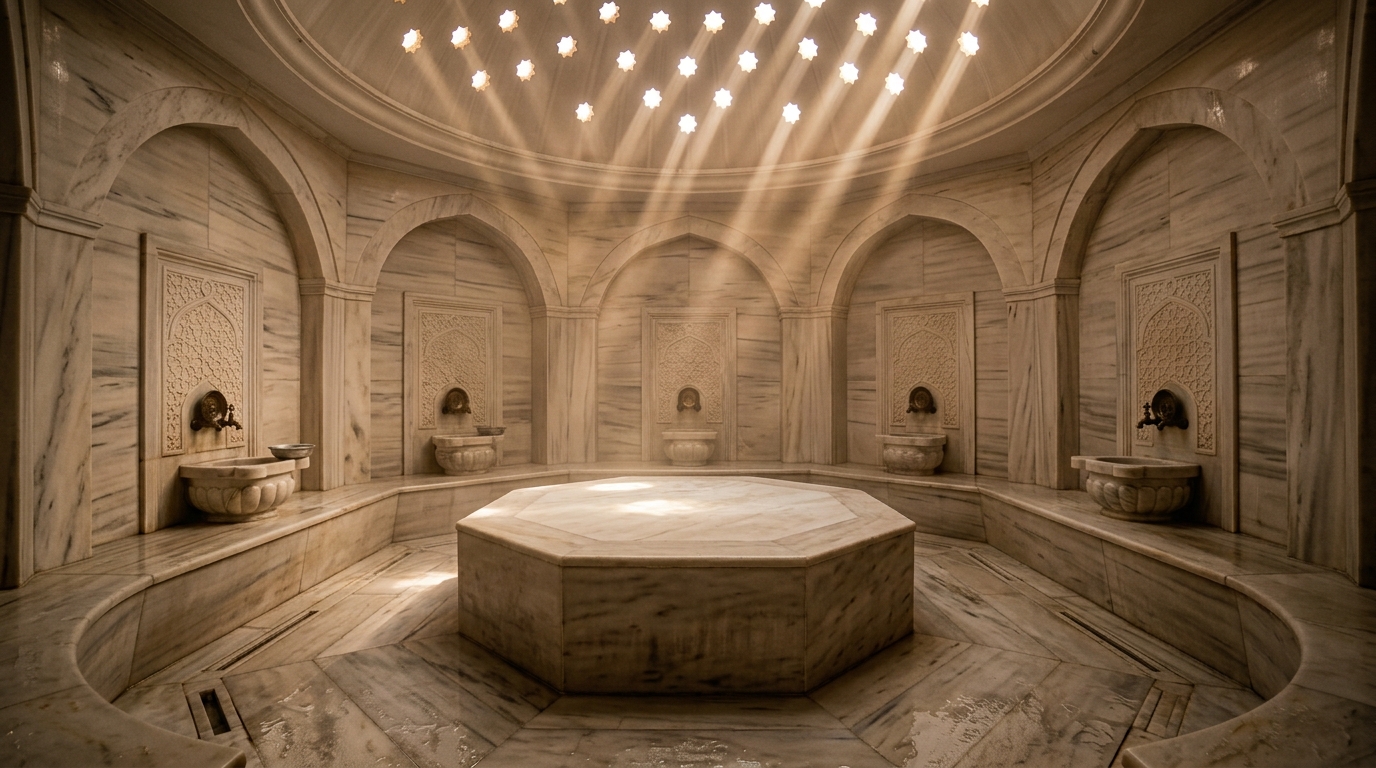
This note goes surface by surface through a hotel or villa hammam: the walls, the floor, the benches, the heated central platform (göbek taşı), the basins (kurna) and the lit feature panels. For each one it gives the property that decides the stone and the figure behind it.
The room it describes runs its air at 40–50 °C, the range we publish for a Turkish hammam. The heated marble platform is a separate surface with its own figure: we design its top for 40–45 °C.
Why does a hammam need different stone on different surfaces?
Because each of its 6 surfaces fails in a different way. The floor fails by being slippery, the walls by staining and absorbing, the göbek taşı by cracking under heat and weight, and the basins by scale and etching. A single stone and a single finish across all six surfaces usually solves two of those problems and creates the other four.
The stone also has to survive the cleaning regime. A hammam in the Gulf is washed with hard water every day, and the scale that forms is removed with acid-based products in many hotels. The stone that looks best in the sample room is not always the one that survives that chemistry.
So the specification is written per surface. That is also how the stone is ordered, cut and laid, because the floor, the wall lining and the platform arrive in different thicknesses and finishes from the quarry.
How much water does hammam marble absorb?
Very little, if it meets the standard. ASTM C503, the American specification for marble dimension stone, sets a maximum absorption of 0.20 % by weight, and ASTM C615 sets 0.40 % for granite. A 30 mm marble floor at 81 kg/m² can therefore hold at most 0.16 kg of water per square metre.
Low absorption matters in a hammam for staining more than for strength. Soap, oils and the minerals in hard water travel into the stone with the water it absorbs and then stay there when the water evaporates. A dense stone keeps them on the surface, where they can be washed off.
Travertine, which is porous by nature, needs its holes filled before it is used on a wet surface. Filled and honed, it is used on walls and benches in many hammams; unfilled, it collects soap and scale in every void and is hard to keep clean.
Which hammam stone survives acid descalers?
Granite does; marble and travertine do not. Marble and travertine are calcium carbonate (CaCO₃), which dissolves in acid, so an acid descaler etches their surface and leaves a dull mark. Granite is a silicate rock and is not attacked by the same products at cleaning strength.
This is where the Gulf water supply enters the specification. Hard water leaves calcium carbonate scale on every wet surface, and the obvious way to remove it is with an acid. On a marble hammam that same acid removes the polish along with the scale, a little more each week.
The practical answer has two parts: pH-neutral cleaners for all calcareous stone, written into the housekeeping manual, and a water softener on the hammam supply so that less scale forms. Where acid cleaning cannot be avoided, the surfaces it reaches are specified in granite.
How slippery is a wet hammam floor?
Too slippery if it is polished. The UK Health and Safety Executive classes a floor with a pendulum test value of 36 or more as having a low slip potential in the conditions tested, and polished stone that is wet with soapy water usually falls well below that. A hammam floor is honed, flamed or textured, never polished.
The test is done wet, with the contaminant the floor will actually carry. In a hammam that means soap, and a finish that passes with clean water can fail with soap on it, so the sample is tested in the condition the room will see.
Walls and benches can keep a softer finish, because no one walks on them. The step down from bench to floor and the approach to the basins are the surfaces where a textured finish matters most, since that is where wet feet change direction.
What stone goes on top of the göbek taşı?
A dense marble slab, honed, thick enough to spread the heat. The göbek taşı is the heated central platform of a Turkish hammam, and its top is designed for a surface temperature of 40–45 °C. The slab has to carry a lying adult without cracking and warm evenly without hot spots.
Thickness is the main lever. A thicker slab smooths the heat from the pipes or cables below it and resists cracking, but it is heavy: a 2.0 × 2.0 m top in marble 200 mm thick weighs about 2,160 kg. Most platforms use a thinner top on a heated core, and that core is drawn separately.
The edge is where most platforms fail. A sharp, polished edge chips and is uncomfortable; a rounded, honed edge survives daily use. On an oval platform the edge is cut from the solid rather than built up from strips, so no joint runs along the place where people sit.
How much does hammam stone move with heat?
A little, and the joints have to allow for it. Taking an assumed coefficient of about 8 × 10⁻⁶ per K for marble, a 600 mm tile that warms from 20 °C to 45 °C grows by 600 × 0.000008 × 25 = 0.12 mm. Across a 6 m wall that is 1.2 mm, which is why a hammam has movement joints.
The stone is not the only thing moving. The screed under the floor, the backing board behind the wall and the heating pipes in the platform all expand at their own rates, and a joint that is filled solid with hard grout transfers that movement straight into the stone.
Movement joints are placed at the perimeter of every surface, at changes of plane and over any joint in the structure below. They are filled with a flexible sealant rated for wet, warm service, not with grout, and they are shown on the setting-out drawing rather than decided on site.
How thick is hammam stone on each surface?
Roughly 20 mm on walls, 30 mm on floors and more on benches and the platform. A 20 mm marble lining weighs about 54 kg/m², a 30 mm floor about 81 kg/m² and a 60 mm bench slab about 162 kg/m², at a density of about 2,700 kg/m³. The platform top is thicker again.
Those weights reach the structure and have to be given to the engineer before the slab is designed. The stone is the heaviest single item in a hammam, and the weight grows with thickness, so every extra 10 mm of floor adds 27 kg per square metre.
The table below sets out the choices we most often make surface by surface, with the property that decides each one.
| Surface | Stone we usually specify | Finish | Deciding property | Figure |
|---|---|---|---|---|
| Floor | granite or dense marble | honed, flamed or textured | slip resistance, wet and soapy | PTV 36 or more (HSE classification) |
| Walls | marble, filled travertine | honed or light polish | water absorption, staining | marble up to 0.20 % (ASTM C503) |
| Benches | marble | honed, rounded edges | weight and edge durability | about 162 kg/m² at 60 mm |
| Göbek taşı top | dense marble slab | honed | even heat, no cracking | surface 40–45 °C |
| Kurna basin | solid carved marble | honed inside | scale and etching | pH-neutral cleaning only |
| Backlit panels | onyx | polished, sealed | translucency | kept out of splash zones |
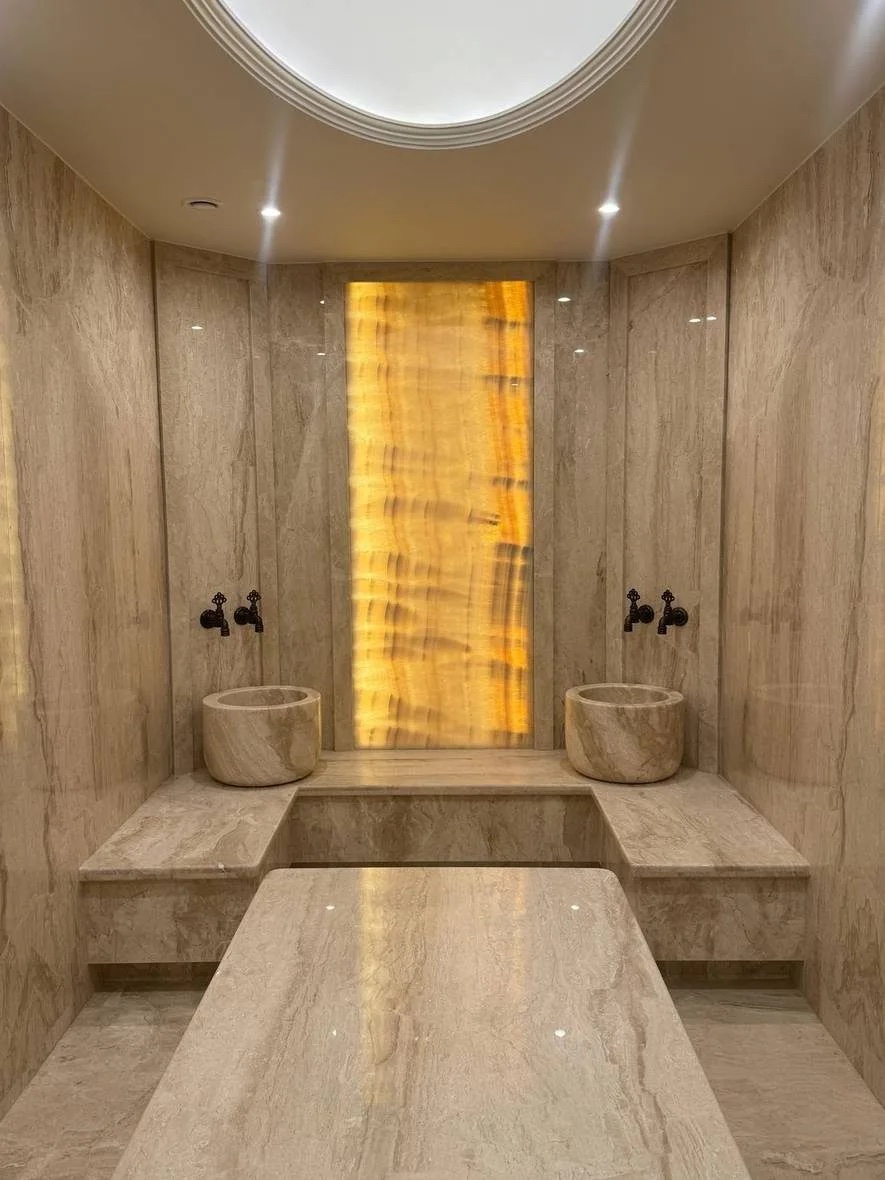
Can onyx be used in a hammam?
Yes, as a lit feature kept away from the 2 basins and the water they throw. Onyx is a banded, translucent form of calcium carbonate, which is what makes it glow when lit from behind and also what makes it soft and acid-sensitive. It belongs on an end wall or in a niche, sealed, and out of the zone where basins and bowls splash.
The lighting behind it is part of the same decision. The fittings sit in a ventilated cavity behind the panel, rated for the humidity of a hammam, with access for maintenance from outside the wet room where possible, because the panel cannot be removed without risk.
In the villa hammam shown above, the onyx panel sits in a recess on the end wall between the two basins. The stone on either side of it is a denser, veined stone that takes the water; the onyx takes only the light.
What does a kurna basin need from its stone?
A solid block, carved rather than assembled, in a dense marble. The kurna is the basin that holds warm water for pouring, fed by 2 taps above it, and it is filled and emptied all day. A carved basin has no joints for water to find; an assembled one has at least four.
Scale is the problem that follows. Hard water leaves a ring at the fill line of every basin, and the reflex is to remove it with acid. On marble that leaves an etched ring instead, so the kurna in particular needs pH-neutral cleaning and, ideally, softened water.
How is hammam stone looked after?
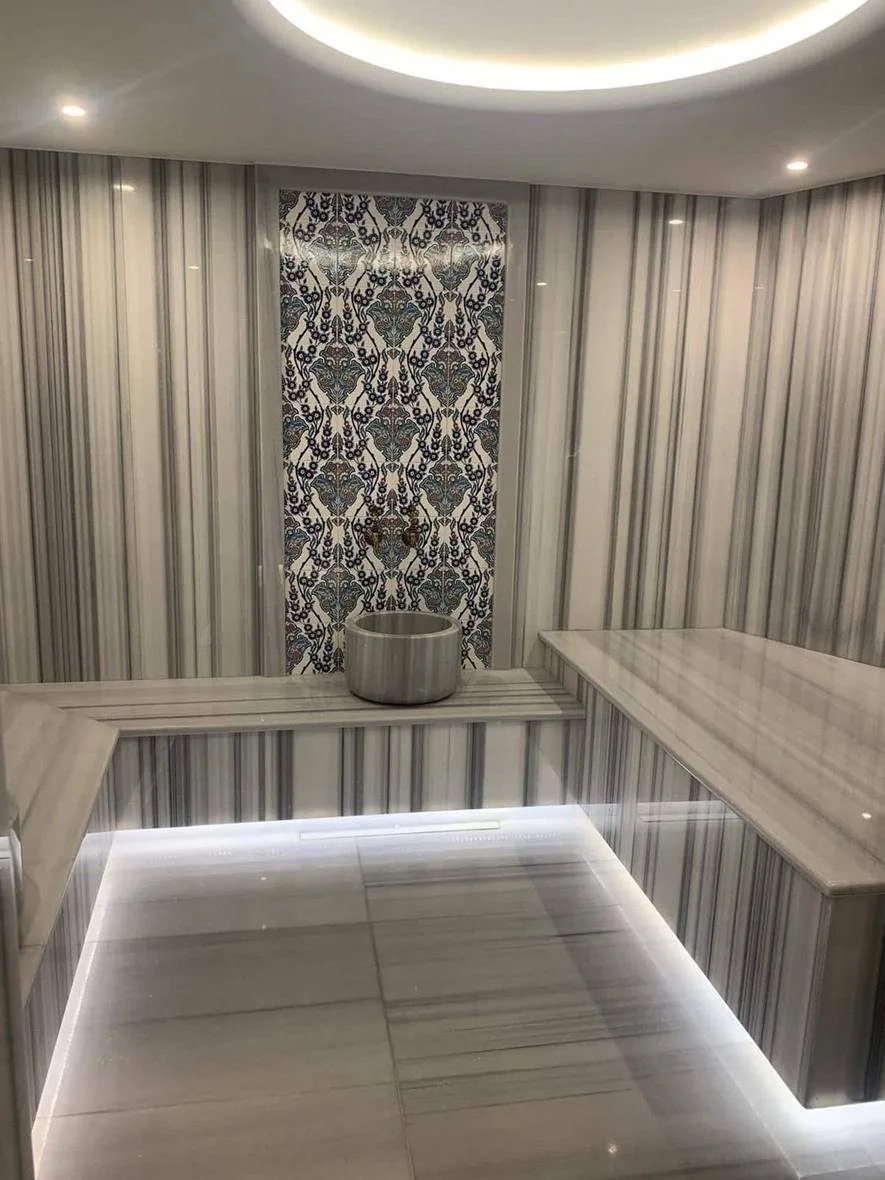
Daily with water and a cleaner at pH 7, weekly with a closer look at joints and basins, and yearly with a reseal where the stone needs it. The cleaning products are chosen for the stone, not the other way round, and they are written into the operator's manual at handover.
The failures we are asked to look at after a few years are almost always chemical rather than structural: etched floors from acid descalers, stained walls from unfilled travertine, and dull basins. Each of them traces back to a cleaning product that suited a different stone.
Our modern hammam page shows contemporary interpretations of the room, our Moroccan bath page covers the related North African room, and our note on what a hammam is and where it comes from sets out the tradition behind the surfaces. The project above is shown on our Novotel Istanbul Bomonti spa page.
Who is writing this
Sauna Dekor Spa Solutions has manufactured and built hammams, saunas and steam rooms from its own facility in İkitelli OSB, Istanbul, since 1987: 40 years of manufacturing, a team of 19 employees, work under TS EN ISO 9001:2015, 5,000+ projects in 35+ countries and 731 named references. This article was reviewed by our Managing Director.
We give a 24-month warranty on workmanship and manufacturing; electrical and mechanical equipment carries a 24-month manufacturer's warranty; and we give a 5-year warranty on structure and waterproofing.
The steam generators and heating controls in a hammam are not our products; they come from their manufacturers, and any CE marking or EN 60335 conformity of that equipment belongs to its manufacturer rather than to us.
Frequently asked questions about hammam stone
What is the most common stone in a hammam?
Marble, for its density, its look and its long use in Turkish baths. ASTM C503 limits marble absorption to 0.20 %, and a honed marble is used on walls, benches, basins and the göbek taşı, with granite or textured stone often chosen for the floor.
Is marble slippery in a hammam?
Polished marble is, when wet and soapy. Hammam floors are honed, flamed or textured, and the HSE classes a pendulum test value of 36 or more as low slip potential in the conditions tested, which is the target for the floor.
Can you use acid cleaners on hammam marble?
No. Marble is calcium carbonate and acid etches it, so descalers leave dull marks. Marble surfaces are cleaned with pH-neutral products, and a softener on the water supply reduces the scale that makes acid tempting.
How hot is the göbek taşı in a hammam?
We design the top of the heated marble platform for a surface temperature of 40–45 °C. The room air is a separate figure; in the hammams we publish it runs at 40–50 °C.
Is travertine suitable for a hammam?
Filled and honed, yes, on walls and benches. Its natural holes collect soap and scale if they are left open, so it is filled before installation and kept away from surfaces that are cleaned with acid.
How thick should hammam marble be?
About 20 mm on walls, 30 mm on floors and 60 mm or more on bench slabs, with a thicker top on the göbek taşı. At about 2,700 kg/m³ that is 54, 81 and 162 kg/m² respectively.
Sources
- ASTM C503 — Standard Specification for Marble Dimension Stone — ASTM International. Maximum absorption of 0.20 % for marble used in the text and table. The standard belongs to ASTM.
- ASTM C615 — Standard Specification for Granite Dimension Stone — ASTM International. Maximum absorption of 0.40 % for granite. The standard belongs to ASTM.
- Assessing the slip resistance of flooring (GEIS2) — Health and Safety Executive, UK. Pendulum test values and the classification of 36 and above as low slip potential.
- Marble — Wikipedia, 2026. Composition of marble as calcite or dolomite, its density and its reaction with acids.
- Hard water — Wikipedia, 2026. Formation of calcium carbonate scale and the use of acids and softening to remove or prevent it.
- Hammam — Wikipedia, 2026. The rooms and fixtures of the hammam, including the heated central platform and basins.


Yorumlar
Yorum Gönder