Cold Plunge Pool Engineering for Hotel and Villa Spas: Chiller Load, Water Treatment and Tanking
Last updated: September 2026
Short answer: a cold plunge pool is two engineering problems wearing one finish — a refrigeration problem and a pool water treatment problem. A 2.5 m³ commercial vessel pulled from a 30 °C fill down to 10 °C has to shed about 58 kWh of heat before anyone gets in, and then hold that temperature against a circulation pump that is itself pushing 1 kW of heat back into the water. Everything else — the stone, the step, the handrail — is downstream of those two numbers.
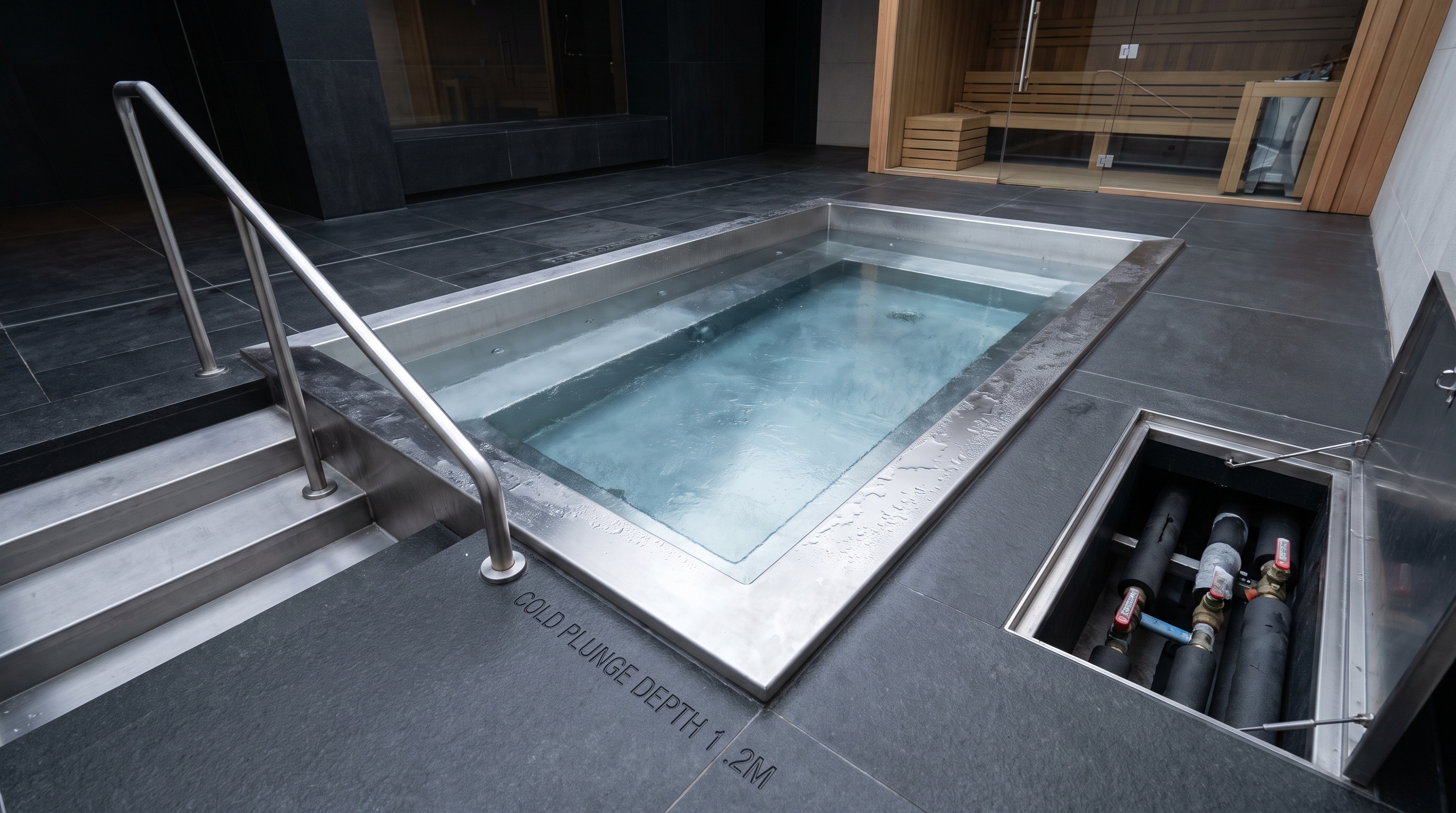
AI-generated concept illustration, not a photograph of a built project.
The cold step is the position a spa gets asked about most and specifies worst. It arrives on a drawing as a rectangle labelled cold plunge, gets priced as a vessel, and then someone asks in week nine where the chiller goes, why the plant room floor is wet, and why the tiled surround of a brand-new pool has started to bloom. None of those are installation faults. They are the consequences of the vessel having been treated as joinery.
Sauna Dekor has designed, manufactured and installed spa wet areas since 1987, and 2026 is our 40th year. The cabins, benches and hammam elements are made in our own workshop at İkitelli OSB, Başakşehir, Istanbul, by a team of 19, and we have completed projects in more than 35 countries. What follows is the order in which we ask the questions when a cold vessel appears on a spa layout.
What is a cold plunge pool, and how is it different from an ice bath or a plunge tub?
A cold plunge pool is a fixed, plumbed, recirculating vessel with its own filtration, disinfection and refrigeration — typically 1.5 to 2.5 m³ held between 8 and 15 °C. An ice bath or plunge tub is a standalone container, filled and drained, with no turnover. The words are used interchangeably in search; the two things are not interchangeable on site.
The distinction matters because it decides which rulebook applies. A drained-and-refilled tub is a piece of equipment. A recirculating vessel serving guests is a pool, and the moment it is a pool it inherits pool hygiene, pool drainage, pool safety geometry and pool plant. Operators who buy the first and run it like the second are the ones who call us in year two.
| Cold plunge pool | Ice bath / plunge tub | Shock bucket | |
|---|---|---|---|
| Water volume | 1.5–2.5 m³ | 0.3–0.9 m³ | 15–40 L per pull |
| Turnover | Continuous, filtered | None — drain and refill | Mains, single pass |
| Refrigeration | Dedicated chiller | Portable pack or ice | None |
| Plant space | Required | Minimal | None |
| Fits in a hotel circuit | Yes, as the destination cold step | Rarely — labour heavy | Yes, as the light cold step |
If the programme cannot carry plant space, the honest answer is not a smaller plunge. It is a different cold step: a shock bucket takes no refrigeration at all and gets used far more often than a badly sited pool.
How big does a cold plunge pool need to be?
For shoulder-depth seated immersion, our standard internal set-out is 1,200–1,500 mm long × 900–1,100 mm wide with 1,100 mm of water depth for one bather, and 1,800–2,000 mm long for two. That lands between 1.5 and 2.5 m³. Below about 1.2 m³ the temperature swings visibly every time somebody gets in.
Volume is a stability decision, not a comfort decision. A 75 kg bather at body temperature entering a small vessel is a heat input the chiller has to chase; in a 0.8 m³ tub three bathers in ten minutes will lift the reading by several degrees and the next guest finds warm water. Larger volume buys thermal inertia, and thermal inertia is what makes the reading on the wall honest.
Depth is where the geometry gets decided against the building, not against the brief. A 1,100 mm water depth plus the tank base, the insulation and the screed is roughly 1,350 mm of structure below the finished floor. On an upper floor that is a slab drop that has to be agreed with the structural engineer before the spa layout is frozen, not after.
How is the chiller load for a cold plunge pool calculated?
Two loads, added. Pull-down is arithmetic: water takes 4.18 kJ to lift one kilogram by one kelvin, so 1 m³ through 1 K is 1.16 kWh. A 2.5 m³ vessel taken from a 30 °C fill down to 10 °C means removing 58 kWh. Hold load is everything putting heat back afterwards.
Divide the pull-down by the time you are allowed. Fifty-eight kilowatt-hours over a 24-hour commissioning fill is 2.4 kW of average duty; the same job in 12 hours is 4.8 kW. Operators rarely ask for 24 hours. They ask for the pool to recover overnight after a Saturday, which is the same sum with a much shorter clock.
The hold load is the one that gets forgotten, and the circulation pump is the largest single line in it. A pump drawing 1.1 kW continuously delivers very nearly all of that 1.1 kW into the water as heat — it is a 1 kW immersion heater that happens to also move water. Add surface gain, gain through an uninsulated shell, and bathers. In a Gulf plant room we size the pack at 4–8 kW of duty for a 2–3 m³ vessel held at 8–12 °C.
Where does the chiller go, and what does it reject its heat into?
A chiller does not remove heat; it moves it. Every kilowatt taken out of the water, plus the compressor's own work, leaves through a condenser elsewhere — roughly 5–10 kW of rejected heat for a typical plunge pack. Put that condenser in an unventilated cupboard and the machine trips in August, exactly when the pool matters most.
Three workable arrangements, in descending order of how often they survive value engineering: a remote air-cooled condenser on a roof or a louvred plant yard; a water-cooled pack tied into the building's condenser water loop; a packaged unit in a properly ventilated plant room with ducted discharge. Refrigerant pipe runs between the pack and a remote condenser have a practical length limit, so the plant position has to be settled while the riser is still a line on a drawing.
Two documents govern this and neither of them is ours. The refrigerating system itself is designed and certified to BS EN 378 by the refrigeration manufacturer, and the refrigerant charge is governed by the EU F-gas rules. We integrate the pack, coordinate the pipe route and build the vessel. We do not manufacture chillers.
How is the water in a cold plunge pool treated and disinfected?
As pool water, on a residual, with a secondary barrier — and knowing that cold slows chemical disinfection rather than speeding it. Disinfection kinetics are temperature dependent: the same free chlorine residual does measurably less work per minute at 10 °C than at 30 °C, so it is held toward the upper end of the band.
The bather load per cubic metre in a plunge is among the highest in the building. A 2 m³ vessel can take fifty entries on a Saturday; a 400 m³ hotel pool would need ten thousand for the same loading. Everything that comes off a body after a heat room — and nobody showers properly between the sauna and the plunge — goes into a very small volume of water.
The practical consequence: full filtration and dosing as for any public pool, a UV or ozone secondary barrier, and a control set that logs rather than just displays. PWTAG's technical notes are the working reference for pool water treatment, and HSE's HSG282 is the reference for spa-pool type vessels.
Does a cold pool have a legionella risk if the water is only 10 °C?
The pool does not; the system around it can. Legionella multiplies roughly between 20 and 45 °C, so water held at 10 °C sits below the growth band. The balance tank, dead legs and fill line in a 28 °C plant space do not, and a plunge switched off for a refurbishment warms into the band within a day.
So the risk assessment follows the vessel's worst state, not its normal one. That means no dead legs in the pipework, a written recommissioning routine after any shutdown longer than a week, and a fill point that cannot sit stagnant at room temperature between uses. HSG282 sets out this reasoning for spa-pool systems in full.
Why is tanking harder in a cold pool than in a warm one?
Because the vessel's outside sits below the room's dew point. A spa at 28 °C and 60% relative humidity has a dew point near 19.5 °C. Anything at 10 °C in that room — tank wall, chilled pipework, fill line — is nine degrees below it and condenses water continuously, on the dry side of the tanking.
This is the failure mode that gets misread as a leak. The membrane is intact, the vessel is sound, and the screed is nonetheless wet, because the water is forming on the wrong side of the waterproofing and has nowhere to go. The fix is not a better membrane. It is closed-cell insulation on the vessel's external faces and on every chilled pipe run, vapour-sealed at every joint, with the insulation continuous through penetrations.
Movement is the second cold-specific item. Austenitic stainless steel expands at about 16.5 × 10⁻⁶ per kelvin, so a 2,500 mm stainless tank cycling through 20 K moves roughly 0.8 mm along its length. A tiled or stone surround does not move with it. Movement joints at the perimeter and at internal corners belong on the drawing from the first issue, not in the snagging list.
How do entry, depth and handrails get resolved?
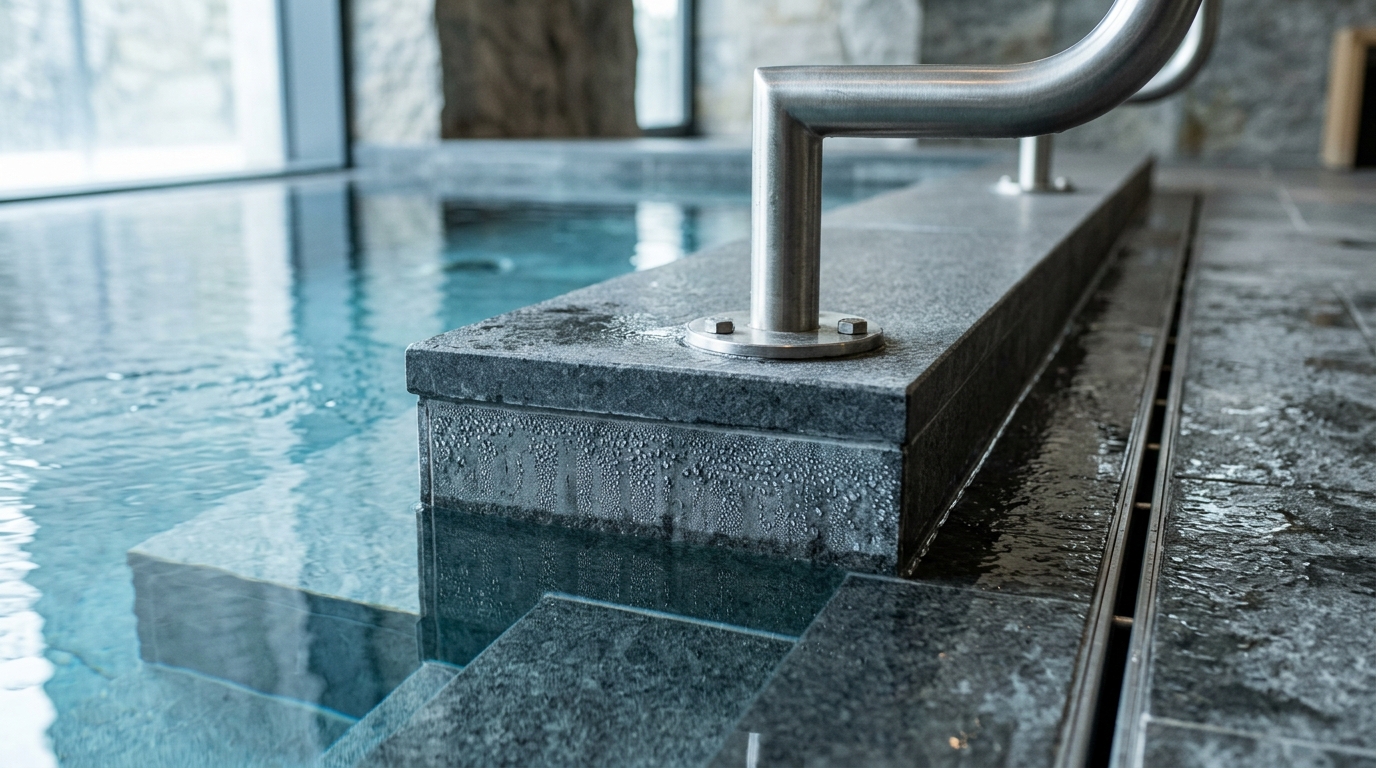
On the assumption that the bather's first three seconds are involuntary. Entry into water below about 15 °C produces an immediate gasp and a sharp rise in breathing rate, so the job is to make that happen while the person holds something. We fit grab rails on both sides and set the first step to be found by foot.
The rest is ordinary pool safety geometry, and the safety requirements for pools are set out in the BS EN 15288 series. Step nosings with a defined slip-resistance class, a clear depth marking at the coping, a continuous rail to the seated position, and a surround fall that takes splash-out to a channel rather than to the corridor. A cold plunge sheds a remarkable amount of water onto the floor.
What does a cold plunge pool draw in energy?
Less than operators fear on pull-down, more than they expect on standby. The 58 kWh above is thermal, not electrical: at a coefficient of performance of 3 the compressor draws about 19 kWh. The line that accumulates is the circulation pump — 1.1 kW running continuously is 26 kWh a day, whether anyone bathes or not.
Which points at three decisions worth making early: insulate the vessel so the pack cycles rather than runs, put the circulation pump on a variable speed drive with a reduced overnight rate that still satisfies the turnover requirement, and site the condenser where it is not fighting a hot wall. The same three decisions apply to any hydrotherapy pool with active temperature control.
Where does the cold plunge pool sit in the circuit?
Within about five paces of the heat it answers, never at the end of a corridor. A guest leaving a sauna at 85 °C uses a cold step visible from the sauna door and walks past one forty metres away. We plan the cold and heat positions as a pair, then set the rest of the thermal suite around them.
The room around the vessel matters as much as the vessel. Cold water in a warm, still room produces surface mist and a floor that stays wet; the cold zone needs its own extract and a floor build that drains. And it needs somewhere to go afterwards — a heated bench or a rest position within sight, because the recovery is part of the sequence and a guest standing in a corridor dripping is a design failure, not a guest failure.
What should you ask a bidder before the order?
Eight questions, and the answers should arrive as numbers rather than adjectives. Each closes a gap that costs money later: the 2 duties in kW, the condenser position, the turnover period, the insulation detail, the movement joints, the recommissioning routine, and the split between what a bidder manufactures and what it buys in.
- What is the pull-down duty in kW, and against what fill temperature and what clock?
- What is the hold duty, and does it include the circulation pump's own heat?
- Where does the condenser sit, and how much heat is it rejecting into what air?
- What is the turnover period, and what secondary disinfection barrier is fitted?
- Who insulates the outside of the vessel and every chilled pipe, and to what vapour-seal detail?
- What is the movement joint layout at the surround?
- What is the recommissioning routine after a shutdown, and is it written?
- Which parts of the scope are manufactured by the bidder and which are bought in and integrated?
Question eight is the one that separates suppliers. Our own answer: we design and build the vessel, the shell, the insulation, the tanking interface and the finish, and we integrate the refrigeration and dosing plant. We do not manufacture the chiller pack, the pumps or the dosing controllers, and the certification for those items belongs to the manufacturers who make them.
AI-generated concept illustration, not a photograph of a built project.
What we are, what we are not, and what we certify
Sauna Dekor designs, manufactures and installs spa wet areas — saunas, steam rooms, hammams, snow rooms, salt rooms and custom cold plunge pools — for hotels, resorts and residences. Founded in Istanbul in 1987, now in our 40th year, manufacturing at İkitelli OSB, Başakşehir, Istanbul, with a team of 19 and completed projects in more than 35 countries. Our quality system is certified to TS EN ISO 9001:2015.
On the cold side specifically, our delivered work includes an ice fountain in a branded residence tower in Istanbul, a stainless cold pool at a resort residence on the Aegean coast in 2025, and a cold plunge at a beach club on the Black Sea coast north of Istanbul in 2025. In 2026 we acted as the specialist spa design sub-consultant on a beach club at a private beachfront estate in Abu Dhabi, engaged by EDGE Architects — that engagement was design and engineering, not manufacture or installation.
What we do not do, stated plainly: we do not manufacture refrigeration packs, circulation pumps, dosing controllers or UV units. Those are made by refrigeration and water-treatment manufacturers, and any CE marking, EN 378 conformity or equivalent certification on them belongs to those manufacturers, not to us. We specify them, integrate them and stand behind the installation.
Frequently asked questions about cold plunge pools
What temperature should a hotel cold plunge pool run at?
Between 8 and 15 °C for a commercial vessel, with 10 to 12 °C the most commonly specified band. Below 8 °C usage drops sharply and supervision requirements rise; above 15 °C the contrast against the heat room stops registering for most guests.
How long does a cold plunge pool take to cool down from filling?
It depends entirely on the chiller duty you bought. A 2.5 m³ vessel needs about 58 kWh of heat removed from a 30 °C fill to reach 10 °C, so a 2.4 kW pack takes roughly 24 hours and a 5 kW pack roughly 12.
Can a cold plunge pool go on an upper floor?
Yes, but it is a structural question first. Two and a half cubic metres of water is 2.5 tonnes before the vessel, and a 1,100 mm water depth needs roughly 1,350 mm of build below the finished floor. Both belong in the structural engineer's brief early.
Do you need a separate drain for a cold plunge pool?
Yes. The vessel needs a drain-down point sized to empty it in a reasonable maintenance window, plus a floor channel for splash-out around the surround. Draining a plunge through the room's general gully is how corridors get flooded.
Is a chiller better than adding ice?
For a fixed commercial vessel, yes. Ice is labour that recurs every day, and it makes the water temperature a function of who turned up to work. A chiller makes it a set point. Ice remains the right answer for temporary installations and for events.
How often does a cold plunge pool need its water changed?
On the same dilution logic as any pool: continuous filtration and dosing, with fresh water replacement driven by the measured level of dissolved solids and combined chlorine rather than by a fixed calendar. The very small volume means those numbers move quickly.
What goes wrong most often on cold plunge installations?
Condensation on the outside of an uninsulated vessel, read as a leak. The dew point in a 28 °C, 60% RH spa room is about 19.5 °C, so every uninsulated cold surface in the room sweats. It is the single most common callback on the cold side.
Sources
- British Standards Institution. BS EN 378 — Refrigerating systems and heat pumps: safety and environmental requirements. knowledge.bsigroup.com
- European Commission, Climate Action. Fluorinated greenhouse gases. climate.ec.europa.eu
- Pool Water Treatment Advisory Group. Technical notes. pwtag.org
- Health and Safety Executive. HSG282 — The control of legionella and other infectious agents in spa-pool systems. hse.gov.uk
- World Health Organization. Guidelines for safe recreational water environments, Volume 2: swimming pools and similar environments. who.int
- British Standards Institution. BS EN 15288 — Swimming pools and similar recreational water facilities: safety requirements for design. knowledge.bsigroup.com


Yorumlar
Yorum Gönder